
For many healthcare providers, the end of a clinical day often marks the beginning of a secondary, more exhausting shift: the pursuit of unpaid claims and the navigation of complex insurance disputes. While the focus should ideally remain on patient care and practice growth, the administrative burden of internal revenue management frequently consumes evening hours and weekend cycles. Consequently, outsourcing medical billing becomes a primary consideration for modern practices.
The decision to outsource medical billing is rarely driven by a single factor, yet the core inquiry remains consistent: what is the actual price of professional revenue cycle management? On average, fee structures are found to range between 4% and 10% of monthly net collections. However, the true value of this investment is determined by more than just a percentage; it is found in the reduction of claim denials and the recovery of lost time.
Quick Stats
- Average outsourced billing cost: 4%–10% of monthly collections
- Per-claim pricing range: $4–$10 per claim
- Hourly billing rate: $20–$30 per hour
- Setup / onboarding fee: $300–$1,900 (one-time)
- U.S. medical billing market size (2024): $16.32 billion
- Market projected to reach $20.5 billion by 2028 (CAGR 12.3%)
- Industry growth rate through 2030: ~11.56% annually
- In-house billing cost: 7%–10% of collections + salaries + overhead
Why Are So Many Practices Outsourcing Medical Billing Right Now?
The complexity of medical billing has reached its highest point. The combination of changing ICD-10 codes and specific requirements from payers and the difficulties of obtaining prior authorization and the large amount of administrative responsibilities has created a situation where healthcare facilities need to maintain their billing operations through internal resources which results in both staff exhaustion and financial losses from rejected and insufficiently compensated claims.
Industry surveys show that 64% of healthcare professionals consider insurance claim denials as their biggest problem while 54% of healthcare workers point to claims processing delays as their ongoing challenge.
The situation demonstrates that 18% of providers need to invest more than 20 hours each month to fix billing mistakes which results in half a workweek being used for administrative tasks that should be handled by an expert. More practices which include both single doctors and extensive multi-specialty practices are now choosing to use medical billing services that operate outside their organization.
The trend towards outsourcing will continue to grow because 34% of healthcare professionals predict that outsourcing will increase in 2025. Outsourcing needs more than basic installation and operation. Businesses need to comprehend both the actual expenses tied to outsourcing their medical billing processes and the different billing models and elements that determine their total outsourcing costs.
The 5 Medical Billing Pricing Models Explained
Before you can evaluate quotes from billing companies, you need to understand how their pricing system works. The current market offers five standard pricing models which present different advantages and disadvantages.
1. Percentage of Collections (Most Common)
This is the dominant model in the industry. The billing company charges a percentage of your net collected revenue, typically between 4% and 10%. For most practices, this lands somewhere in the 5%–8% range depending on specialty and volume.
The beauty of this model is alignment: the billing company only earns more when you collect more. That’s a built-in incentive for them to chase denials aggressively and minimize underpayments.
Example: A family practice collecting $80,000/month at a 6% fee pays $4,800/month far less than maintaining two full-time billers at $3,500–$5,000 each plus benefits, software, and training.
2. Per-Claim Pricing
Some companies charge a flat fee per claim submitted, typically $4 to $10 for full-service billing, or as low as $0.30–$2.00 for clearinghouse-only submission. This model works well for high-volume, low-complexity practices like primary care or urgent care where claims are predictable and simple.
Example: A primary care clinic submits 1,000 claims/month and pays $6 per claim, totaling $6,000/month for full-service billing.
3. Hourly Rate Billing
Less common as an ongoing model, hourly billing ($20–$30/hour) is typically used for specialized one-off projects credentialing, audit support, or denial rework on aged accounts receivable. You’ll rarely find a billing company pricing a full RCM partnership this way.
Example: A practice hires a billing expert at $25/hour to fix old denied claims, spending 40 hours = $1,000 for the project.
4. Flat Monthly Fee
Some companies offer a fixed monthly subscription regardless of claim volume. Rates range from $1,000 to $5,000 or more per month for small to mid-sized practices. This model offers cost predictability, but watch for volume caps and scope limitations buried in the fine print.
Example: A small clinic pays a fixed $2,500/month, whether they submit 300 claims or 800 claims that month.
5. Hybrid Model
Increasingly popular, the hybrid model combines a flat per-claim fee for standard claims with a percentage-based fee for specialized tasks like denial management or A/R recovery. This is a solid choice for multi-specialty practices where claim complexity varies significantly across departments.
Example: A multi-specialty practice pays $5 per standard claim, plus 5% on recovered revenue from denied or complex claims.
Medical Billing Cost Model Comparison (Relative Cost Range)
| Billing Model | Typical Rate | Relative Cost Indicator |
| % of Collections Model | 4%–10% | ███████████████████████████████████ |
| Per-Claim Model | $4–$10/claim | █████████████████████████ |
| Hourly Rate | $20–$30/hr | ███████████████████████████ |
| In-House Billing | 7%–10% + salaries | ██████████████████████████████████████████ |
| Flat Monthly Fee | $1,000–$5,000/mo | ██████████████████████████████ |
Source: Industry averages compiled from AMA, CAQH, and CareCloud 2024–2025 reports
Complete Breakdown: What Does Outsourced Medical Billing Actually Cost?
The quoted rate is rarely the final number. Here’s a full cost breakdown to help you budget accurately before committing to any vendor.
Base Service Fee
| Practice Type | Typical Rate | Est. Monthly Cost (on $100K revenue) |
| Solo Practice | 8%–10.9% | $8,000–$10,900 |
| Small Group (2–5 physicians) | 6%–9% | $6,000–$9,000 |
| Mid-Sized Practice (6–15 physicians) | 5%–7% | $5,000–$7,000 |
| Large Group / Hospital Affiliate | 4%–6% | $4,000–$6,000 |
| Specialty (Behavioral Health, Surgery) | 7%–12% | $7,000–$12,000 |
One-Time Setup & Onboarding Fees
Most billing companies charge a one-time fee to get you set up. The EHR system integration together with data transfer and clearinghouse setup and employee training programs are included in this package.
| Setup Component | Typical Cost Range |
| Per-provider setup fee | $300–$500 per provider |
| Flat group onboarding fee | $1,400–$1,900 |
| EHR/EMR integration fee | $300–$3,000 |
| Data migration (large practices) | $500–$2,000 |
| Clearinghouse enrollment | $0–$500 |
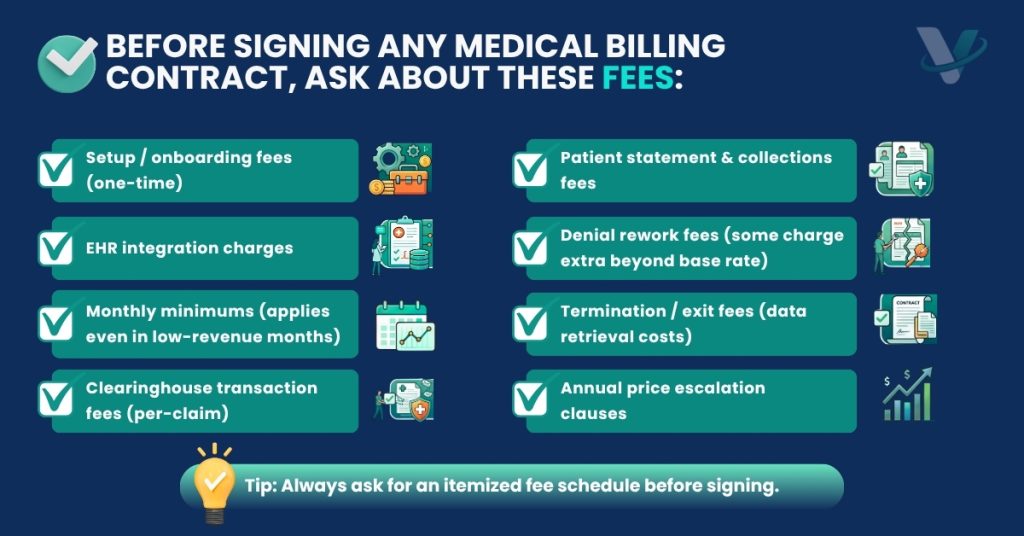
Ongoing Administrative & Software Fees
Beyond the base percentage, expect these recurring charges depending on your vendor:
- Administrative/software access fees: $3,000–$6,800 annually
- Clearinghouse transaction fees: $0.30–$2.00 per claim (if not bundled)
- Monthly minimums (for low-volume months): $500–$2,000
- Denial rework fees (if not included): 10%–20% of recovered amount
- Patient statement/collections support: $0.50–$2.00 per statement
7 Factors That Determine Your Outsourced Billing Cost
Two practices in the same city can get very different quotes from the same billing company. Here’s why:
1. Medical Specialty
Specialty is perhaps the biggest cost driver. A primary care or family medicine practice with simple E&M codes will pay significantly less than a surgical, behavioral health, or cardiology practice where coding complexity, prior authorization requirements, and audit risk are all higher. Complex specialties routinely pay 2%–4% more than general practice.
2. Claim Volume
Volume works in your favor. The more claims you submit each month, the more negotiating power you have. High-volume practices often secure rates at the lower end of the range (4%–5%), while low-volume solo practices may pay 9%–11%.
3. Average Reimbursement Per Claim
This is counterintuitive: practices with lower average reimbursements (like physical therapy) often pay higher percentage rates than those with high reimbursements (like orthopedic surgery). The billing company’s cost to process each claim is roughly the same, so lower-value claims require a higher percentage to make the work financially viable.
4. Scope of Services
Depends on whether you want only basic claims submission or complete revenue cycle management, which includes eligibility verification, prior authorization, denial management, coding audits, and patient collection services. Full-service RCM partnerships cost more, but they usually increase total collection amounts by a large margin.
5. Geographic Location
Different regions experience different labor costs and industry competition. Urban markets with more billing vendors tend to have more competitive pricing, while rural areas or underserved markets may have fewer options and higher rates.
6. Technology & Automation
Billing companies that utilize sophisticated AI-based systems along with their automated denial management systems will present customers with slightly increased pricing. The benefits from enhanced operational efficiency and improved claim submission accuracy will result in reduced costs, which will lead to quicker payment processing.
7. Your EHR / Practice Management System
Integration becomes simple when your organization uses standard EHR platforms, which include Epic, Athenahealth, and eClinicalWorks. The implementation of custom or legacy systems requires additional expenses for both installation and continuous data synchronization.
Outsourced vs. In-House Medical Billing: The Real Cost Comparison
This is the comparison every practice manager should run before making a decision. Let’s look at the true all-in cost of each option.
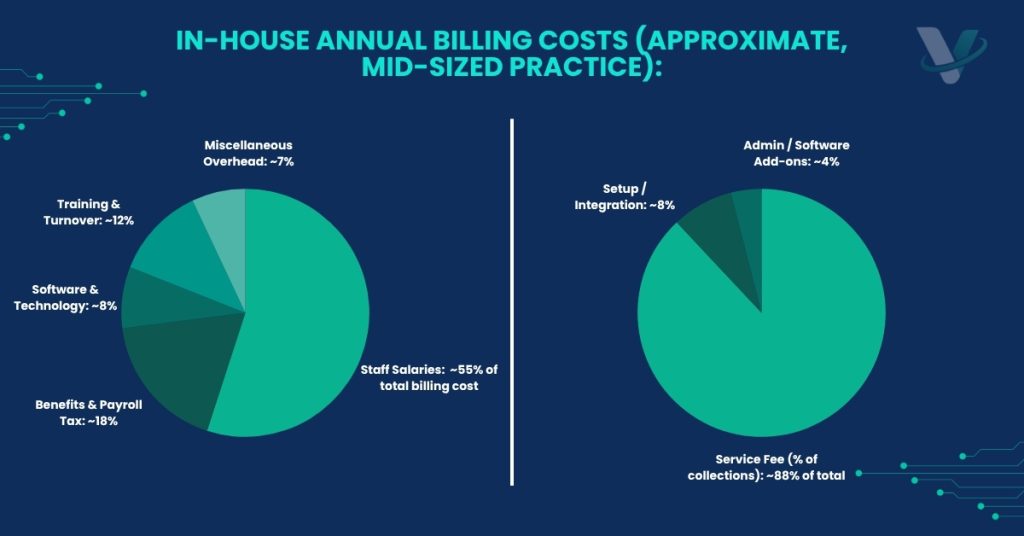
| Cost Component | In-House Billing | Outsourced Billing |
| Staff salaries (2 billers) | $70,000–$100,000/yr | Included in service fee |
| Benefits & payroll taxes (~30%) | $21,000–$30,000/yr | N/A |
| Billing software & licenses | $3,600–$10,200/yr | Usually included |
| Training & continuing education | $2,000–$5,000/yr | N/A |
| Turnover & recruitment cost | $5,000–$15,000/yr | N/A |
| Error & denial rate impact | Higher (generalist staff) | Lower (specialists) |
| Estimated total annual cost | $100,000–$160,000+ | ~$48,000–$90,000* |
| Scalability | Limited | Fully scalable |
*Based on a mid-sized practice collecting $800,000–$900,000 annually at a 6% outsourced billing rate.
The math shows that most practices save more money through outsourced medical billing than they would save with their own in-house billing system which leaves out the financial benefits of increased revenue that comes from diminished denial rates and quicker payment processes.
What’s the ROI of Outsourcing Medical Billing?
The first part of the equation requires assessment through cost measurement. The second part requires evaluation of what you will receive in return.
Industry data shows that using a professional billing service leads to better clean claim rates and lower denial rates while also speeding up payment processing times. Here is the practical result for that situation:
- Clean claim rate improvement: The specialized billing teams achieve 95%+ success which exceeds the typical in-house rate of 70%–80%.
- Denial rate reduction: The average denial rates of 9%–11% decrease to 2%–4% through the use of expert coding and pre-authorization support.
- Days in A/R: The billing companies achieve 30–35 days in accounts receivable while in-house teams take 45–60 days to complete their work.
- Revenue recovery: In-house teams fail to resubmit 30% of denied claims while outsourced teams work to obtain all possible recoverable funds.
- Staff time reclaimed: Administrative work outsourcing to providers results in a 40+ hour monthly time saving which enables staff to focus on patient care and practice growth activities.
ROI Example: A behavioral health clinic collecting $150,000/month outsources at 4% = $6,000/month. By reducing denials and improving clean claim rates, they recover an additional 8% in previously lost revenue = $12,000/month net gain, even after billing fees.
Medical Billing Costs by Specialty: What Should Your Practice Expect?
| Specialty | Typical % Rate | Complexity Level | Notes |
| Family / Primary Care | 4%–7% | Low–Medium | Simple E&M codes, high volume |
| Internal Medicine | 5%–8% | Medium | Chronic disease management adds complexity |
| Pediatrics | 5%–8% | Medium | Vaccine billing adds volume |
| Behavioral Health / Psychiatry | 7%–12% | High | Prior auth heavy, low reimbursements |
| Cardiology | 6%–10% | High | Complex modifiers, imaging PA |
| Orthopedics / Surgery | 5%–9% | High | High reimbursement, complex coding |
| Physical / Occupational Therapy | 7%–11% | Medium–High | Low reimbursements drive higher % |
| Radiology | 4%–7% | Medium | High claim volume, specialized coding |
| Urgent Care | 4%–7% | Low–Medium | High volume, streamlined billing |
| Multi-Specialty Groups | 5%–8% | Varies | Hybrid models often preferred |
Red Flags to Watch for When Evaluating Medical Billing Companies
Billing companies do not share equal standards of service delivery. The following warning signs should stop you from signing any contract:
- No transparent fee schedule: If they won’t provide itemized pricing in writing, walk away.
- No performance reporting: You should receive monthly reports on claim submission rates, denial rates, A/R aging, and collections.
- Offshore-only teams: Businesses should understand which locations execute their billing work because they must ensure HIPAA compliance.
- Vague denial management: Ask specifically: who is responsible for denied claims? How many times will they resubmit? What’s the escalation process?
- Long lock-in contracts with steep exit fees: Reputable billing companies are confident enough in their results to offer reasonable contract terms.
- Suspiciously low rates: A rate below 3% almost always means corners are being cut either on service scope, staff quality, or both.
How to Choose the Right Medical Billing Partner in 2026
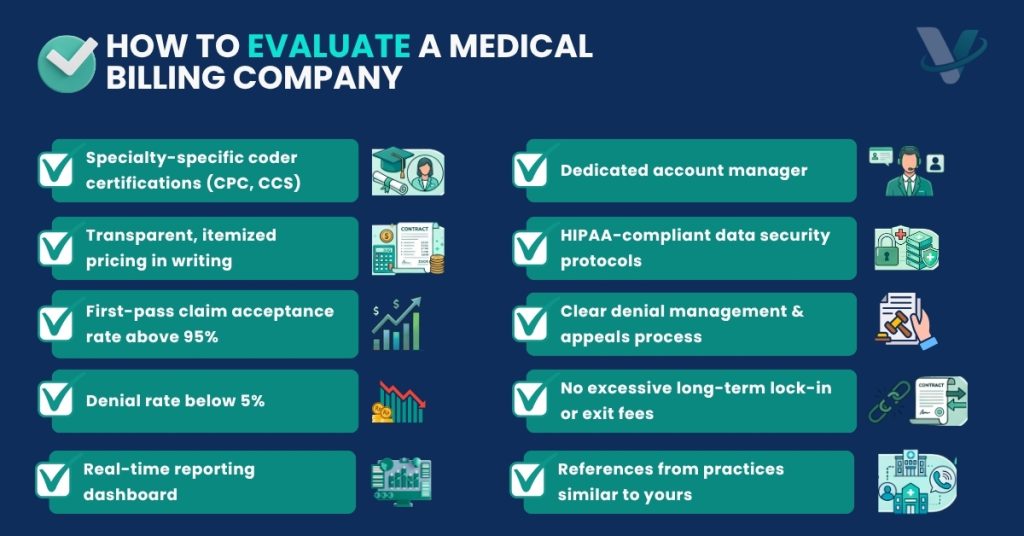
The right billing partner isn’t just the cheapest one. Here are the evaluation criteria to use:
- Specialty experience: Do they have certified coders with experience in your specific specialty?
- Technology stack: Do they use modern, HIPAA-compliant billing software with real-time dashboards?
- Denial management depth: How do they handle appeals? What’s their first-pass acceptance rate?
- Transparency and reporting: Will you have 24/7 access to your billing data and performance metrics?
- References and track record: Can they provide case studies or references from similar practices?
- Compliance protocols: How do they stay current with coding changes, CMS updates, and payer policy changes?
- U.S.-based team: Verify with IRS Form 941 as IRS Form 941 allows verification of a company’s actual U.S.-based employee count by showing their payroll records.
For more on evaluating billing partners, the American Medical Association’s practice management resources and MGMA’s benchmarking data are excellent external references for setting performance expectations.
Frequently Asked Questions About Medical Billing Outsourcing Costs
Is outsourcing medical billing worth it for small practices?
Absolutely. Solo and small practices actually benefit most from outsourcing because they typically can’t afford a dedicated billing department.
What’s the average cost of medical billing for a solo practice?
According to AMA data, solo practices pay an average of 10.9% of collections for billing services. This is higher than larger practices because lower claim volumes mean less negotiating leverage. A solo practice generating $200,000 annually can expect to pay roughly $21,800/year in billing costs.
Do medical billing companies charge for denied claims?
This varies. Most percentage-based companies only earn their fee on collected revenue, which means they have a strong incentive to resolve denials. Always clarify in your contract whether denial rework is included in the base fee or billed separately.
How quickly will I see results after outsourcing?
Most practices see measurable improvements in clean claim rates and A/R days within 60–90 days of onboarding with a new billing partner. Full optimization typically takes 3–6 months as the billing team learns your payer mix and common denial patterns.
What’s included in a full-service medical billing package?
Full-service billing typically includes: patient eligibility verification, claim scrubbing and submission, payment posting, denial management and appeals, A/R follow-up, patient statement processing, monthly performance reporting, and coding compliance support. Make sure you know exactly what’s in scope before signing.
Why Vigilant Medical Group Is the Right Billing Partner for Your Practice
At Vigilant Medical Billing, we don’t just submit claims, but we protect your revenue cycle from every angle. Our team of certified medical billing specialists combines deep specialty expertise with modern technology to deliver results that show up in your collections, not just in promises.
Here’s what sets us apart:
- Specialty-trained coders with experience across 20+ medical specialties
- Transparent pricing: no hidden fees, no surprises, no lock-in traps
- Real-time reporting dashboards so you always know where your money is
- Industry-leading first-pass claim acceptance rates
- Aggressive denial management with systematic appeals pursuit
- HIPAA-compliant, U.S.-based billing operations
- Dedicated account manager for every client
Whether you’re a solo physician frustrated with administrative overload, a growing group practice looking to scale without adding headcount, or a specialty clinic tired of chronic underpayments, Vigilant Medical Billing has a tailored solution that fits your practice and your budget.
Turn Your Billing Into a Profit Engine
Vigilant Medical Group helps practices reduce costs while increasing collections without the operational chaos.
✔ Reduce claim denials ✔ Maximize reimbursements ✔ Zero administrative headaches
The Bottom Line
Outsourcing medical billing costs anywhere from 4% to 12% of your monthly collections depending on your specialty, practice size, claim volume, and the level of service you need. Yes, there are setup fees, software fees, and other line items to budget for, but when you compare the total cost against the all-in expense of in-house billing, the numbers almost always favor outsourcing.
More importantly, the right billing partner doesn’t just cost you money; it makes you money by recovering denied claims, eliminating underpayments, and freeing your clinical team to focus on patients instead of paperwork.
Ready to find out exactly what outsourcing would cost for your specific practice and how much revenue you could be recovering? Contact Vigilant Medical Billing today for a free, no-obligation revenue audit. We’ll analyze your current billing performance and show you exactly where the gaps are.