




Oncology Medical Billing Services

Protect Every Dollar Behind Complex Cancer Care

Oncology care carries high-cost treatments, recurring visits, payer scrutiny, and little room for revenue leakage. One missed detail can delay payment on care already delivered.

Our oncology billing services help practices keep revenue steady without pulling attention away from patients. We bring the billing discipline needed to protect collections, reduce financial pressure, and support growth in a specialty where every claim matters.

Vigilant Medical Group helps chiropractic providers turn completed care into collected revenue with fewer billing obstacles, stronger reimbursement visibility, and a revenue cycle built around how chiropractic practices actually operate.

98%+

Billing Accuracy

Up to 25%

Fewer Delays

Why Oncology Practices Work With Us

Who We Are

  • Oncology Revenue Focus: Billing support built around complex cancer care.
  • High-Value Claim Control: Extra attention on costly treatments and recurring payer issues.
  • Root-Cause Denial Review: We find and fix the reason denials repeat.
  • Contract & Payment Checks: Payments checked against contracts, EOBs, and expected rates.
  • Clear RCM Visibility: Simple updates on A/R, denials, and collections.

All-in-One Oncology Medical Billing Services

Our oncology medical billing company helps cancer care providers protect revenue with tighter claim control, AI-supported review, and specialty-focused RCM expertise.

Our Services

Our Expertise

Oncology Claim Control

Oncology claims carry more financial risk than routine medical billing. A small mismatch in coding, drug units, diagnosis support, or payer rules can hold up a high-value claim. Our team reviews oncology claims with specialty-level accuracy before they move through the revenue cycle.

  • CPT, ICD-10, HCPCS, and modifier accuracy
  • Medical necessity and diagnosis alignment
  • Drug unit and dosage review
  • Payer-specific claim edits
  • Clean claim checks before submission
  • High-value claim priority tracking

We combine oncology billing expertise with AI-assisted claim checks to catch patterns that manual checks often miss. This helps practices reduce avoidable delays, protect reimbursement, and keep revenue moving without adding pressure on clinical staff.

Chemo & Infusion Billing

Chemotherapy and infusion billing require exact attention because the claim value is high and payer review is strict. Our billing team looks beyond basic code entry and checks the full billing picture, including drug units, administration codes, payer rules, and supporting documentation.

  • Chemotherapy administration code review
  • Infusion time and unit validation
  • HCPCS drug code accuracy
  • Wastage and modifier checks
  • Payer policy matching
  • High-cost drug claim monitoring

Our AI-supported review flags unusual payment risks, missing details, and repeat payer issues before they turn into denials. This gives oncology practices better control over infusion revenue and helps prevent expensive claims from sitting unpaid.

Radiation Oncology Billing

Radiation oncology billing often becomes difficult because treatment plans, fractions, simulations, imaging, and technical/professional components must stay aligned. Our radiation oncology medical billing services team reviews radiation claims with a clear focus on accuracy, sequencing, and payer expectations.

  • Radiation therapy code review
  • Technical and professional component checks
  • Modifier and bundling validation
  • Treatment course billing review
  • Payer edit correction
  • Claim pattern monitoring

Instead of handling radiation claim issues one by one, we identify where the breakdown starts. Our RCM experts use billing data, denial trends, and AI-supported claim analysis to improve claim quality before submission and reduce recurring payment delays.

Authorization Intelligence

Oncology authorizations can delay revenue when approvals, treatment details, and submitted claims do not match. We help practices manage authorization risk by connecting payer requirements with the billing workflow, so approved care does not turn into denied revenue.

  • Treatment authorization review
  • Approval-to-claim matching
  • Payer rule checks
  • Expiry and visit limit tracking
  • Missing authorization alerts
  • Denial reason mapping

Our AI-assisted process helps identify authorization gaps early, especially for chemotherapy, infusion, imaging, and recurring oncology treatments. This gives the billing team a stronger control point before claims are submitted and protects payment on already delivered care.

Denial & Payment Recovery

Oncology denials need more than resubmission. Many claims fail because of authorization gaps, medical necessity edits, payer-specific rules, coding conflicts, or payment mismatches. Our team reviews the root cause first, then builds a focused recovery path.

  • Root-cause denial review
  • Appeal documentation support
  • High-balance A/R prioritization
  • Underpayment identification
  • Payer follow-up strategy
  • Recurring denial trend reports

We use RCM expertise and AI-backed denial analysis to find patterns across payers, providers, and treatment types. This helps oncology practices recover more revenue and reduce the same denial from repeating across future claims.

AI Revenue Visibility

Oncology leaders need clear visibility into where revenue is stuck. We turn billing data into simple, useful insights so providers can see which payers, claims, denials, and payment gaps need attention first.

  • A/R aging by payer and claim value
  • Denial trends by treatment type
  • Clean claim performance tracking
  • Payment variance review
    High-risk claim alerts
  • Revenue leakage insights

Our AI-supported reporting helps detect patterns faster, including delayed payments, underpaid claims, repeated denials, and high-value accounts at risk. This gives oncology practices a clearer view of financial performance without drowning the team in complex reports.

Our Process for Oncology Revenue Control

We keep oncology billing simple, organized, and focused on payment accuracy. Our process helps practices reduce claim delays, protect high-value treatments, and get clearer control over denials, A/R, and reimbursement.

Which oncology billing challenges are affecting your revenue?

Unique Features of Our Chiropractic Medical Billing Services

Regimen Logic Mapping

We review oncology claims against the treatment pattern, not just the visit. Our team checks whether diagnosis, drug codes, administration codes, and visit timing support the billed regimen, helping reduce mismatches between clinical care and payer expectations.

Drug Unit Normalization

Cancer drugs often create payment risk when dosage, vial size, billing units, and payer unit rules do not align. We normalize units before claim release, so billed quantities better match documentation, administered dose, and payer reimbursement logic.

NDC–HCPCS Crosswalk

We connect NDC details with HCPCS drug billing to avoid gaps between pharmacy records and claim data. This is especially useful for injectable oncology drugs, biosimilars, and payer requests that require clear drug-level traceability.

Waste Modifier Control

Drug wastage can easily be missed or billed incorrectly. We review discarded drug documentation, unit splits, and modifier use such as JW and JZ where applicable, helping practices protect legitimate reimbursement while staying within payer billing rules.

LCD/NCD Policy Sync

Many oncology claims depend on medical necessity rules from Medicare LCDs, NCDs, and payer policies. We check diagnosis support, coverage limits, and documentation signals before submission to reduce avoidable medical necessity denials.

MUE & NCCI Guardrails

Our claim checks include medically unlikely edits, NCCI conflicts, bundled services, and modifier risk. This helps oncology practices catch technical billing conflicts before submission, especially on complex same-day services and multi-code treatment encounters.

Fraction Count Validation

For radiation oncology, we review treatment fractions, planning codes, delivery codes, and image guidance patterns. This helps prevent billing issues caused by mismatched treatment course data, incorrect sequencing, or unsupported radiation therapy charges.

Component Split Review

Oncology billing may involve technical, professional, facility, and global billing differences. We review component logic so services are billed under the right structure, reducing the risk of duplicate billing, missing revenue, or payer rejections.

Molecular Test Controls

Genomic and molecular pathology billing needs careful code and policy review. We check test type, diagnosis support, prior payer rules, and documentation requirements for oncology panels, helping reduce denials on high-cost diagnostic claims.

Clinical Trial Segmentation

Clinical trial claims need a different level of separation between routine care, sponsor-covered items, and billable patient services. We help flag trial-related billing risk so the wrong charges are not sent to the wrong payer.

Buy-and-Bill Reconciliation

For practices managing oncology drugs in-house, we compare administered drugs, billing records, and expected claim value. This helps find gaps between purchased inventory, documented usage, and what was actually billed for reimbursement.

AI Claim Risk Scoring

Our AI-supported review highlights claims with unusual patterns, missing data, payer-sensitive codes, or high denial probability. This gives the billing team a smarter way to prioritize review before expensive oncology claims leave the system.

Let’s Make Every Oncology Claim Count

Stop avoidable delays before they cost your practice revenue.

Let’s Make Every Oncology Claim Count

Stop avoidable delays before they cost your practice revenue.

In-House vs Outsourced Oncology Billing Services

IN-HOUSE ONCOLOGY BILLING Higher cost / limited specialty coverage

IN-HOUSE Oncology BILLING

Why In-House Billing Gets Difficult

High-Cost Claim Pressure

Oncology claims involve chemo drugs, infusion units, radiation codes, and authorizations. One missed detail can delay a large payment.

Staff Dependency

If one billing employee leaves, takes time off, or lacks oncology experience, claims and follow-ups can slow down fast.

Limited Payer Tracking

In-house teams may not have enough time to track payer edits, underpayments, denials, and changing oncology billing rules.

Rising Overhead

Salaries, training, software, audits, and claim follow-up tools can increase cost without improving collections.

OUTSOURCED ONCOLOGY BILLING

Specialty billing support built for cancer care revenue

Oncology-focused coding, claim review, and denial control

Chemo, infusion, radiation, and high-cost drug billing support

Authorization-to-claim matching before submission

AI-assisted claim risk checks and denial pattern review

A/R follow-up by payer, balance, claim age, and denial reason

Underpayment review against contracts, EOBs, and expected rates

Root-cause denial analysis to prevent repeat issues

Clean claim checks for CPT, ICD-10, HCPCS, modifiers, and units

Clear reporting on collections, denials, A/R, and revenue gaps

Scalable billing support without adding internal staff burden

Oncology Revenue Protection Service.

We help cancer care practices protect high-value claims from delays, denials, underpayments, and avoidable write-offs.

The billing support oncology practices need to protect every treatment dollar

Oncology claims carry serious financial risk because one missed unit, modifier, authorization detail, or payer policy can delay thousands in reimbursement. Our team reviews high-cost treatment claims before they become payer problems. We focus on the areas where oncology revenue is most vulnerable: chemotherapy billing, infusion claims, injectable drugs, radiation therapy charges, authorization gaps, and payer-specific edits. This helps your practice protect revenue without overloading your internal team.

High-Cost Drug Control

Chemo, biologic, biosimilar, and injectable claims are reviewed for HCPCS, NDC, dosage, wastage, and JW/JZ modifier accuracy.

Authorization Matching

We match treatment approvals with dates, diagnosis, drug codes, visit limits, and payer rules before claims are submitted.

Payment Gap Recovery

Underpaid oncology claims are checked against EOBs, payer contracts, allowed amounts, 835 files, and expected reimbursement.

When claims are denied or underpaid, we do not stop at resubmission

Denied oncology claims often point to a deeper issue: medical necessity edits, NCCI/MUE conflicts, missing authorization support, incorrect drug units, or contract variance. We review the root cause before sending claims back to the payer. Our RCM experts track denials, underpayments, and aging balances by payer, code, modifier, claim value, and documentation gap. This helps recover more revenue, reduce repeat denials, and stop high-value claims from turning into write-offs.

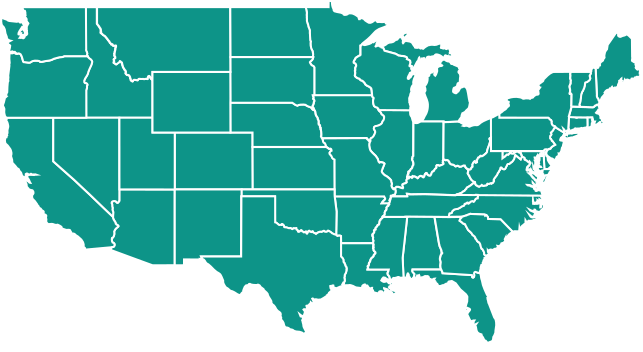
Nationwide State Billing Expertise

Our oncology billing support is built for practices working across different payer rules, Medicaid plans, commercial policies, and state-level billing requirements. We help providers manage claim accuracy, denials, and reimbursement risk with state-specific RCM knowledge.

Across USA

State-Specific Oncology Billing Support

Oncology reimbursement changes from state to state because payer behavior, Medicaid rules, managed care edits, and authorization requirements are not the same everywhere. Our team applies local billing logic to protect high-value cancer care claims.

Our State Billing Expertise Snapshot
Area Our Focus
Medicaid State plan rules and managed care edits
Payers Local claim edits and filing rules
Auths Treatment, drug, date, and visit matching
Denials Payer-wise root-cause tracking
Payments EOB, contract, and rate checks

Don’t Let Your Oncology Claims Go Unpaid

Get oncology medical billing services to avoid claim delays, payer issues, and revenue leakage.

How do we help you

Frequently Asked Questions About Oncology

" "

Oncology billing comes with high-value claims, strict payer rules, recurring treatments, and complex drug reimbursement. These FAQs answer the questions practices often ask before outsourcing their billing, improving denial control, or reviewing revenue leakage.

What are oncology billing services?
Oncology medical billing services manage the revenue cycle for cancer care practices, including chemotherapy, infusion therapy, radiation oncology, injectable drugs, authorizations, denials, payments, and A/R. The goal is to protect high-value claims from delays, underpayments, and avoidable write-offs.
We review high-cost drug claims for HCPCS, NDC, dosage, billed units, payer unit rules, wastage documentation, and modifier accuracy. This is especially important for chemotherapy drugs, biologics, biosimilars, injectables, and immunotherapy claims.
Yes. Outsourcing oncology medical billing services is easy with us as we work with your existing EHR, PMS, clearinghouse, and billing workflows. Our team reviews your current setup, payer list, claim flow, denial patterns, and reporting needs before aligning our oncology billing support with your practice operations.
Some improvements can appear early through cleaner claim review, faster denial action, and better A/R prioritization. Bigger improvements usually depend on claim volume, payer mix, current denial rate, aging A/R, documentation quality, and how many historical issues need correction.
Vigilant Medical Group is oncology medical billing services provider who focuses on the billing details that directly affect oncology reimbursement, including authorization matching, drug unit accuracy, high-cost claim review, denial root-cause analysis, underpayment recovery, and clear revenue visibility for cancer care providers.

CONTACT US

Tell Us What’s Slowing Down Your Oncology Revenue

Every oncology practice faces different billing pressure. Share a few details about your practice, and we’ll recommend the right billing support to protect claims, reduce delays, and improve revenue control.