Modifier 24 exists to answer one question for the payer: does this visit have anything to do with the surgery or not? When a patient is inside a global period and comes in for something completely separate, appending Modifier 24 to the E/M code tells the insurance company that this visit stands on its own. It is not a wound check. It is not follow up. It is a new problem that happens to fall inside the post op window, and it deserves its own payment.
In practice, this is one of the modifiers that gets skipped, misused, and second guessed more than almost any other. A patient has knee surgery in March, walks in with a sinus infection in April, and the front desk has no idea a global period is even running. The claim goes out clean, comes back denied, and someone writes it off because chasing a single office visit feels like more trouble than it is worth.
Our team at Vigilant Medical Billing & Coding Services works with practices across Texas and other states, and unrelated visits during global periods are one of the quietest sources of lost revenue we find when we audit a new client’s claims. Not dramatic. Just steady, avoidable leakage.
What Is Modifier 24?
In easy words, it is an unrelated evaluation and management service by the same physician or other qualified health care professional during a postoperative period.
Say a patient is seen for something that has nothing to do with a recent surgery, but the visit lands inside that surgery’s global period. Left alone, that claim gets denied automatically, because the payer’s system assumes any visit in that window is routine post op care, and routine post op care was already paid for with the surgery. Modifier 24 is how the payer is told no, this one is different, this one should be paid on its own.
One restriction is worth stating early. The modifier is only ever attached to E/M codes. Office visits, outpatient and inpatient visits, some eye exam codes. Never procedures, never tests, never supplies.
First Things First: The Global Period
None of this makes sense without the global period, so that is where the story has to start.
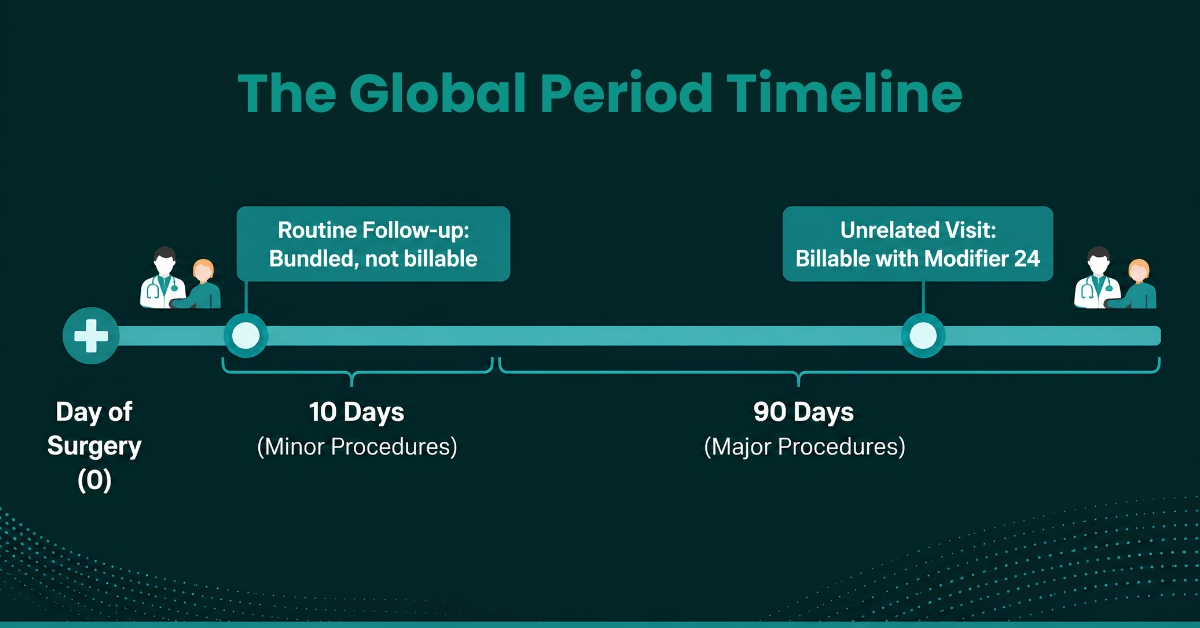
When a surgery is paid for, more than the operation itself is being paid for. The payment covers a package. The procedure, plus the routine care wrapped around it. Follow ups, wound checks, suture removal, the ordinary business of recovery. All of it bundled into one fee, which is why it gets called the global surgical package.
How long that bundle lasts depends on the procedure:
- 0 days for certain minor procedures, where only same day care is included.
- 10 days for most minor procedures. The day of surgery plus the ten days after it.
- 90 days for major surgery, and this one also reaches back to include the day before the operation.
Inside that window, any E/M visit billed by the operating surgeon is presumed related to the surgery. Same goes for anyone in the same group and same specialty, since payers treat them as one physician. The claim gets denied as included, no questions asked. Overcoming that presumption is the entire job of Modifier 24.
When Should Modifier 24 Be Used?
So the surgery has happened. The clock is running. And at some point inside that window, the patient walks back through the door. This is the moment the decision gets made, and a few conditions have to be met before the modifier goes anywhere near the claim:
- The visit falls within the postoperative global period, from the day after the procedure onward.
- It is performed by the surgeon who did the operation, or by someone in the same group practice and specialty.
- The reason for the visit is truly unrelated to the surgery, backed by a different diagnosis code.
- What is being billed is an E/M service. Not a procedure.
- The note makes the separation from post op care obvious.
Miss one and the modifier does not belong there. Payers audit this one hard, so the strictness is not optional.
A Quick Word on “Unrelated”
This is where it gets messy, because unrelated does not mean the same thing to everyone. Under CMS rules, which Medicare and plenty of other payers follow, nearly everything tied to the surgery counts as related. Pain control. Wound care. Even complications, unless the patient has to go back to the operating room. The AMA is looser about it and lets some complications be billed separately. That gap between the two causes real confusion, so each payer’s position should be confirmed before the claim goes out. In writing, if it can be managed.
Real World Examples
Where Modifier 24 Is Appropriate
- A knee replacement is done, and three weeks later the same patient turns up with chest pain and shortness of breath. New problem entirely, so the visit is billed with Modifier 24.
- A wrist fracture gets repaired. A week on, the patient comes back with ear pain. The ear has nothing to do with the wrist.
- Cataract surgery on one eye, then a new condition shows up in the other eye during the 90 day window. Unrelated, so it qualifies.
Where It Should Never Be Used
- Routine follow ups, wound checks, dressing changes, suture removal. This is exactly what the global payment already covers.
- Surgical pain, or anything that is just normal recovery.
- Complications that stay out of the operating room, at least where the payer follows CMS.
- Anything on the same day as the surgery itself. Other modifiers handle that, more on this below.
- Procedures and diagnostic tests. E/M codes only.
Modifier 24 vs 25 vs 79: Keeping Them Straight
These three get mixed up constantly, and the mix ups end in denials. What separates them, mostly, is timing.
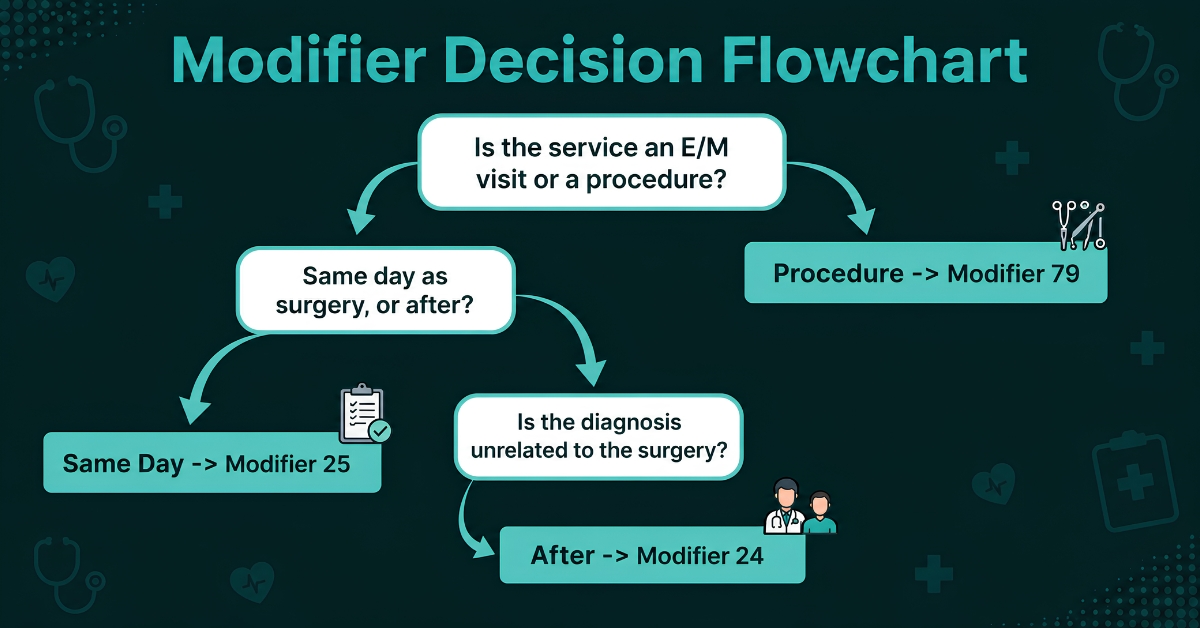
- Modifier 25: a significant, separately identifiable E/M service on the same day as a procedure.
- Modifier 24: an unrelated E/M service during the global period, starting the day after.
- Modifier 79: an unrelated procedure, not a visit, during the postoperative period. And once it is billed, a fresh global period starts.
One habit sorts most of this out. Ask what is being billed before anything else. A procedure means 24 is off the table straight away. An E/M visit means the next question is timing. Same day, think 25. After the day of surgery, think 24.
Documentation: The Part That Decides Everything
Even a correctly used modifier will not save a claim with weak notes. When Modifier 24 is on a claim, the record has to make the separation from surgical care obvious to a stranger. An auditor who has never met the patient should be able to see it in seconds.
What should be in the record:
- A chief complaint that clearly stands apart from the recovery.
- A diagnosis code different from the surgical one.
- A narrative showing the visit was medically necessary in its own right.
- Assessment and plan details written for the new problem, not borrowed from the post op template.
There is a test seasoned coders like to apply. Take the surgery out of the picture completely and read the note again. Does it still hold up as a standalone visit? If yes, the documentation is probably fine. If the note needs the surgery to explain itself, expect trouble.
Why Modifier 24 Claims Get Denied
The denials tend to trace back to the same handful of causes:
- The same diagnosis code was used on the surgery and the visit. To the payer’s system, that reads as related, whatever the notes say.
- The modifier was put on a related visit. Pain management, wound care, that sort of thing.
- It was simply forgotten, and the claim got swallowed by the global package without anyone noticing.
- The notes were thin. The visit was probably legitimate, but the record never proved it.
- Payer quirks were ignored. Some commercial plans and state Medicaid programmes run their own logic on global periods, and a few are notorious for denying first and asking questions later.
The fix is mostly about routine. Global periods get verified before any E/M visit inside a post op window is billed. Policies for the top payers get checked and kept somewhere visible. And modifier usage gets audited internally, before someone outside does it first.
Final Thoughts
Once the sequence is clear, Modifier 24 stops being scary. A surgery opens a global period. Routine recovery inside it is already paid for. An unrelated visit inside it deserves its own payment, but only when it carries the modifier, a different diagnosis, and a note that can stand on its own two feet.
The trouble is that busy practices lose track of the sequence. Global periods overlap. Providers cover for each other. Payers keep redrawing the line between related and unrelated. And that is precisely where the revenue slips away, a visit at a time, without anyone really seeing it happen.
At Vigilant Medical Billing & Coding Services, global period tracking, modifier accuracy, and denial prevention are treated as everyday revenue cycle work, not an afterthought, so practices get paid in full for what was actually done. If Modifier 24 denials have been appearing on your reports, or if there is a suspicion that unrelated visits are being written off quietly, book your free audit today and have your claims reviewed. What has been left out might surprise you.
Frequently Asked Questions
What is Modifier 24 used for?
It is used to report an E/M visit that is unrelated to a recent surgery when that visit falls inside the postoperative global period. The payer is being told to pay the visit separately rather than bundling it into the surgical payment.
What is an example of Modifier 24?
A patient who had a knee replacement is seen by the same surgeon three weeks later for chest pain. The chest has nothing to do with the knee, so the office visit is billed with Modifier 24 and a diagnosis code for the new problem.
What is the difference between Modifier 24 and Modifier 25?
Timing, in a word. Modifier 25 is for a separate E/M service on the same day as a procedure. Modifier 24 is for an unrelated E/M service after the day of surgery, during the global period.
Can Modifier 24 and Modifier 25 be used together?
Yes, though only in rare situations. It happens when an unrelated E/M visit occurs during a global period and a separate minor procedure is also performed that same day. Both parts need to be documented fully.
What is the difference between Modifier 24 and Modifier 79?
Modifier 24 goes on E/M visits. Modifier 79 goes on unrelated procedures performed during the postoperative period, and once 79 is billed, a brand new global period begins for that procedure.
Can Modifier 24 be used on the same day as surgery?
No. It applies from the day after the procedure onward. For same day E/M services, Modifier 25 or Modifier 57 should be looked at instead.
Does Modifier 24 affect reimbursement?
Directly, yes. Without it, an unrelated E/M visit inside a global period is denied as included in the surgical payment. With it, and with solid documentation behind it, the visit is paid separately at the appropriate E/M level.
Is Modifier 24 only for the surgeon who performed the procedure?
It covers the operating physician along with other physicians in the same group practice and the same specialty, because payers treat them as a single physician for billing purposes.