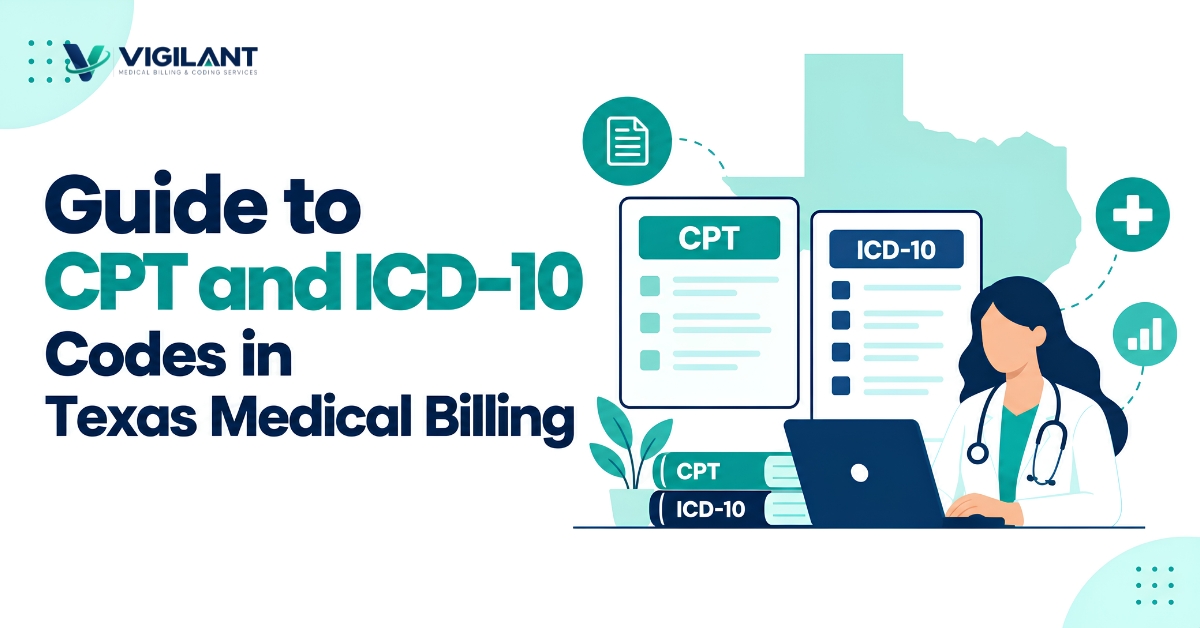
A CPT code identifies the service a provider performed. An ICD-10 code identifies the diagnosis that made the service necessary. The Texas medical billing depends on these two codes matching up correctly on a claim, since a procedure billed without a diagnosis code that supports it is one of the most common reasons a claim gets denied in this state. This guide covers how Texas Medicaid decides if care is medically needed for a specific diagnosis, how audio-only telehealth is billed when modifier 93 is used and also, how early delivery claims get checked.
Medical Necessity Rules of Medicaid Texas ICD-10
Texas Medicaid, administered by TMHP, requires a diagnosis code to be coded to its highest level of specificity and to reasonably support the procedure code billed alongside it. An unspecified diagnosis code, or a diagnosis code that does not logically connect to the service performed, is a routine cause of claim rejection or denial. This is the diagnosis-procedure linkage requirement referenced throughout TMHP’s provider manuals, and it applies across specialties, not only to the obstetric and telehealth examples covered below.
TMHP Claim Denial ICD-10 Linkage Issues
A claim is denied for ICD-10 linkage reasons when the diagnosis code submitted does not establish medical necessity for the specific procedure billed. Three patterns account for most of these denials in Texas Medicaid billing.
- Unspecified diagnosis codes submitted where a more specific code exists and clinical documentation supports it.
- Diagnosis codes that do not match the procedure, such as a diagnosis for one body system billed alongside a procedure code for a different one, with no secondary diagnosis connecting them.
- Missing required companion codes, such as a gestational age code on an obstetric claim, where TMHP requires more than one ICD-10 code to fully support the billed service.
Correcting a linkage denial generally means resubmitting the claim with a diagnosis code that matches the medical record and the procedure billed, rather than appealing the payment decision itself.
Telehealth Modifier 93 in Texas
Modifier 93 identifies a service delivered by synchronous telephone, meaning audio-only, technology. Texas Medicaid distinguishes this from modifier 95, which is used for synchronous audio-video telehealth. The two are not interchangeable, and TMHP claims are processed differently depending on which one is billed.
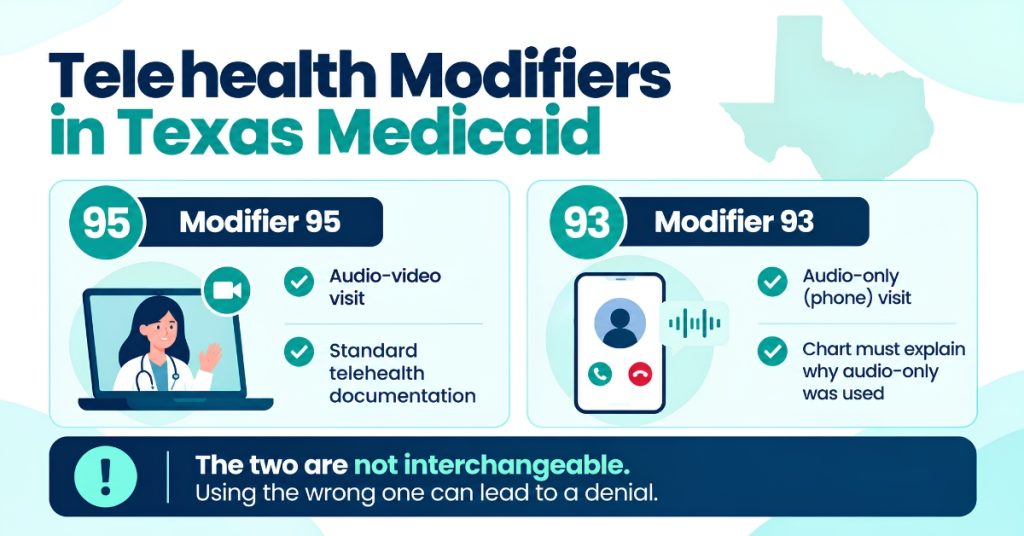
| Modifier | Delivery Method | Texas Medicaid Requirement |
|---|---|---|
| 95 | Synchronous audio-video telehealth | Standard telehealth documentation applies |
| 93 | Synchronous telephone (audio-only) | Medical record must document the reason audio-only technology was used |
Coverage for non-behavioral health services delivered by audio-only technology expanded for Texas Medicaid fee-for-service claims effective November 1, 2023, following interim guidance HHSC issued on May 12, 2023, under House Bill 4 from the 87th Legislature. For established patients, non-behavioral health office and outpatient services delivered by audio-only technology must be billed with modifier 93. Managed care organizations determine which telemedicine, telehealth, and audio-only services they cover under Senate Bill 670, so coverage can differ between a Texas Medicaid MCO and traditional fee-for-service Medicaid.
Some procedure codes already describe telephone or audio-only delivery in their own code description. Those codes do not require modifier 93 to be added, since the delivery method is already built into the code itself.
Texas Early Delivery ICD-10 Codes and Medical Necessity
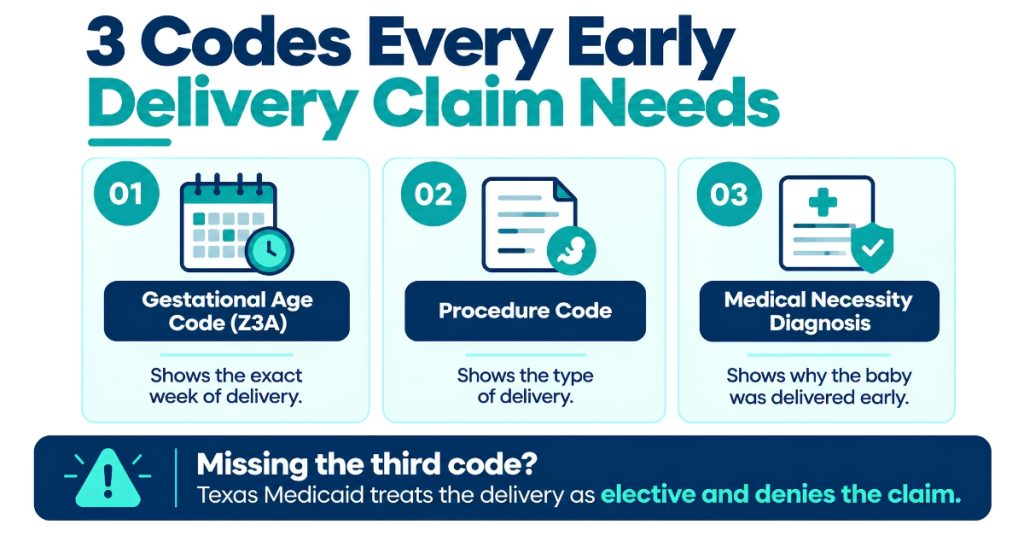
Texas Medicaid does not reimburse an elective delivery performed before 39 weeks gestation unless the claim documents medical necessity. This policy traces back to House Bill 1983 from the 82nd Legislature, which directed HHSC to develop quality initiatives reducing non-medically indicated deliveries before the 39th week of gestation.
A delivery claim submitted for a birth before 39 weeks generally requires three elements to avoid denial: a Z3A code indicating the exact gestational age at delivery, a procedure code identifying the type of delivery, and a diagnosis code establishing a medically necessary reason for delivering early. Without a qualifying diagnosis code in that third position, TMHP and Texas Medicaid managed care organizations treat the delivery as elective and deny the claim as not medically necessary.
Qualifying medical indications recognized under Texas Medicaid managed care clinical policy include placental abruption, placenta previa, unexplained antenatal hemorrhage, fetal demise, and preeclampsia, among other documented maternal or fetal conditions. A delivery claim coded without one of these supporting diagnoses, for a birth before 39 weeks, is coded as elective by default.
Texas Senate Bill 1264 and Coding Accuracy
Senate Bill 1264 limits what a patient can be billed when an out-of-network provider treats them at an in-network facility or during an emergency. Correct CPT and ICD-10 coding is part of how that protection gets applied correctly on the claim itself. A claim coded accurately identifies the procedure performed, the provider’s network status, and the diagnosis supporting the service, which is what allows a health plan to apply SB 1264’s cost-sharing limits and route any payment dispute to the correct mediation or arbitration track. A miscoded claim risks being processed as a standard out-of-network bill, which can result in the patient being billed an amount SB 1264 was written to prevent.
Coding Compliance Notes for Texas Medical Billing
Diagnosis-procedure linkage is checked most efficiently before a claim is submitted, not after a denial comes back. That means confirming the ICD-10 code supports the CPT code billed, confirming the correct modifier is attached for any telehealth service, and confirming an obstetric claim includes the gestational age and, where applicable, the medical necessity diagnosis for any delivery before 39 weeks.
This kind of pre-submission coding review is built into the claims process at Vigilant Medical Billing & Coding Services, so a linkage problem is caught before the claim goes out rather than after a denial requires a resubmission.
Conclusion
On Texas Medicaid claims, CPT and ICD-10 codes must match up. The diagnosis code has to back the procedure that was billed. If the two do not line up, the claim can be denied. This same rule shows in the situations listed here. For audio-only telehealth, modifier 93 is needed. A clear note in the chart is also needed that explains why the audio-only visit was used. For early deliveries, the claim must include a gestational age code. That code also has to go with a qualifying medical need diagnosis. For SB 1264 protections, the claim has to be coded correctly so it can be sent to the right payment path.
The main point is simple. When coding is done right the first time, the claim is less likely to get denied and sent back for changes.
Schedule a Free Billing Audit with Vigilant Medical Billing & Coding Services
Frequently Asked Questions
What is the main difference between a CPT code and an ICD-10 code?
A CPT code identifies the procedure or service a provider performed. An ICD-10 code identifies the diagnosis or condition that made the procedure medically necessary. Texas Medicaid requires the two to logically connect on a claim, a requirement generally referred to as diagnosis-procedure linkage.
Why would Texas Medicaid deny a claim for an ICD-10 linkage problem?
These denials usually come up when the diagnosis code submitted does not support the medical need for the service that is billed. The diagnosis code has to line up with what was done. Some common issues are like a diagnosis code used that is too general or a code that does not match the procedure, or missing a companion code to go with the main diagnosis.
When does a Texas Medicaid claim require modifier 93?
Modifier 93 is needed when a service is given by live phone or by audio-only technology. This is for an established patient and a non-behavioral health visit. Do not use modifier 93 for video visits. Synchronous audio-video telehealth uses modifier 95 instead.
Why does Texas Medicaid deny claims for deliveries before 39 weeks?
Texas Medicaid does not reimburse an elective delivery before 39 weeks gestation without a qualifying medical necessity diagnosis on the claim. This policy follows House Bill 1983 from the 82nd Legislature. A claim missing the gestational age code or the supporting diagnosis is treated as an elective early delivery and denied.
How does accurate coding relate to Senate Bill 1264 compliance?
Senate Bill 1264 limits patient billing when an out-of-network provider treats them at an in-network facility or during an emergency. Accurate CPT and ICD-10 coding is part of how a claim gets correctly identified for that protection. A claim coded incorrectly risks being processed as a standard out-of-network bill instead, which can lead to the patient being billed in a way SB 1264 was written to prevent.