
An anesthesia care team model is how a group staffs its rooms: who’s in each one, who’s directing, and how many cases one anesthesiologist covers at once. It decides the modifiers on every claim and how Medicare splits the payment. Get it wrong, and a busy morning becomes a quiet pay cut. For help with your own group, see our anesthesia billing services.
Key takeaways
- Your care team model is simply how you staff cases. The anesthesiologist might work alone or direct CRNAs or CAAs, or a CRNA might work without an anesthesiologist.
- Medical direction runs from one to four concurrent cases. The anesthesiologist bills QY or QK, the CRNA or CAA bills QX, and Medicare pays each of them 50%.
- Medical supervision (AD) applies beyond four concurrent cases, or when any of the seven requirements is missing. It pays the anesthesiologist only 3 base units, plus 1 for presence at induction.
- A fifth overlapping room can cut the anesthesiologist’s pay on a 25-unit case from 12.5 units to 4 units.
- CRNAs bill QZ without medical direction. Opt-out states such as Arizona and California don’t require physician supervision for Medicare.
The five anesthesia care team models at a glance
| Model | Ratio | Anesthesiologist bills | CRNA or CAA bills | How payment splits |
| Personally performed | 1 anesthesiologist, 1 case | AA | None | 100% to the anesthesiologist |
| Medical direction, single case | 1:1 | QY | QX | 50% to each |
| Medical direction, concurrent cases | 1:2 to 1:4 | QK | QX | 50% to each |
| Medical supervision | More than 1:4, or a missed direction requirement | AD | QX | Anesthesiologist: 3 base units, plus 1 if present at induction. CRNA: 50% |
| CRNA without medical direction | CRNA alone | None | QZ | 100% to the CRNA |
What is medical direction?
Anesthesia medical direction means an anesthesiologist is directing one to four concurrent cases performed by CRNAs or certified anesthesiologist assistants (CAAs), meeting all seven Medicare requirements on every one. The anesthesiologist bills QY for one case or QK for two to four, and the CRNA or CAA bills QX. Each side gets 50%, so the case pays the same total as AA.
The 7 medical direction requirements
For each directed case, the anesthesiologist must:
- Perform the pre-anesthetic examination and evaluation
- Prescribe the anesthesia plan
- Personally participate in the most demanding parts of the plan, including induction and emergence when applicable
- Make sure any procedures they don’t perform are done by a qualified individual
- Monitor the course of anesthesia at frequent intervals
- Stay physically present and available for immediate diagnosis and treatment of emergencies
- Provide indicated post-anesthesia care
Every one of these steps has to show up in the record. If an auditor can’t find documented presence at induction or emergence, the case can be downgraded from medical direction to medical supervision, and the anesthesiologist’s share drops to a few base units. That’s why induction and emergence deserve a second look on every chart.
What is medical supervision?
Anesthesia medical supervision applies when the anesthesiologist is involved in more than four concurrent cases, or misses any of the seven medical direction requirements. It’s billed with modifier AD. Medicare pays the anesthesiologist just 3 base units per case, plus 1 more for presence at induction, however long the case runs. The CRNA still bills QX and is paid 50%.
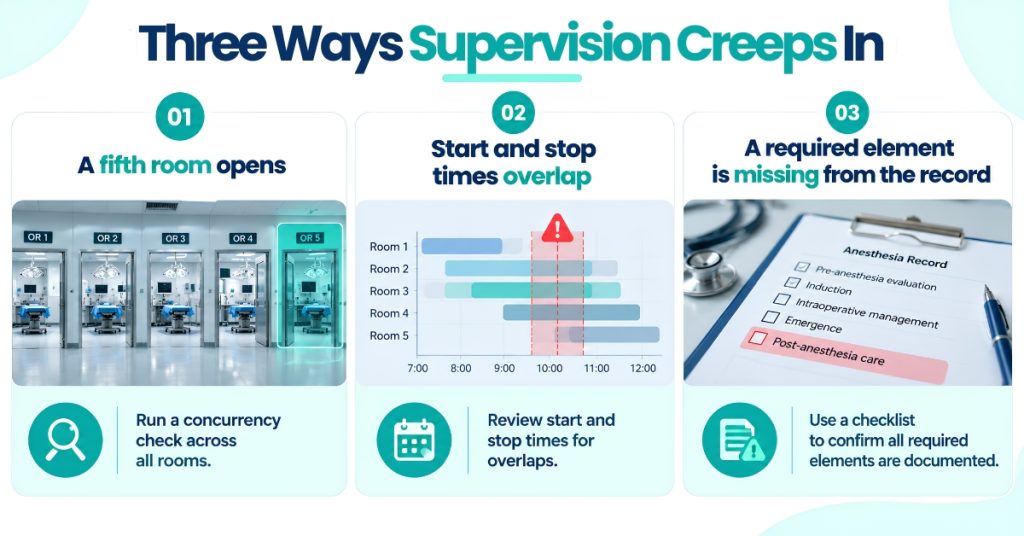
Groups don’t plan for medical supervision. It sneaks in. Maybe a fifth room opened before another case finished, or the start and stop times on two records overlap by a few minutes. Sometimes a required element just never made it into the chart. All three can be spotted before billing, and that’s where the money gets saved.
Medical direction vs medical supervision: the difference in dollars
Here’s what the QK vs AD modifier difference looks like on a single case. Take a lumbar fusion with instrumentation (CPT 00670, 13 base units) that runs 180 minutes. That’s 25 units in total.
- Medically directed (QK): the anesthesiologist is paid half of the 25 units, the equivalent of 12.5 units.
- Medically supervised (AD), present at induction: the anesthesiologist is paid 4 units, about a 68% cut.
12.5 units vs 4 units
Now say one anesthesiologist covering four fusions lets a fifth fusion start. Every case that overlaps that stretch can fall to AD. Across five cases, that’s about 42 units of anesthesiologist pay lost in a single morning. Commercial payers that follow Medicare’s medical direction rules cut payment in exactly the same way.
How concurrency is counted
Concurrency in anesthesia is the number of cases one anesthesiologist is directing at the same moment. It’s measured minute by minute across the whole day, not case by case. So if four rooms are running and a fifth case starts at 10:15, every case running between 10:15 and the moment concurrency drops back to four is affected.
- Use real start and stop times from the anesthesia record, never scheduled times.
- Run a concurrency check across every room before claims go out, not after a denial.
- Watch handoffs: a relief anesthesiologist picking up rooms changes who is counted where.
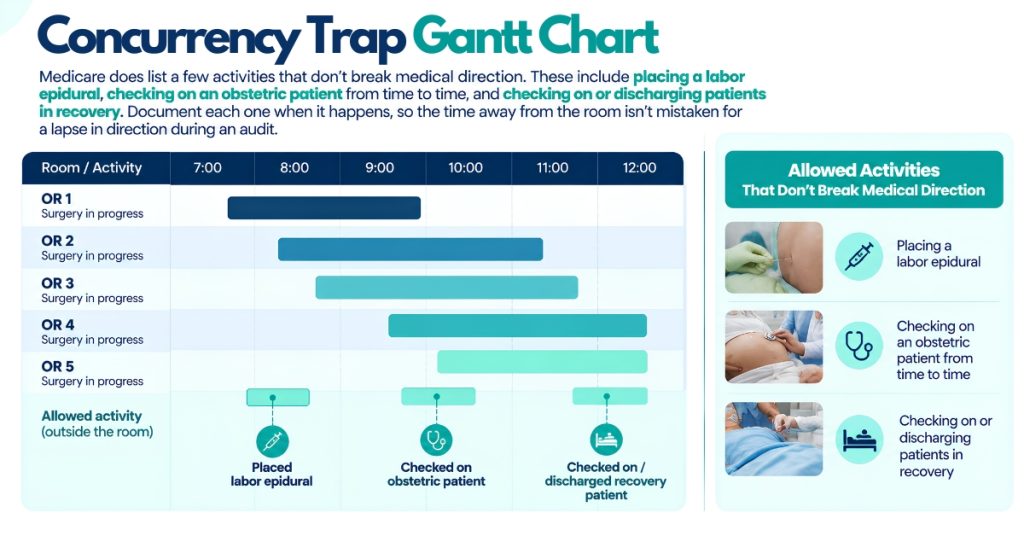
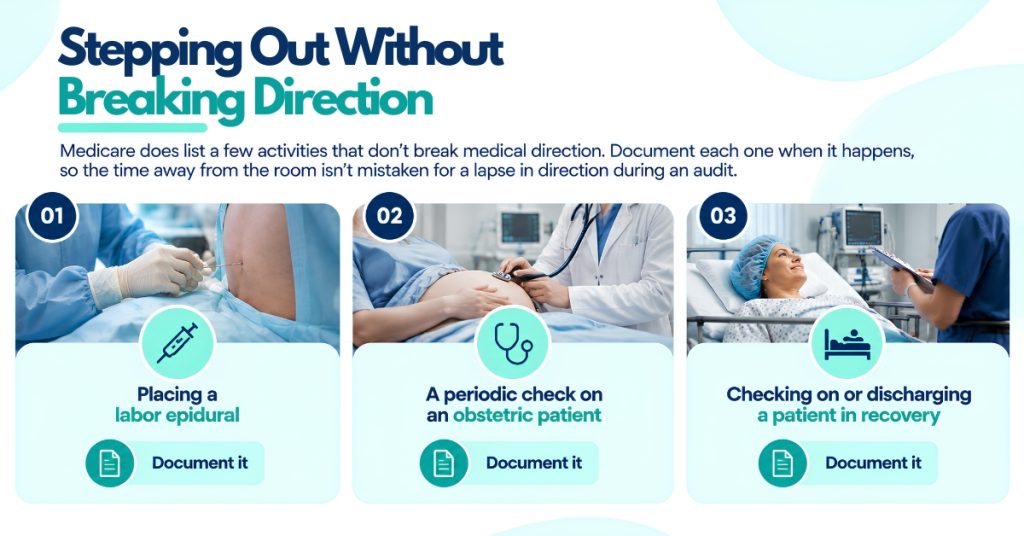
Medicare does list a few activities that don’t break medical direction. These include placing a labor epidural, checking on an obstetric patient from time to time, and checking on or discharging patients in recovery. Document each one when it happens, so the time away from the room isn’t mistaken for a lapse in direction during an audit.
CRNA-only care and opt-out states
AA CRNA working without medical direction bills QZ, and Medicare pays the CRNA 100% of the allowed amount. Whether a physician has to supervise depends on the state. CRNA opt-out states have removed Medicare’s supervision requirement, while the others still have it. Here’s how CRNA supervision works in each, using states where our clients work as examples.
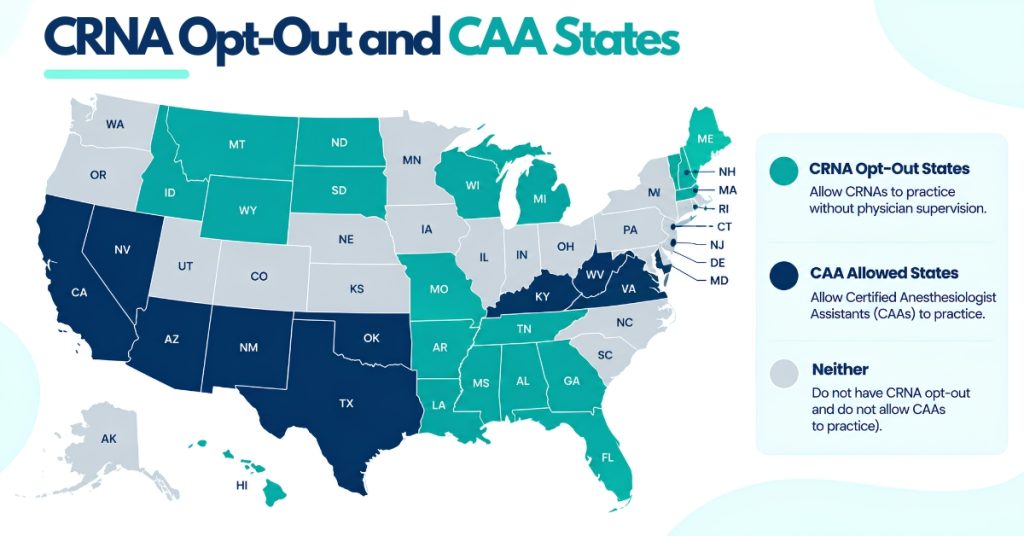
- Opt-out states: More than 25 states, including Arizona and California, have opted out of Medicare’s CRNA supervision requirement. CRNAs there can work without physician supervision for Medicare patients.
- Non-opt-out states, such as Nevada, Texas, Florida and New York: The CRNA must be supervised by a physician, which can be the operating surgeon. That supervision isn’t medical direction, and it doesn’t let the surgeon bill for anesthesia.
Medicare is only one layer, though. State nursing and medical board rules can be stricter than Medicare, and a facility’s own bylaws can be stricter than both. Before you set up CRNA-only coverage anywhere, check all three. A model that works under Medicare can still break a hospital’s medical staff rules, and that’s a costly thing to discover late.
Where anesthesiologist assistants fit
Certified anesthesiologist assistants always work under an anesthesiologist’s medical direction, so the anesthesiologist assistant care team is the only model they fit. They bill QX, never QZ, and count toward concurrency just as a CRNA does. More than 20 states allow CAAs to practice, including Nevada, Texas and Florida. Arizona, California and New York currently don’t, so care teams there use CRNAs.
Which care team model is right for your group?
Your model drives both cost and collections. Running a 1:4 anesthesia care team ratio means hiring fewer anesthesiologists, but the concurrency and documentation have to be spotless. Going anesthesiologist-only is the reverse: billing is easy, staffing is costly. For a rural hospital or a small ASC, CRNA-only coverage is sometimes what makes the numbers work, particularly in opt-out states, where Medicare doesn’t require physician supervision.
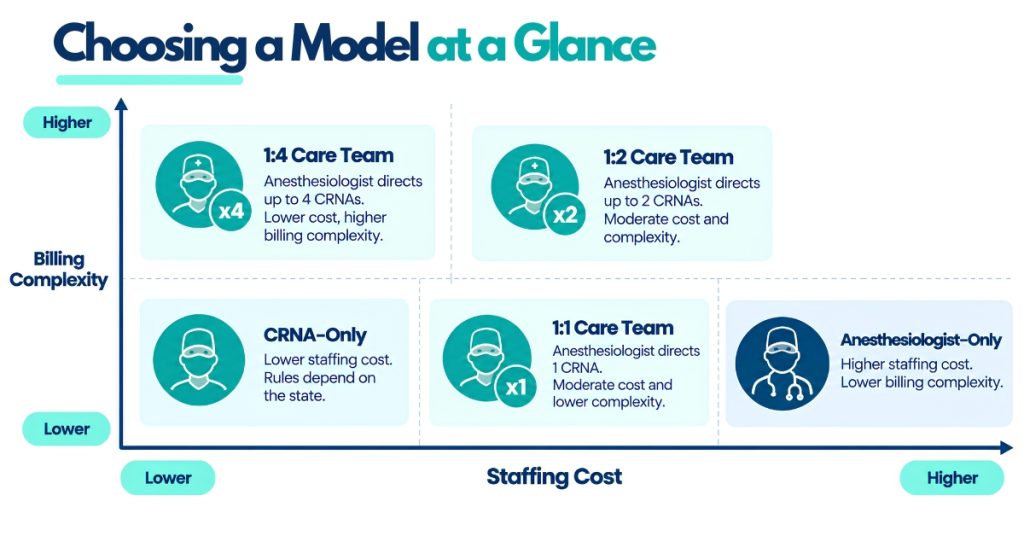
Before you take on a new hospital or ASC, model each option against the facility’s case mix, hours and payer mix. Compare what each model would cost to staff with what it would collect. If expected collections won’t cover the staffing cost, that gap is the number you take into the stipend conversation with the facility.
Common care team billing mistakes
- QK billed when concurrency reached five or more cases
- QX on the CRNA claim with no matching QK or QY claim for the same patient and time
- Medical direction billed without documented presence at induction and emergence
- QZ billed in a non-opt-out state with no supervising physician documented
- Scheduled times used instead of actual anesthesia start and stop times
Get a free care team and coverage review
Vigilant Medical Billing & Coding Services checks concurrency, modifiers and medical direction documentation across all your rooms. For new facilities, we also model staffing and stipends before you sign. To see how we handle the rest of the revenue cycle management, take a look at our anesthesia billing services.
About Vigilant Medical Billing & Coding Services
Vigilant Medical Billing & Coding Services is an anesthesia and physician revenue cycle management company headquartered in Mesquite, Texas. Its services include:
- Billing and coding for anesthesia groups
- Credentialing for anesthesiologists and CRNAs, and for certified anesthesiologist assistants (CAAs) in states that allow them
- Coverage planning and stipend numbers for hospitals and surgery centers
- No Surprises Act open negotiation and independent dispute resolution
The company’s leadership has worked in anesthesia revenue cycle management since 2016. Across its clients, net collections run at 98.8% and the denial rate is 1.12%. The company wins 88% of IDR disputes, and credentialing typically takes 4 to 6 weeks.
Frequently asked questions
What is the difference between medical direction and medical supervision?
Medical direction means an anesthesiologist directs one to four concurrent cases and meets all seven Medicare requirements on each. It’s billed with QY or QK and paid at 50%. Medical supervision applies when the anesthesiologist covers more than four cases or misses a requirement. It’s billed with AD and pays only 3 base units, plus 1 for presence at induction.
What is an anesthesia care team model?
It’s the way an anesthesia group staffs its cases. The five models come down to three basic set-ups: an anesthesiologist working alone, an anesthesiologist directing CRNAs or anesthesiologist assistants at up to 1:4, or CRNAs working on their own. Which one you use determines the modifiers on each claim and how the payment gets divided. That makes it a billing decision as much as a staffing one.
How many cases can an anesthesiologist medically direct?
Four at a time, under Medicare rules. Once a fifth case starts while the other four are still going, every case caught in that overlap drops to medical supervision and is billed with AD. Concurrency is tracked minute by minute. Even a short overlap, say ten minutes while one room is closing, is enough to cause it.
Does a CRNA need physician supervision?
For Medicare, yes, unless the state has opted out of the supervision requirement. Arizona and California are opt-out states, so CRNAs there can work without physician supervision. In states such as Nevada, Texas, Florida and New York, a physician must supervise, and that can be the operating surgeon. Keep in mind that state law and a hospital’s own bylaws can ask for more than Medicare does.
Can anesthesiologist assistants work without an anesthesiologist?
No. A certified anesthesiologist assistant always works under an anesthesiologist’s medical direction and bills with modifier QX. They can’t practice on their own or bill QZ the way a CRNA can. They also count toward the anesthesiologist’s concurrency limit of four, in exactly the same way a directed CRNA does.
Sources
- CMS Medicare Claims Processing Manual, Chapter 12, Section 50 (anesthesia services): https://www.cms.gov/regulations-and-guidance/guidance/manuals/downloads/clm104c12.pdf
- 42 CFR 415.110, conditions for payment for medically directed anesthesia services: https://www.ecfr.gov/current/title-42/section-415.110
- Becker’s ASC Review, the states where CRNAs do not need physician supervision (2026): https://www.beckersasc.com/?p=108540
- American Academy of Anesthesiologist Assistants, state practice map: https://www.anesthetist.org/