Sooner or later every practice hits this fork in the road. Denials keep coming, the coding backlog keeps growing, and two ideas land on the table in the same meeting. Buy better coding software. Or hand the whole thing to an outside team. Both sound like savings. In practice, one of them usually costs a lot more than the brochure suggested.
The team at Vigilant Medical Billing & Coding Services watches this decision play out every week. A practice buys a well reviewed coding tool, waits for the denials to drop, and six months later calls Vigilant Medical Billing & Coding Services because nothing dropped. With 500+ specialty trained certified coders serving practices in all 50 states, coding accuracy held at 95 to 98 percent, and a 99.4 percent clean claim rate, Vigilant Medical Billing & Coding Services sits at a useful vantage point for this question. The company sees exactly where software earns its keep and where it quietly does not. What follows are the actual numbers on both sides.
What Medical Coding Software Actually Does
There are really two kinds of coding software. Encoders are lookup tools. A coder types a keyword and gets the matching ICD-10, CPT, or HCPCS codes with the relevant guidelines and payer edits attached. Then there is computer assisted coding, or CAC, which reads the clinical note itself and suggests codes on its own. A coder still reviews every suggestion before anything goes out.
Notice what both descriptions have in common. A coder. Software does not code charts, people do, and no vendor demo changes that. The tool makes a trained coder faster. It does not make an untrained one accurate. That single fact drives most of the cost math below.
The Real Cost of Medical Coding Software
The license fee is the number on the invoice. It is also the smallest number involved. A practice keeping coding in house pays for all of this:
- The license itself. Encoders generally run 400 to 1,200 dollars per coder each year. Billing platforms with coding features sit around 100 to 500 dollars per provider per month for smaller practices, and CAC usually comes as a paid add on.
- Getting it running. Setup, data migration, and EHR integration commonly add 2,000 to 10,000 dollars before the first claim goes through. Sometimes more.
- The person behind the screen. A certified coder averages about 55,000 dollars a year in salary. Add payroll taxes, health insurance, and paid leave and the real figure lands between 70,000 and 85,000 dollars. This one line dwarfs everything else.
- Staying current. ICD-10 changes every year. So do CPT codes and payer rules. Certification renewals and continuing education never stop, they just renew.
- Losing people. The US is short an estimated 10,000 to 15,000 qualified coders right now. Replacing one costs about 20 percent of that coder’s salary in recruiting alone, and the chair can sit empty for months while charts stack up.
Add it all up for a small practice with one coder and the total passes 90,000 dollars a year without breaking a sweat. Denials not included.
The Real Cost of Outsourced Medical Coding
Outsourcing flips the model. The practice stops buying tools and hiring people to operate them, and instead pays for finished work. Coded charts. Clean claims. Denials somebody else chases down.
Pricing takes one of three shapes. A percentage of collections, most often 4 to 7 percent. A flat rate per claim or per chart. Or a fixed monthly fee for an agreed volume. Whichever shape it takes, the coders, their software, their training, and every compliance update belong to the vendor. Not to the practice.
So where do the savings land? Industry analyses put the reduction at roughly 30 to 40 percent versus running an internal team, mostly because the fixed costs simply vanish. No payroll burden. No license renewals. No recruiter fees when a coder resigns in flu season.
Real figures make it concrete. When Vigilant Medical Billing & Coding Services maps a typical practice’s in-house billing costs against its own service, the in-house column comes to about 153,000 dollars a year. Ninety thousand for billing staff, 18,000 on software and training, 25,000 chasing denials, another 20,000 on coding review. Practices that make the switch commonly keep 100,000 dollars or more of that.
Side by Side: Software vs Outsourced Coding
| Cost Factor | Coding Software (In-House) | Outsourced Coding |
|---|---|---|
| Upfront cost | License fees plus setup, training, and integration | None. Fees begin once work starts |
| Ongoing cost | Around 400 to 1,200 dollars per coder yearly, plus 100 to 500 dollars a month for billing platforms | Usually 4 to 7 percent of collections, or a flat per claim rate |
| Staff still needed | Yes. Someone has to run the software | No. Certified coders come with the service |
| Salary burden | 70,000 to 85,000 dollars per in-house coder once benefits are counted | Zero. Payroll shifts to the vendor |
| Coding updates | The practice tracks ICD-10, CPT, and payer changes | Handled by the vendor |
| Denial rework | Practice staff, at 25 to 117 dollars per claim | Included in most agreements |
| Scalability | Capped by headcount and licenses | Moves up or down with patient volume |
| Accuracy responsibility | Sits with the practice | Sits with the coding partner |
The Costs Software Never Shows
Price is half the picture. Accuracy is the other half, and it is the half that bleeds quietly.
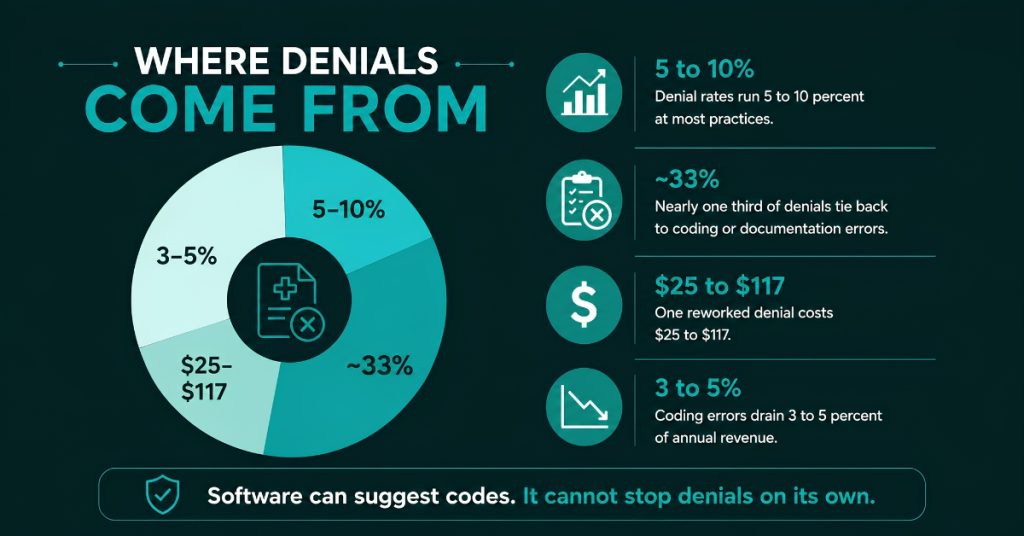
Coding errors drain an estimated 3 to 5 percent of a practice’s annual revenue. Industry wide, the figure is around 36 billion dollars a year. Most practices run denial rates between 5 and 10 percent, and close to a third of those denials trace back to coding or documentation problems. Not payer games. Coding.
Can software fix that? Partly. AI assisted tools now reach 85 to 96 percent accuracy on routine charts, which sounds impressive until the other 4 to 15 percent comes into view. Complex cases. Vague documentation. Specialty rules the model has never seen. A tool can suggest a code, but it cannot defend one in an audit, and it will not pick up the phone when the payer pushes back. Meanwhile each reworked denial eats 25 to 117 dollars of staff time, and the denials nobody gets to become write offs. Permanent ones.
When Buying Software Makes Sense
A practice that already employs experienced certified coders who just need faster lookup and validation will find an encoder a sensible productivity buy. The same goes for groups whose claim volume genuinely keeps a full team busy all year, and for hospital systems where owning the coding function is a strategic choice and budget is not the squeeze.
All three of those need to be true at once, though. At most independent practices, at least one is not.
When Outsourcing Saves More
Now the situations most practices actually live in. Outsourcing wins when:
- Certified coders are hard to find or keep. Coding vacancy rates hover near 30 percent nationally and salaries climb every year.
- The denial rate sits above 5 percent and the backlog belongs to nobody in particular.
- Patient volume swings with the seasons, so a fixed salary makes sense for half the year and hurts for the other half.
- The practice bills in a rule heavy specialty like cardiology, orthopedics, or behavioral health, where a generalist coder’s mistakes get expensive fast.
- Leadership prefers a predictable fee tied to revenue over fixed overhead that stays put when collections dip.
So Which One Saves More?
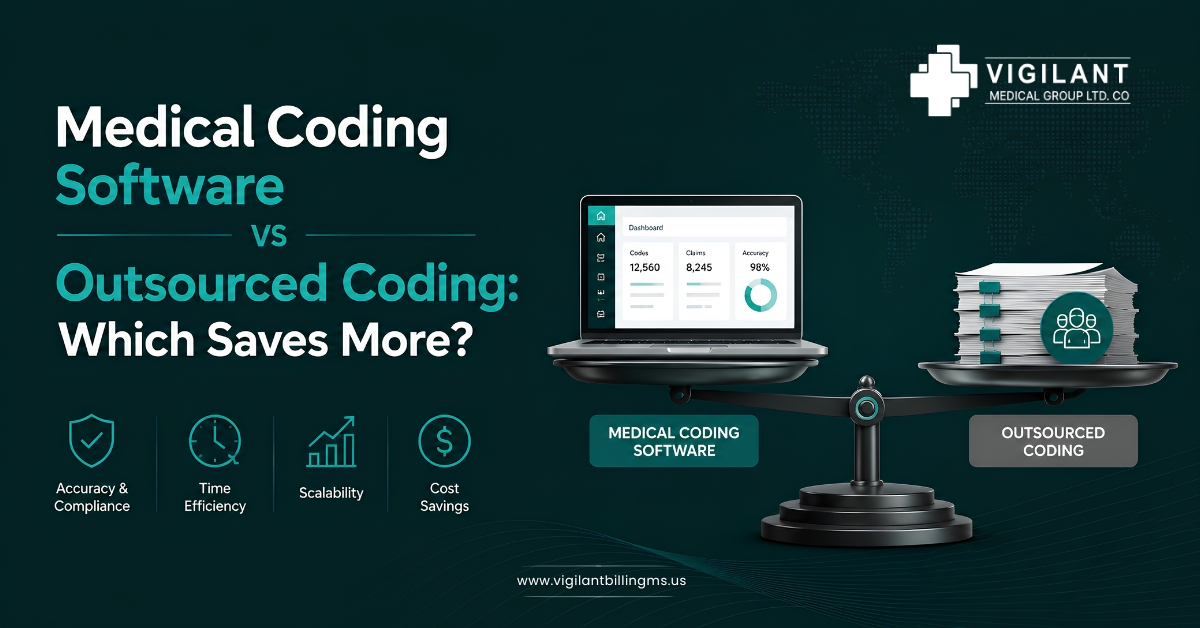
At most small and mid sized practices, outsourcing. And honestly, it is not close. Software trims the minutes a coder spends hunting for codes. Outsourcing removes the salaries, the training, the turnover risk, the licenses, and the denial rework from the books in one move, and swaps all of it for a single fee that rises and falls with revenue.
The exception is the large organization with stable high volume and a coding department it intends to keep. There, better software sharpens a team already on payroll. Everyone else is carrying enterprise overhead for a problem a partner would absorb for less.
One detail worth knowing before deciding. A good coding partner brings the software along anyway. Vigilant Medical Billing & Coding Services coders work inside the practice’s existing EHR with encoder tools, claim scrubbing, and payer edits already loaded. Technology and people, one fee. Nothing for the front office to learn, nothing new to buy.
Conclusion:
There is no universal answer here, only the answer for a specific practice, and it depends on volume, specialty, and denial pattern. Vigilant Medical Billing & Coding Services is headquartered in Texas and supports practices in all 50 states with 500+ specialty trained certified coders, a 99.4 percent clean claim rate, denial rates under 3 percent, and AR days under 38. The team works inside whatever EHR a practice already uses, so nothing about the existing workflow has to change.
Want the exact figure for a specific practice instead of an estimate? Book a free billing audit with Vigilant Medical Billing & Coding Services today. Vigilant Medical Billing & Coding Services RCM experts will show where revenue is leaking and what fixing it would cost. Call +1-469-799-5556 for more details.
Frequently Asked Questions
Is it cheaper to outsource medical coding or keep it in house?
Outsourcing, for most practices. An in-house coder costs 70,000 to 85,000 dollars a year once benefits are counted, and that is before software, training, and turnover. Outsourced coding usually runs 4 to 7 percent of collections and wipes those fixed costs out, which is why practices typically see coding costs fall by 30 to 40 percent.
How much does medical coding software cost?
Encoder licenses sit around 400 to 1,200 dollars per coder per year. Cloud billing and coding platforms cost 100 to 500 dollars per provider monthly for small practices, and implementation adds another 2,000 to 10,000 dollars or more. Hospital grade CAC systems can run into six or seven figures.
Can AI medical coding software replace human coders?
AI assisted coding hits 85 to 96 percent accuracy on routine charts, but complex diagnoses, thin documentation, and compliance review still need a certified coder’s judgment. The teams getting the best results pair the tools with people rather than choosing between them.
What percentage do medical coding and billing companies charge?
Most sit between 4 and 7 percent of monthly collections. Full service billing contracts can stretch from 3 to 10 percent depending on volume, specialty, and how much of the revenue cycle the vendor takes on. Some quote flat per claim or fixed monthly rates instead. A reputable partner earns only when claims actually get paid.