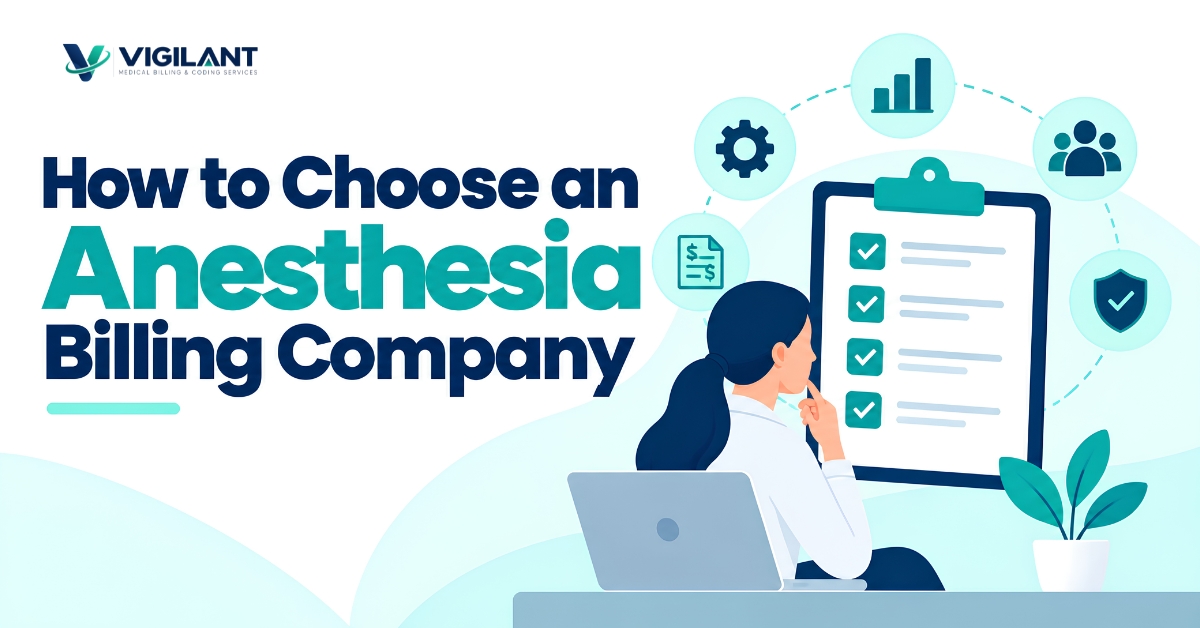
Picking from the anesthesia billing companies out there is a big money decision for any anesthesia group. It’s also hard to reverse once the contract is signed. When the fit is right, every unit and minute gets paid, your providers stay credentialed, and low out-of-network payments get challenged. When it isn’t, the losses are quiet. It can take a year or more before someone looks closely at the numbers and realizes what’s been happening. This guide is meant to help you avoid that. It covers anesthesia billing cost first, then the questions to ask an anesthesia billing company before you sign anything, and finally the red flags that mean you should walk away.
Not sure yet what kind of company you want? Start with our comparison of the best anesthesia billing companies, which breaks down the four main types.
Key takeaways
- Between units, time, care team modifiers and the No Surprises Act, anesthesia isn’t billed like other specialties. A specialist biller is worth it.
- Fees are usually a percentage of net collections. Check what that percentage pays for before you look at the number itself.
- Put all 13 questions below to every vendor. If the answers on medical direction, credentialing or IDR get vague, be careful.
- Switching usually takes 30 to 90 days. Planned properly, cash keeps coming in the whole time.
Why anesthesia needs a specialist, not a general biller
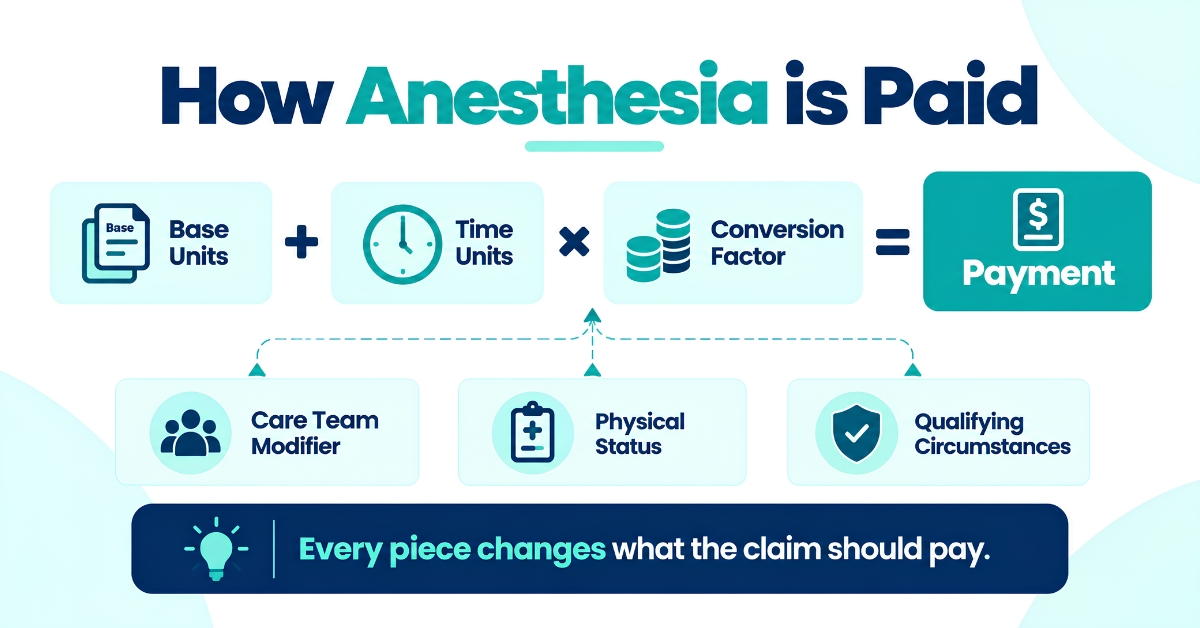
The payment math alone sets anesthesia apart. You take base units plus time units and multiply by a conversion factor, and then care team modifiers, physical status and qualifying circumstances each move the number. On top of that come issues most practices never run into. Medical direction rules. Concurrency. Hospital stipends. Credentialing for CRNAs and anesthesiologist assistants. And, for most out-of-network cases at in-network facilities, No Surprises Act disputes. Any general billing company can get claims out the door. What a specialist anesthesia billing company adds is knowing what each claim should have paid, and catching it when it wasn’t.
What anesthesia billing companies charge
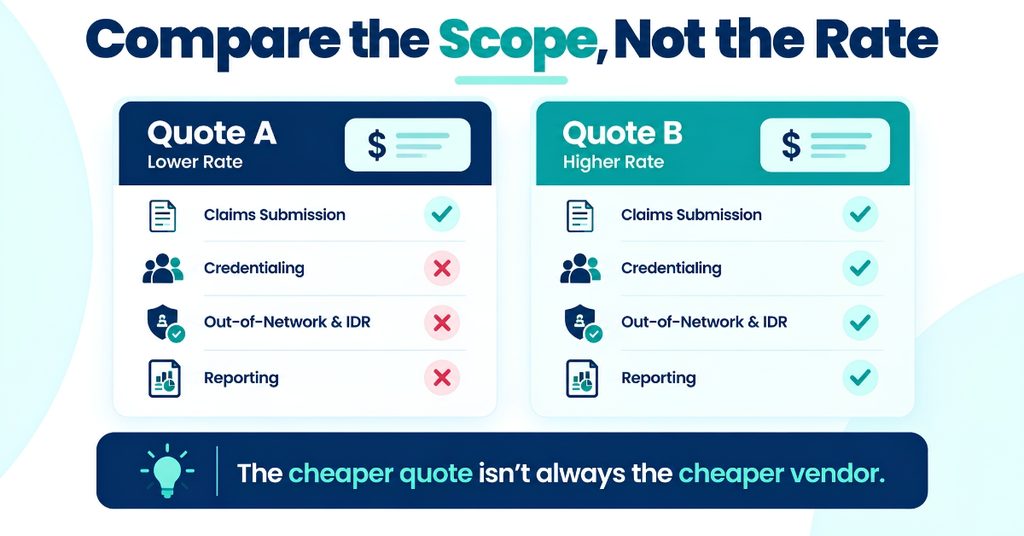
The usual model is a percentage of net collections, and most anesthesia billing companies work that way. The percentage itself varies. Anesthesia billing rates move with case volume and payer mix. They also depend on how many facilities you cover, and on what the fee includes. Pay the most attention to that last one. A quote with a low percentage can leave out credentialing, out-of-network disputes and reporting. Add those back in, and it may cost more than a higher rate that includes everything. Look at scope first. Price comes second.
| Usually included | Sometimes extra | Often separate |
| Coding, charge entry, claim submission, payer follow-up, denial work and patient statements | Credentialing and payer enrollment, hospital privileges, stipend analysis and custom reporting | Out-of-network open negotiation and IDR, usually priced as a contingency on what’s recovered |
However the quote is structured, get it in writing: what the fee covers, and what’s billed on top. Some groups also hire anesthesia billing consultants before going out to bid, to review what their current vendor charges and delivers.
13 questions to ask any anesthesia billing company
Below are the questions to ask an anesthesia billing company before you sign. We’ve grouped them by the four areas the work falls into. You can also download them as a checklist to take into vendor meetings.
Coding and billing
- Do your coders spend their whole day on anesthesia? What certifications do they have?
- Walk us through how you capture anesthesia time. Who compares it with the anesthesia record?
- What checks happen on concurrency and medical direction documentation before a QK or QY claim goes out?
- Do you bill physical status modifiers and qualifying circumstances wherever the payer covers them?
Credentialing and coverage
- Can you credential our anesthesiologists, CRNAs and anesthesiologist assistants and link each of them to our group?
- Who tracks hospital and ASC privileges, and the renewal dates?
- When we’re weighing a new hospital or ASC, can you model staffing and stipends using our claims data?
Out-of-network and IDR
- Once the first payment comes in, do you keep going with open negotiation and IDR, or is that the end of it?
- How are denied out-of-network claims handled, and how do you decide between IDR and an appeal?
- What goes into the case for each disputed claim? And if a dispute is lost, who pays the IDR filing and arbitration fees?
Reporting and contract
- What’s in the monthly reports? Can we break them down by facility, surgeon, payer and provider?
- Who owns our data, and how do we get it back if we leave?
- How much notice does the contract require, and who works the AR during a transition?
Red flags when comparing anesthesia billing companies
One of these on its own is worth asking about. Spot two or three, and it’s probably time to talk to someone else.
- You ask about QK, QY and QX, and nobody can give you a straight answer.
- Out-of-network claims get written off. Or they’re left alone once the first payment posts.
- They can’t give you days in AR or a denial rate broken out by payer.
- Credentialing is “handled by your office.”
- It’s a long lock-in, and the contract says nothing clear about leaving or getting your data back.
- Their reports stop at charges and payments. Units, time and cases by facility aren’t there.
In-house vs outsourced anesthesia billing
With an in-house team, you’re in charge of everything. Staffing it is the hard part. Anesthesia billers with real experience don’t come along often. If one quits, or takes a few weeks off, claims can pile up for a month. Outsourcing anesthesia billing services puts a whole team on that work instead: specialty coders, credentialing staff and people who handle IDR. You usually pay a set percentage for it. Plenty of groups split the difference. They keep a practice manager in-house to manage the relationship and let the vendor do the billing.
| In-house | Outsourced | |
| Pros | You control staff and priorities directly, and answers come from people down the hall. | You get a full team for anesthesia coding, credentialing and IDR. Costs go up and down with collections, and someone covers when a person is out. |
| Cons | Anesthesia coders are hard to hire and replace. One absence can hold up a month of claims, and credentialing and IDR often fall behind. | You have less day-to-day control, and a lot rides on choosing the right vendor. Check the exit terms and data ownership before signing. |
How to switch anesthesia billing companies without losing cash
A dip in cash flow isn’t a given when switching anesthesia billing companies. It mostly comes down to planning the handover. Here’s the order we recommend:
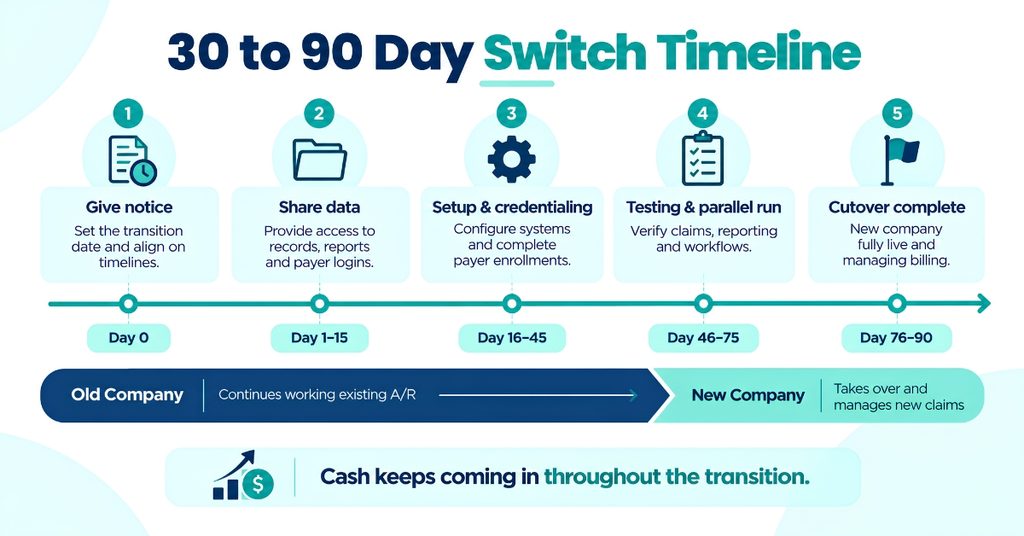
- Give notice as your contract requires, and request a full export of claims, payments, AR and credentialing files.
- Ask the new company to build a transition AR list. That way, older claims don’t get dropped.
- Get payer enrollment, ERA, EFT and clearinghouse settings updated before the cutover date.
- Compare both companies’ reports side by side for the first 60 days. Gaps show up quickly this way.
- Check that someone is tracking the dispute deadline on every open out-of-network claim.
Where Vigilant Medical Billing & Coding Services Fits
We built Vigilant Billing & Coding Services around anesthesia groups that cover hospitals and ASCs. Our anesthesia clients are in Nevada, Arizona and Texas, with other client practices in California, Florida and New York. The work covers billing and coding, credentialing for anesthesiologists, CRNAs and CAAs, coverage and stipend modeling, and out-of-network IDR. Each client gets a monthly report by facility, surgeon and payer. And yes, ask us all 13 questions too.
About Vigilant Billing & Coding Services
Vigilant Medical Billing & Coding Services is an anesthesia and physician revenue cycle management company headquartered in Mesquite, Texas. Its services include:
- Billing and coding for anesthesia groups
- Credentialing for anesthesiologists and CRNAs, and for certified anesthesiologist assistants (CAAs) in states that allow them
- Coverage planning and stipend numbers for hospitals and surgery centers
- No Surprises Act open negotiation and independent dispute resolution
The company’s leadership has worked in anesthesia revenue cycle management since 2016. Across its clients, net collections run at 98.8% and the denial rate is 1.12%. The company wins 88% of IDR disputes, and credentialing typically takes 4 to 6 weeks.
Frequently asked questions
How much do anesthesia billing companies charge?
It’s almost always a percentage of net collections. Where that percentage lands depends on how many cases you do, which payers you see, and what’s in the scope. IDR on out-of-network claims is often quoted separately, usually as a share of whatever extra gets recovered. That’s where comparing gets tricky. Say one vendor quotes a low rate that doesn’t cover credentialing or IDR, and another quotes higher but includes both. The second may well cost you less. So before you settle on anesthesia billing cost, get each vendor to write down what’s in the fee and what isn’t.
What should I look for in an anesthesia billing company?
The coders are where we’d look first. Anesthesia should be their whole day, and they should be checking time and concurrency on every case. After that, there are four more things to ask about. Does the company credential anesthesiologists, CRNAs and anesthesiologist assistants in-house? Does it take out-of-network claims to open negotiation and IDR? Will you get monthly reports broken out by facility and payer? And what do the exit terms say? The better anesthesiology billing companies won’t be vague about how you leave or how your data comes back.
Should an anesthesia group outsource billing?
Yes, for most groups. Sending claims out is the simple bit. Anesthesia coding, credentialing and fighting out-of-network underpayments all take real skill, and an in-house team would need someone good at each one. That’s three hard hires. A setup that works for many groups keeps one person on their own side, usually the practice manager, to check the vendor’s work and go over the monthly reports.
How long does it take to switch anesthesia billing companies?
Most switches take somewhere in the region of 30 to 90 days. You can’t move faster than your contract’s notice period allows. Beyond that, payers set most of the pace, because enrollment changes take as long as they take. The other factor is how quickly the new clearinghouse connection is ready. Meanwhile, the old company should still be working your existing AR. If it stops early, that’s when cash flow dips.