Anesthesia modifiers tell the payer who gave the anesthesia and how the care team was set up. They decide whether a claim pays at 100%, splits 50/50 between an anesthesiologist and a CRNA, or drops to a few base units. When modifiers are wrong, claims get underpaid or denied, and it’s one of the most common reasons that happens.
Key takeaways
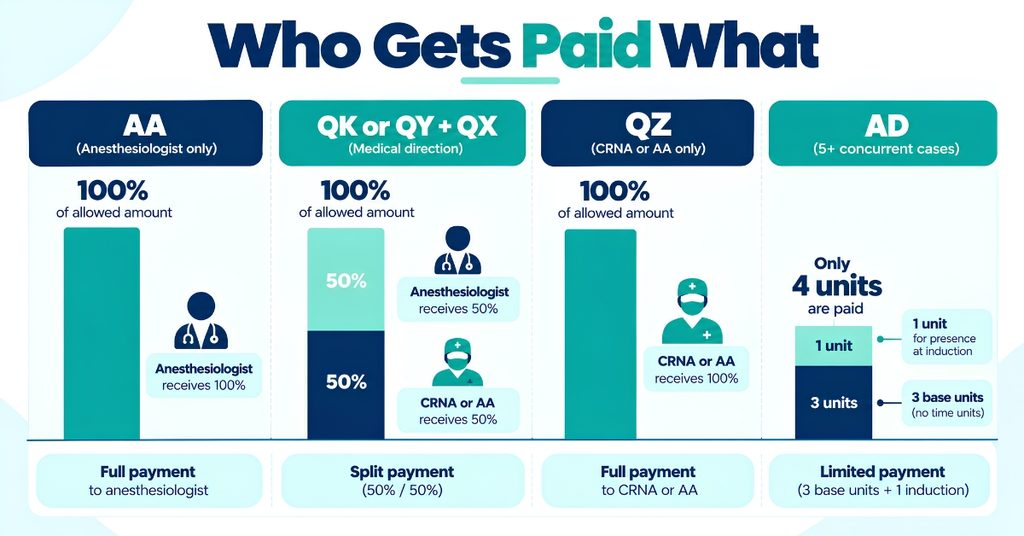
- AA and QZ pay 100% of the allowed amount. QK, QY and QX split it 50/50 between the anesthesiologist and the CRNA or AA.
- QK covers two to four concurrent cases. Once concurrency reaches five, the anesthesiologist drops to AD, which pays only a few base units.
- Medical direction modifiers only hold up if all seven Medicare requirements are documented for every case.
- QS, G8, G9 and the P1 to P6 physical status modifiers add detail, and many commercial payers pay extra units for P3 to P5.
Anesthesia modifiers at a glance
| Modifier | Who bills it | When to use it | How payment splits |
| AA | Anesthesiologist | Personally performed the case | 100% of allowed |
| QK | Anesthesiologist | Medically directed 2 to 4 concurrent cases | 50% of allowed |
| QY | Anesthesiologist | Medically directed 1 CRNA or AA | 50% of allowed |
| QX | CRNA or anesthesiologist assistant | Case medically directed by an anesthesiologist | 50% of allowed |
| QZ | CRNA | No medical direction by an anesthesiologist | 100% of allowed |
| AD | Anesthesiologist | Supervised more than 4 concurrent cases | 3 base units (plus 1 if present at induction) |
AA modifier: anesthesia personally performed
Modifier AA is used when the anesthesiologist personally performs the whole anesthesia service, with no CRNA or anesthesiologist assistant on the case. Medicare pays the full allowed amount. You’ll see AA most often in smaller ASCs, on high-risk cases and in physician-only groups, where the anesthesiologist stays with one patient from start to finish.
QK modifier: medical direction of 2 to 4 concurrent cases
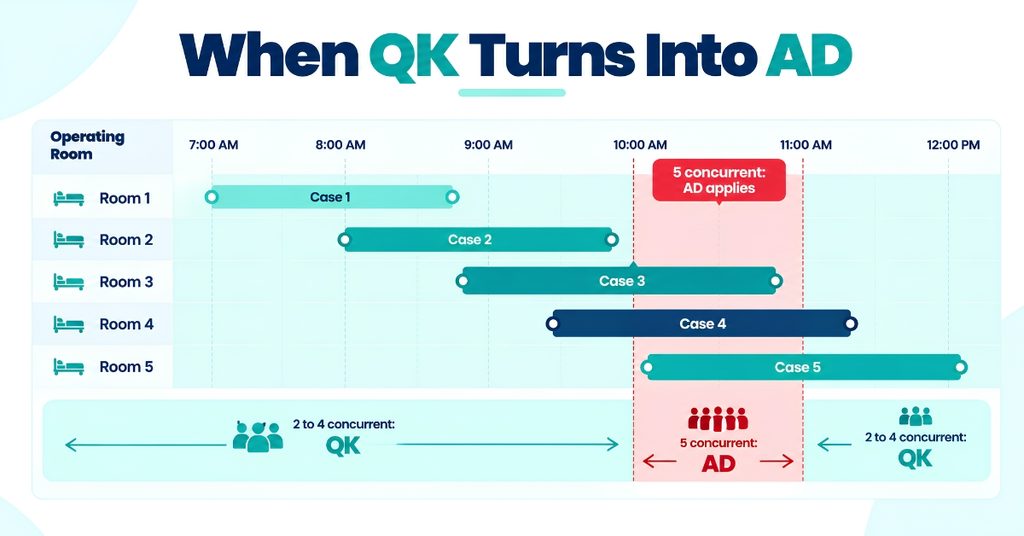
Modifier QK means the anesthesiologist medically directed two, three or four concurrent anesthesia cases, each with a qualified individual such as a CRNA or anesthesiologist assistant. The anesthesiologist bills QK on each case, and each CRNA or AA bills QX. Medicare pays each side 50% of the allowed amount, so together the two claims add up to the full amount.
Concurrency is counted at every point in time, not as a daily average. If the anesthesiologist is covering four rooms and a fifth case starts, every case overlapping that stretch falls to medical supervision (AD), which pays far less. Accurate start and stop times on every anesthesia record are what protect QK on audit.
QY modifier: medical direction of one CRNA
The anesthesiologist bills modifier QY when medically directing one CRNA or anesthesiologist assistant on a single case, and the CRNA or AA bills QX. Medicare splits payment 50/50, just as it does with QK. That means a 1:1 directed case usually brings the group the same total as a personally performed case billed with AA.
QX modifier: CRNA or AA service with medical direction
The CRNA or anesthesiologist assistant bills modifier QX when an anesthesiologist medically directs the case. It’s always paired with QK or QY on the anesthesiologist’s claim for the same patient and time. Anesthesiologist assistants always bill QX, because they can only work under medical direction. A QX claim with no matching QK or QY is a common cause of denials.
QZ modifier: CRNA service without medical direction
Modifier QZ is billed when a CRNA gives anesthesia without medical direction from an anesthesiologist, with the CRNA paid 100% of the allowed amount. Supervision still matters. In states that haven’t opted out of Medicare’s supervision rule, such as Nevada and Texas, a physician must supervise, and that can be the operating surgeon. Opt-out states like Arizona don’t require it.
AD modifier: medical supervision of more than 4 cases
Modifier AD applies when an anesthesiologist is involved in more than four concurrent cases, or doesn’t meet all the medical direction requirements. Medicare pays only 3 base units, plus 1 time unit if the anesthesiologist was present at induction. AD usually points to a staffing or documentation problem, not a choice. Our guide to medical supervision vs medical direction explains the difference.
The 7 medical direction requirements
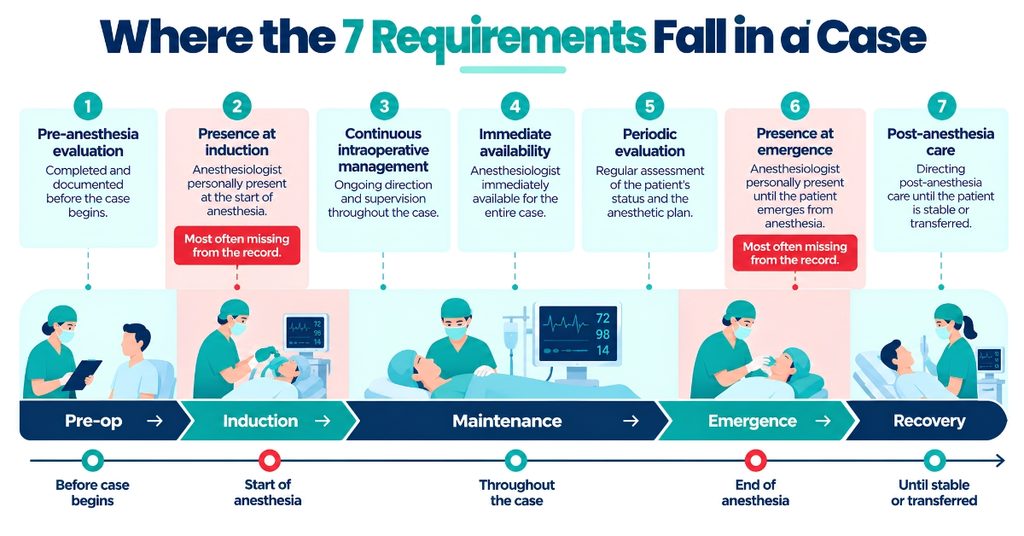
For QK and QY to hold up, Medicare requires the anesthesiologist to do every one of the following, for each case:
- Perform the pre-anesthetic examination and evaluation
- Prescribe the anesthesia plan
- Personally participate in the most demanding parts of the plan, including induction and emergence when applicable
- Ensure any procedures they don’t perform are done by a qualified individual
- Monitor the course of anesthesia at frequent intervals
- Remain physically present and available for immediate diagnosis and treatment of emergencies
- Provide indicated post-anesthesia care
If any one of these steps is missing from the record, an auditor can downgrade the claim from medical direction to medical supervision. That turns a 50% payment into a few base units. Presence at induction and emergence is the step that most often goes undocumented, so it’s the one worth checking first.
Other anesthesia modifiers you will see
Beyond the main medical direction modifiers, a few others show up on anesthesia claims. The QS modifier flags monitored anesthesia care, the G8 and G9 modifiers add detail to MAC, and the anesthesia physical status modifiers (P1 to P6) describe how sick the patient was. Modifier 23 covers unusual anesthesia. Here’s what each one does:
| Modifier | What it means | Payment note |
| QS | Monitored anesthesia care (MAC) | Informational. Reported alongside the care team modifier. |
| G8 | MAC for deep, complex, complicated or markedly invasive surgical procedures | Can support medical necessity for MAC with some payers |
| G9 | MAC for a patient with a history of severe cardiopulmonary conditions | Can support medical necessity for MAC with some payers |
| P1 to P6 | Physical status of the patient | Medicare pays no extra units, but many commercial payers add units for P3, P4 and P5 |
| 23 | Unusual anesthesia: general anesthesia for a procedure that normally needs none | Documentation should explain why general anesthesia was needed |
Common anesthesia modifier errors that cost money
These five mistakes with anesthesia billing modifiers come up again and again, and each one costs money:
- QK billed when concurrency reached five or more cases
- QX on the CRNA claim with no matching QK or QY claim from the anesthesiologist
- Missing medical direction documentation, especially presence at induction and emergence
- QZ billed in a non-opt-out state without physician supervision documented
- Physical status modifiers left off commercial claims that pay for them
Most of these come down to the same thing: CRNA modifiers and anesthesiologist modifiers that don’t line up for the same case.
Get your anesthesia modifiers audited
Vigilant Medical Billing & Coding Services audit modifier use, concurrency and medical direction documentation for anesthesia groups in Nevada, Arizona and Texas. When we find errors, we also fix the workflow behind them, so the same mistakes don’t come back the following month. To see everything else we handle for anesthesia groups, take a look at our anesthesia billing services.
About Vigilant Medical Billing & Coding Services
Vigilant Medical Billing & Coding Services is an anesthesia and physician revenue cycle management company headquartered in Mesquite, Texas. Its services include:
- Billing and coding for anesthesia groups
- Credentialing for anesthesiologists and CRNAs, and for certified anesthesiologist assistants (CAAs) in states that allow them
- Coverage planning and stipend numbers for hospitals and surgery centers
- No Surprises Act open negotiation and independent dispute resolution
The company’s leadership has worked in anesthesia revenue cycle management since 2016. Across its clients, net collections run at 98.8% and the denial rate is 1.12%. The company wins 88% of IDR disputes, and credentialing typically takes 4 to 6 weeks.
Frequently asked questions
What is the QK modifier in anesthesia?
The QK modifier means an anesthesiologist medically directed two to four concurrent anesthesia cases, each performed by a qualified individual such as a CRNA or anesthesiologist assistant. Medicare pays the anesthesiologist 50% of the allowed amount on each directed case. The CRNA or AA bills QX for the other 50%, and all seven medical direction requirements must be documented.
What is the QX modifier?
A CRNA or anesthesiologist assistant bills the QX modifier when an anesthesiologist medically directs the anesthesia service. It has to be paired with QK or QY on the anesthesiologist’s claim for the same patient and time. Medicare pays each side 50% of the allowed amount. Without the matching anesthesiologist claim, the QX claim is likely to be denied.
What is the QZ modifier?
A CRNA bills the QZ modifier when providing anesthesia without medical direction from an anesthesiologist. Medicare pays the CRNA 100% of the allowed amount. In states that haven’t opted out of Medicare’s supervision rule, a physician still has to supervise, though the operating surgeon can fill that role. Opt-out states don’t require physician supervision for Medicare.
What is the difference between QK and QY?
Both are medical direction modifiers billed by the anesthesiologist, and both pay 50% of the allowed amount. The difference is how many cases are running at once. QY is for directing one CRNA or anesthesiologist assistant on a single case. QK is for directing two, three or four concurrent cases. Above four, the anesthesiologist moves to AD.
When is the AD modifier used?
The AD modifier is used when an anesthesiologist supervises more than four concurrent cases, or doesn’t meet all of the medical direction requirements. Medicare then pays only three base units, plus one time unit if the anesthesiologist was present at induction. Because the drop in payment is so large, AD usually signals a staffing or documentation problem.
Sources
- CMS Medicare Claims Processing Manual, Chapter 12, Section 50 (anesthesia services): https://www.cms.gov/regulations-and-guidance/guidance/manuals/downloads/clm104c12.pdf
- 42 CFR 415.110, Conditions for payment: Medically directed anesthesia services: https://www.ecfr.gov/current/title-42/chapter-IV/subchapter-B/part-415/subpart-C/section-415.110