
If your group covers a labor and delivery unit, you probably bill the 01967 CPT code more than almost anything else. It’s the code for neuraxial labor analgesia when a vaginal delivery is planned, or in everyday terms, the labor epidural. It’s also surprisingly easy to underbill, since no two payers seem to count labor time the same way. For help with your OB service line, see our anesthesia billing services.
Key takeaways
- The labor epidural code, 01967, is worth 5 base units.
- If labor ends in a cesarean, add 01968 (2 base units). If it ends in a cesarean hysterectomy, add 01969 (5 base units). Neither is ever billed alone.
- A scheduled cesarean, with no labor epidural first, goes on the claim as 01961 (7 base units).
- There’s no single way payers count labor time. Some pay all of it, some cap it, some pay only bedside minutes, and some pay a flat amount. Match each claim to the payer.
- Under Medicare’s rules, placing a labor epidural doesn’t cost an anesthesiologist medical direction in their other rooms.
01967 at a glance
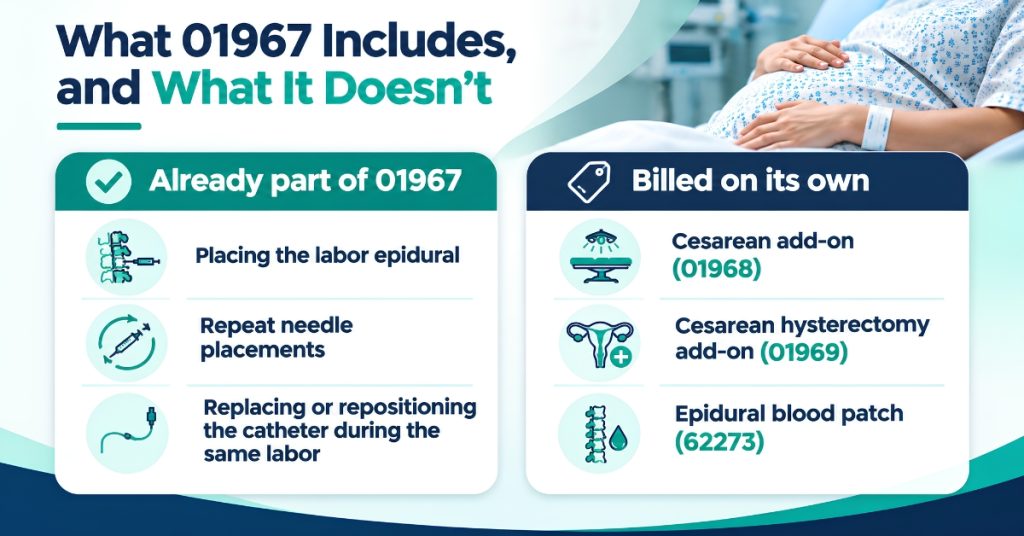
Start with scope. An epidural, a spinal and a combined spinal-epidural all fall under 01967, provided a vaginal delivery is what everyone’s planning for. That’s the core of neuraxial labor analgesia billing. And if the provider has to re-stick the patient or swap the catheter halfway through labor? Still 01967. Nothing extra to bill. The table sums it up:
| Item | Detail |
| What it covers | Epidural, spinal or combined spinal-epidural for labor, with a planned vaginal delivery |
| Base units | 5 |
| Time | Starts when the provider begins preparing the patient; end rules vary by payer |
| Add-on codes | 01968 (cesarean after labor epidural, 2 base units) and 01969 (cesarean hysterectomy after labor epidural, 5 base units) |
| Billed with | Care team modifier (AA, QK, QY, QX or QZ) and physical status modifier |
The OB anesthesia codes and when to use each
There are six codes to know for OB anesthesia billing. Picking the right one mostly comes down to a single question: did the patient have a labor epidural before anything else happened? When the answer is yes, a cesarean or hysterectomy rides on top of 01967 as an add-on. When it’s no, the delivery gets a standalone code.
| Code | Use it when | Base units |
| 01960 | Anesthesia for vaginal delivery only, with no labor epidural before | 5 |
| 01961 | Cesarean delivery only, such as a scheduled cesarean with a spinal | 7 |
| 01962 | Urgent hysterectomy after delivery | 8 |
| 01967 | Labor epidural for a planned vaginal delivery | 5 |
| 01968 | Add-on to 01967 when the patient goes on to a cesarean | 2 |
| 01969 | Add-on to 01967 when the patient goes on to a cesarean hysterectomy | 5 |
01968 and 01969 can’t stand alone. They only ever appear beside 01967. What about a cesarean that was always the plan, with no labor epidural beforehand? That one’s 01961, the standalone code for cesarean anesthesia. Coding it as 01967 plus 01968 instead happens more than you’d think, and it’s an easy catch for any payer.
How payers count labor epidural time
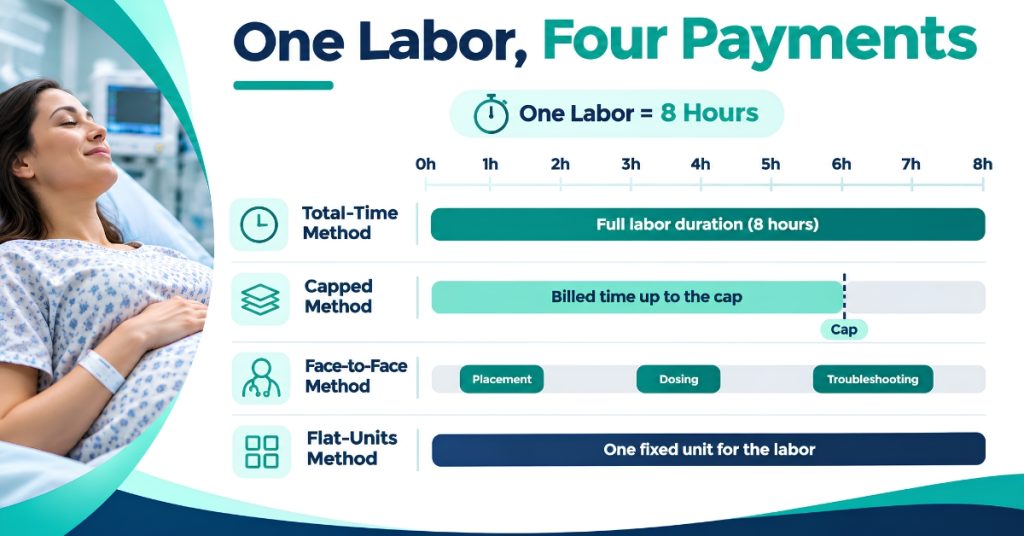
A labor can last six hours or twenty, and payers aren’t keen to pay for every minute of it. So each one sets its own rule, and labor epidural billing changes depending on which rule applies. Before you work out labor epidural time units on any claim, find out which of these four methods the payer uses:
- Total time: Base units plus every minute from start to finish. It’s the best deal for the group, and the least common.
- Total time with a cap: Every minute counts until you hit the payer’s ceiling, often a set number of time units.
- Face-to-face time: Only the minutes the provider spends at the bedside, for things like placement, dosing and troubleshooting.
- Flat units: One fixed number of units per epidural, whether labor takes three hours or thirty.
Mixing the methods up costs money either way. Send a full-time claim to a face-to-face payer, and it’ll be cut back or denied outright. Send bedside minutes to a payer that would have paid every minute, and nobody complains, because the claim pays. You just never see the money you missed. That’s why the payer’s rule has to be checked first.
When does labor epidural time start and stop?
The clock starts as soon as the anesthesia provider begins getting the patient ready for the epidural, so before the catheter is placed. When it stops is less clear-cut. According to the American Society of Anesthesiologists, a lot of groups stop the clock one hour after an uncomplicated vaginal delivery. Whatever rule your group settles on, use actual times from the record and apply it the same way on every chart.
When a labor epidural turns into a cesarean
When a patient with a labor epidural goes to the OR for a cesarean, 01967 stays on the claim for the labor, and the 01968 add-on code covers the surgery. A hysterectomy on top? Swap 01968 for 01969. Time on the add-on is counted like any surgical case, as continuous face-to-face time. Then check four things:
- The reason for the switch is in the chart (failure to progress, fetal distress, or whatever it was).
- Write down when the cesarean anesthesia started. Many payers pay that time separately, on the add-on code.
- For an emergency cesarean, add qualifying circumstance 99140 for any payer that pays it.
- Choose the physical status modifier from the mother’s condition. The baby’s doesn’t count.
Other OB billing rules that matter
Then there are the smaller obstetric anesthesia billing rules. On their own, none of them is hard. The trouble is volume. On a busy labor and delivery unit, one small slip gets repeated claim after claim, sometimes for months, before anybody catches it. These are the four worth pinning to the wall:
- A catheter that’s replaced or repositioned during the same labor is still one 01967, not two.
- An epidural blood patch for a post-dural puncture headache is its own service, billed with CPT 62273.
- Medicare doesn’t count placing a labor epidural, or checking on a laboring patient now and then, as a break in medical direction of other rooms. Write it down anyway, so an auditor doesn’t read it as a lapse.
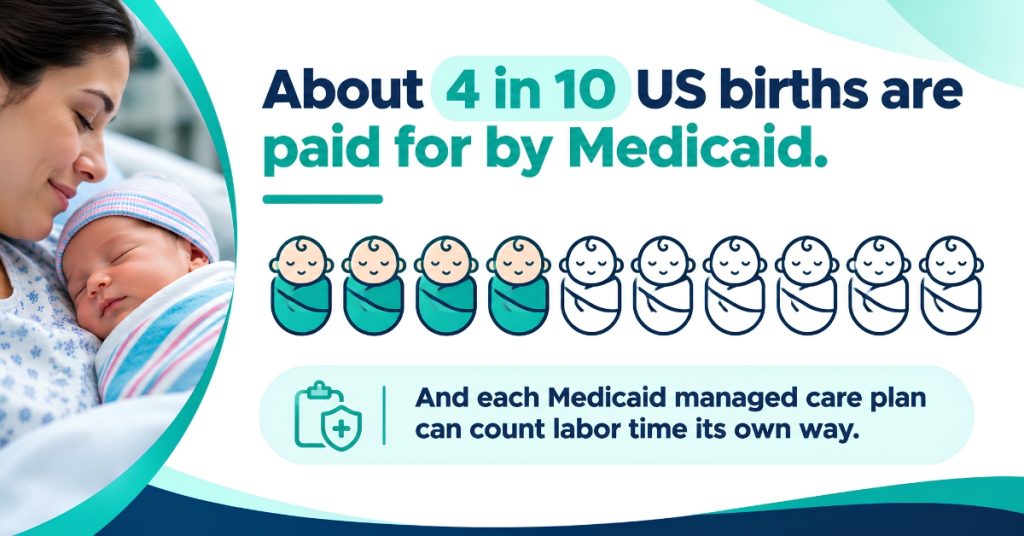
- Medicaid pays for about 4 in 10 US births, so it’s a big part of most OB books, and it often pays OB anesthesia at a flat rate. Each Medicaid managed care plan may also have its own time rule.
Common 01967 billing errors
When 01967 billing goes wrong, it’s nearly always one of five things. None of them is hard to find once you know where to look. Pull a month of OB claims, go down this list, and you’ll know fairly quickly whether your group has a problem. The first one on the list is the most common:
- 01968 billed on its own, or 01967 plus 01968 used for a scheduled cesarean
- Total time sent to a face-to-face payer, or face time sent to a total-time payer
- A missing start time, or an end time that doesn’t line up with the delivery note
- Physical status picked from the baby’s condition rather than the mother’s
- No care team modifiers when a CRNA runs the epidural under medical direction
OB coverage, stipends and out-of-network epidurals
Somebody has to be on the labor floor around the clock, even on a night with a single delivery. Add a heavy Medicaid mix and capped time, and OB collections often fall short of what in-house coverage costs. That gap is the argument for an OB anesthesia stipend. We work out what your unit really collects, payer by payer, and build the number from your own claims.
Out of network at an in-network hospital? Then your labor epidurals are covered by the No Surprises Act, and the patient can’t be balance billed. That doesn’t mean you’re stuck with a low payment. Underpayments, and denials of payment on covered services, can go to open negotiation and then independent dispute resolution. Our independent dispute resolution services page explains how.
Get your OB anesthesia billing reviewed
We’ll look at your OB claims the way a payer’s auditor would: code choice, the time method for each payer, add-on codes and modifiers. Then we’ll show you what each case should have paid. Across our clients, net collections run at 98.8% and the denial rate is 1.12%. The OB anesthesia billing review costs nothing.
About Vigilant Medical Billing & Coding Services
Vigilant Medical Billing & Coding Services is an anesthesia and physician revenue cycle management company headquartered in Mesquite, Texas. Its services include:
- Billing and coding for anesthesia groups
- Credentialing for anesthesiologists and CRNAs, and for certified anesthesiologist assistants (CAAs) in states that allow them
- Coverage planning and stipend numbers for hospitals and surgery centers
- No Surprises Act open negotiation and independent dispute resolution
The company’s leadership has worked in anesthesia revenue cycle management since 2016. Across its clients, net collections run at 98.8% and the denial rate is 1.12%. The company wins 88% of IDR disputes, and credentialing typically takes 4 to 6 weeks.
Frequently asked questions
What is CPT code 01967?
Short version: it’s the labor epidural code. More precisely, 01967 covers neuraxial labor analgesia or anesthesia for a planned vaginal delivery, which can mean an epidural, a spinal or a combined spinal-epidural. It’s worth 5 base units, and re-sticks or catheter swaps during the same labor are already included, so you don’t bill them separately.
How many base units is 01967?
Five base units. Time is where it gets complicated. Depending on the payer, you might be paid for the whole labor, for the whole labor up to a cap, for bedside time only, or a flat number of units however long it ran. There’s no national standard, so look up each payer’s rule before you build the claim.
When do you use 01968?
Use 01968 when a patient who had a labor epidural ends up having a cesarean. It’s an add-on, so it always goes with 01967 and is never billed by itself. It carries 2 base units. The cesarean time is reported on 01968 and counted as continuous face-to-face time, the same way you’d count time for any surgery.
What is the difference between 01961 and 01968?
It comes down to whether a labor epidural came first. 01961 is for a cesarean with no epidural beforehand, like a scheduled cesarean done under a spinal. 01968 only works as an add-on to 01967, when a labor epidural turns into a cesarean. Billing 01967 plus 01968 for a planned cesarean is a common slip, and payers usually catch it.
Can you bill a second 01967 if the epidural is replaced?
No. Swapping or adjusting the catheter during the same labor is already part of the first 01967, so there’s nothing extra to bill. Repeat needle placements work the same way. An epidural blood patch for a post-dural puncture headache is a different story. That’s a separate procedure, and it’s billed with CPT 62273.
Sources
- CMS, anesthesia base units by CPT code: https://www.cms.gov/anesthesiologists-information-center
- CMS Medicare Claims Processing Manual, Chapter 12, Section 50 (anesthesia services): https://www.cms.gov/regulations-and-guidance/guidance/manuals/downloads/clm104c12.pdf
- American Society of Anesthesiologists, billing and coding for labor analgesia: https://www.asahq.org/quality-and-practice-management/managing-your-practice/timely-topics-in-payment-and-practice-management/billing-and-coding-for-labor-analgesia