
Anesthesia billing follows different rules from almost every other specialty. There’s no fixed fee per CPT code. What you get paid comes down to units: some for the work, some for the time. In these anesthesia billing guidelines, we start with the formula and the three kinds of units, then move on to conversion factors and payer mix, four worked examples you can compare your own claims against, and the modifiers that shift payment.
Key takeaways
- Anesthesia payment = (base units + time units + modifying units) x conversion factor.
- Base units come from the ASA Relative Value Guide. Time units are usually one per 15 minutes of documented anesthesia time.
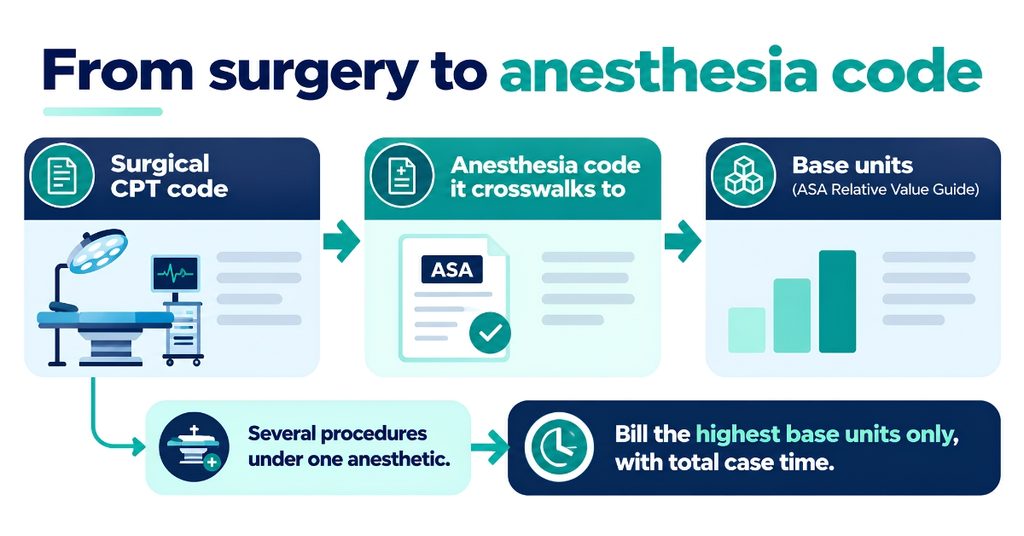
- Only one anesthesia code is billed per anesthetic: the one with the highest base units, with total case time.
- The conversion factor in each payer contract is the biggest lever on revenue, so track average paid per unit by payer.
- Medicare doesn’t pay physical status or qualifying circumstance units, but many commercial payers do.
The anesthesia billing formula
If you want to understand how anesthesia billing works, start here. Medicare and most commercial payers calculate anesthesia payment as (base units + time units + modifying units) x conversion factor. Every part follows its own rules. Get one wrong, and the error carries straight into what you’re paid. Here’s a quick rundown of each:
- Base units: Anesthesia base units are set by the Relative Value Guide from the American Society of Anesthesiologists (ASA). The more complex the anesthesia code, the more base units it carries.
- Time units: Most payers count one unit for every 15 minutes of anesthesia time, and many accept partial units too.
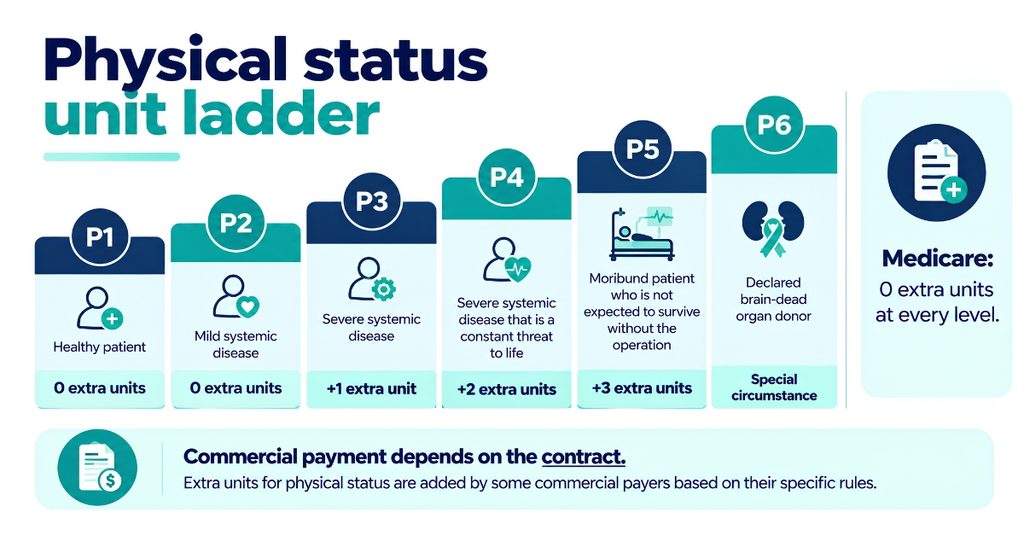
- Modifying units: Extra units some payers add for physical status (P3 to P5) and qualifying circumstances. Medicare doesn’t pay them.
- Conversion factor: The dollar value of one unit, set by each payer contract.
How anesthesia time is counted
Anesthesia time starts when the anesthesia provider begins preparing the patient for anesthesia in the operating room or an equivalent area. It ends when the provider is no longer in personal attendance and the patient is safely placed under postoperative care. Both points have to be recorded as actual start and stop times, never as estimates.
Medicare divides the total minutes by 15 to get anesthesia time units. Many commercial payers do the same, while some round to the nearest whole unit instead. A 52-minute case, for example, comes to 3.5 units under Medicare’s method. Our guide to anesthesia time units covers the differences between payers in more detail.
Choosing the anesthesia code
An anesthesia CPT code (00100 to 01999) tells the payer which part of the body was involved and what kind of procedure it was, without naming the surgery. Standard anesthesia coding guidelines have the coder crosswalk the surgical CPT code to its anesthesia code, then look up the base units in the ASA Relative Value Guide. When several procedures happen under one anesthetic, only the code with the highest base units is billed.
| Anesthesia code | Typical procedure | Base units |
| 00600 | Cervical spine procedures | 10 |
| 00630 | Lumbar spine procedures | 8 |
| 00670 | Extensive spine procedures, including instrumentation | 13 |
| 01991 | Diagnostic or therapeutic nerve blocks and injections (other than prone) | 3 |
| 01992 | Nerve blocks and injections in the prone position | 5 |
These five codes are only a sample. Our list of commonly used CPT codes for anesthesia covers many more, along with their base units. Whichever code you land on, it carries the time for the entire case. A sloppy time record can cost you as much as picking the wrong code.
Conversion factors and payer mix
The conversion factor is set by each payer contract, and it’s the biggest lever on what your group collects. The anesthesia conversion factor can differ widely from one payer to the next, so the same 25-unit case can pay very different amounts. That’s why we track average paid per unit for every payer, every month.
Payer mix matters just as much. It’s the share of your volume that comes from commercial plans, Medicare, Medicare Advantage, Medicaid, workers’ compensation and out-of-network claims. Health plans now publish what they pay other anesthesia groups in your market, so you can see whether each of your contracts sits below market, and by roughly how much.
Worked examples
Below are four anesthesia billing examples built on real codes and the formula from earlier. We’ve laid out the units one line at a time, so the math is easy to follow and to compare with your own claims. Swap in your contracted conversion factor to see what each case should pay with each of your payers, then compare it with what was actually paid.
Example 1: Lumbar fusion, anesthesiologist personally performed
- Anesthesia code 00670: 13 base units
- Anesthesia time 180 minutes: 12 time units
- Total: 25 units x your contracted conversion factor, billed with modifier AA
Example 2: Same case, medically directed CRNA
- Same 25 units and the same allowed amount
- Anesthesiologist bills QY or QK and is paid 50%, the equivalent of 12.5 units
- CRNA bills QX and is paid 50%, the equivalent of 12.5 units
Example 3: Prone lumbar injection under MAC
- Anesthesia code 01992: 5 base units
- Anesthesia time 30 minutes: 2 time units
- Total: 7 units x your contracted conversion factor, with the care team modifier plus QS for MAC
Example 4: Commercial claim with physical status
- Lumbar fusion (00670): 13 base units plus 12 time units
- Patient classified P3: many commercial payers add 1 unit
- Total: 26 units x the contracted commercial conversion factor
Modifiers that change anesthesia payment
Care team modifiers decide who gets paid and how much. AA is for personally performed cases, QK and QY for medical direction, and QX for a medically directed CRNA or anesthesiologist assistant. A CRNA working without medical direction bills QZ, and AD covers medical supervision of more than four cases. Our full guide to anesthesia modifiers explains each one.
CMS anesthesia billing rules to know
Most CMS anesthesia billing guidelines come down to a handful of rules. Many commercial payers follow them too, so they’re worth knowing even if most of your volume isn’t Medicare. Miss one, and a claim can be denied or downgraded on audit. Here are the five you’ll run into most:
- For medical direction, the anesthesiologist has to meet all seven Medicare requirements on every case. Being present at induction and emergence is part of that.
- An anesthesiologist can medically direct no more than four concurrent cases.
- Medicare doesn’t pay physical status modifiers or qualifying circumstance codes.
- Only one anesthesia code is billed per anesthetic, using the highest base units.
- Anesthesia time must be documented with actual start and stop times.
Out-of-network anesthesia claims
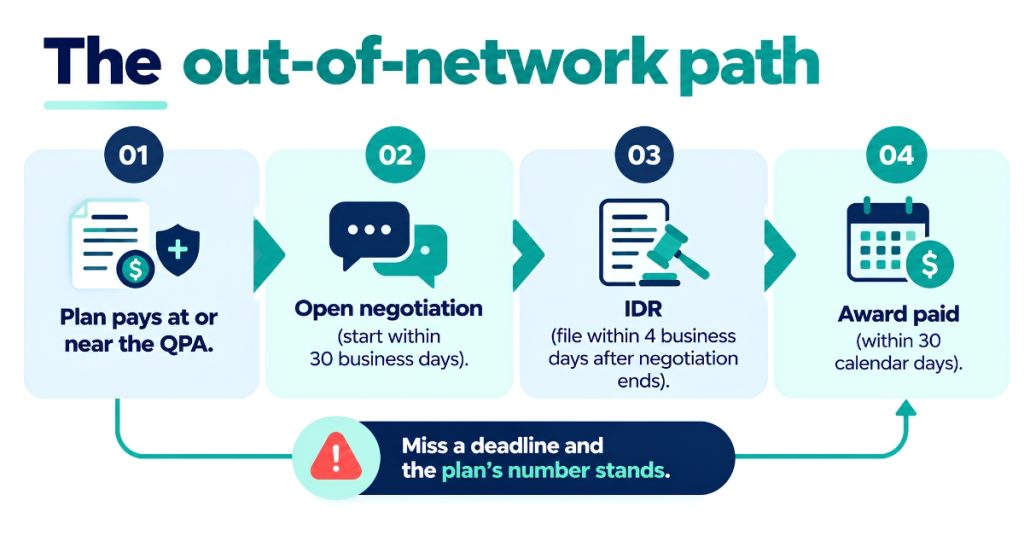
When an anesthesia group is out of network at an in-network facility, the No Surprises Act applies. The group can’t balance bill the patient, and the plan often pays at or near its qualifying payment amount (QPA). Groups can challenge those payments, along with denials of payment on covered services, through open negotiation and independent dispute resolution.
Need your anesthesia billing checked?
Vigilant Billing audits anesthesia claims for groups in Nevada, Arizona and Texas. We check units, time, modifiers and out-of-network payments against what each case should have paid, then show you where the gaps are. If you’d like a second opinion on your billing for anesthesia services, start with a free audit or see our anesthesia billing services.
About Vigilant Medical Billing & Coding Services
Vigilant Medical Billing & Coding Services is an anesthesia and physician revenue cycle management company headquartered in Mesquite, Texas. Its services include:
- Billing and coding for anesthesia groups
- Credentialing for anesthesiologists and CRNAs, and for certified anesthesiologist assistants (CAAs) in states that allow them
- Coverage planning and stipend numbers for hospitals and surgery centers
- No Surprises Act open negotiation and independent dispute resolution
The company’s leadership has worked in anesthesia revenue cycle management since 2016. Across its clients, net collections run at 98.8% and the denial rate is 1.12%. The company wins 88% of IDR disputes, and credentialing typically takes 4 to 6 weeks.
Frequently asked questions
How is anesthesia billing calculated?
Add the base units, time units and any modifying units, then multiply the total by the payer’s conversion factor. Base units come from the ASA Relative Value Guide for each anesthesia code. Time is usually counted at one unit per 15 minutes. Modifying units for physical status and qualifying circumstances only apply with payers that pay for them.
How are anesthesia time units calculated?
Take the total anesthesia minutes and divide by 15. The clock starts once the provider begins getting the patient ready for anesthesia, and it stops when the patient is safely in postoperative care. Medicare keeps partial units, which turns 52 minutes into 3.5 units. Some commercial payers round to the nearest whole unit instead, which would make it 3.
How do I know if my anesthesia conversion factor is too low?
Compare your average paid per unit for each commercial payer with what that payer pays other anesthesia groups in your market. The federal Transparency in Coverage rule makes health plans post those negotiated rates, so you can compare one payer at a time. A rate near the bottom of the range usually means there’s room to ask for more.
Can you bill multiple anesthesia codes for one surgery?
Generally, no. If a patient has several procedures under the same anesthetic, you bill one anesthesia code, the one with the most base units, and attach the full case time to it. The exception is anesthesia add-on codes, such as 01968 billed with 01967 when a labor epidural becomes a cesarean. Adding a second primary anesthesia code for that anesthetic is an easy mistake to make, and it tends to end in a denial or, later on, a recoupment.
Does Medicare pay for anesthesia physical status modifiers?
No. Medicare doesn’t pay extra units for physical status modifiers P1 to P6, or for qualifying circumstance codes. Many commercial and workers’ compensation payers do, though, so they should still be reported on every claim. Under the ASA Relative Value Guide, P3 adds 1 unit, P4 adds 2 units and P5 adds 3 units.
Sources
- CMS Medicare Claims Processing Manual, Chapter 12, Section 50 (anesthesia services): https://www.cms.gov/regulations-and-guidance/guidance/manuals/downloads/clm104c12.pdf
- 42 CFR 414.46, additional rules for payment of anesthesia services: https://www.ecfr.gov/current/title-42/section-414.46
- CMS, Transparency in Coverage (price transparency data): https://www.cms.gov/priorities/key-initiatives/healthplan-price-transparency
- American Society of Anesthesiologists, Relative Value Guide (asahq.org) [add the exact page link]