
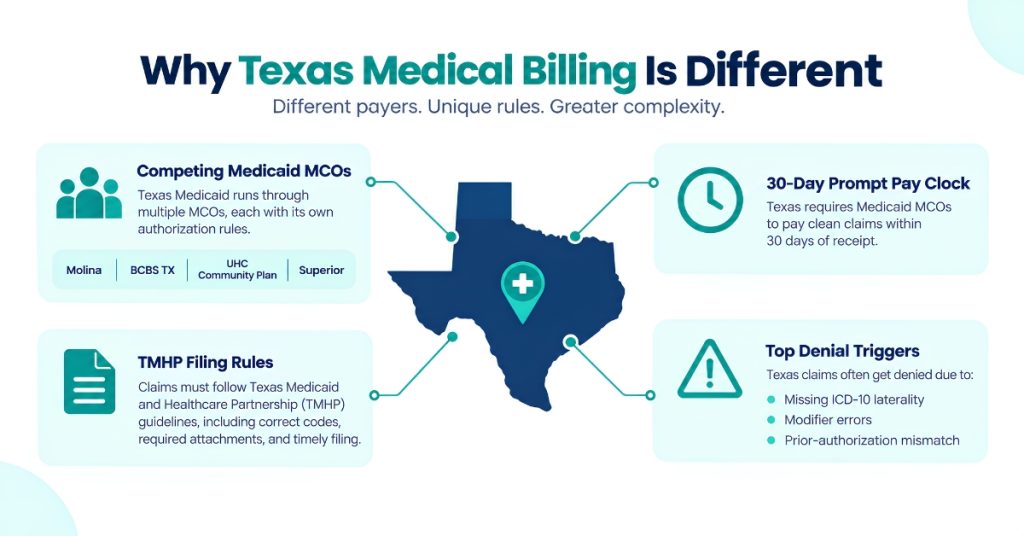
Medical billing companies in Texas manage the full claim cycle, from insurance verification to final payment. Texas Medicaid is delivered through multiple competing managed care organizations (MCOs), each with different prior authorization processes and denial trends. Texas also has a prompt-pay law that requires state-regulated insurers to pay clean electronic claims within 30 days of receipt, which rewards practices that get claims right the first time.
In 2024, the national initial claim denial rate hit 11.81%, with Medicare Advantage denials increasing by 55.7% from 2022 to 2023. This blog contains a list of the best medical billing and coding companies for Texas practices in 2026, ranked by specialty coverage, EHR compatibility, pricing options, and Texas payer experience.
How to Find the Best Texas Medical Billing Company
Not every medical billing service company understands Texas-specific payer behavior. Evaluate each company on the following:
Clean claim rate: This is the percentage of claims accepted on first submission without errors; strong Texas vendors report 95% or higher.
Texas Medicaid / TMHP familiarity: Ask whether the vendor actively tracks Texas Medicaid & Healthcare Partnership (TMHP) claim rules, timely-filing deadlines, and MCO authorization requirements, or just handles Medicaid generically.
Specialty billing depth: Orthopedics, interventional pain management, and cardiology carry some of the highest prior-authorization denial rates in Texas. General claims experience is not a substitute for specialty-specific coding knowledge here.
EHR/EMR compatibility: Ask whether the vendor works inside your existing system, such as Epic, Tebra (formerly Kareo), athenahealth, or eClinicalWorks, or will ask you to switch platforms.
Pricing transparency: Percentage-of-collections, flat monthly fee, per-claim charge, and hybrid models each shift risk differently between your practice and the vendor.
Denial management process: How does the company actually handle CARC/RARC code review, appeals, and payer follow-up timelines day-to-day?
Common Pricing Models Among Texas Medical Billing Companies
| Pricing Model | How It Works | Best Fit |
| Percentage of Collections | Vendor charges a % of what is actually collected, aligning incentives with practice revenue | Practices wanting shared risk and results-based billing |
| Flat Monthly Fee | Fixed fee regardless of claim volume or collections | High-volume practices with predictable claim counts |
| Per-Claim Charge | Fee charged per claim submitted | Smaller practices with lower, variable volume |
| Hybrid Model | Combination of a base fee plus a smaller percentage of collections | Multi-specialty or multi-location groups |
Most Texas RCM vendors, including Vigilant Medical Billing, offer percentage-based, flat-monthly, or hybrid pricing depending on practice volume and specialty mix, with quotes issued after a review of claim volume and payer mix rather than a flat published rate.
The 10 Best Medical Billing Companies in Texas
1. Vigilant Medical Billing
1. Vigilant Medical Billing
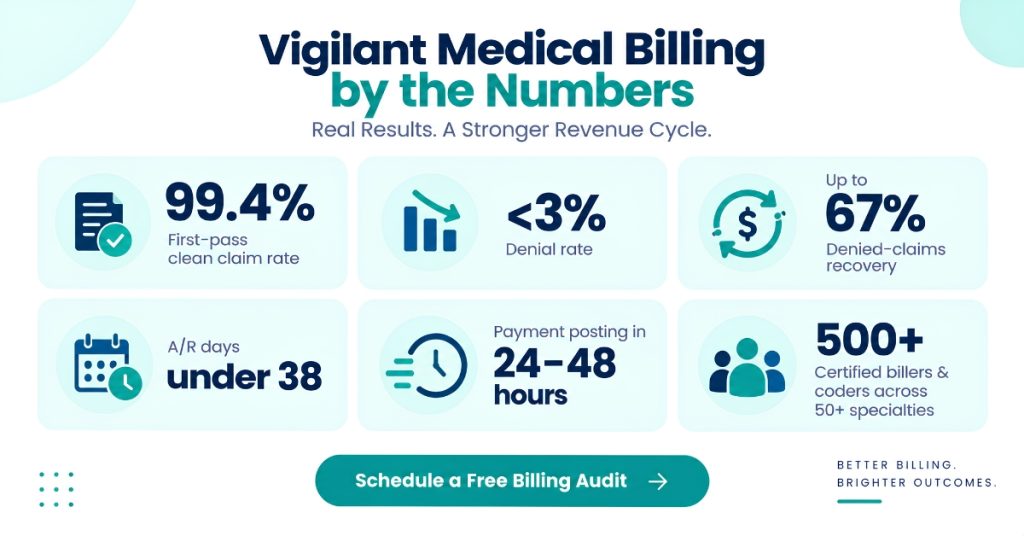
Vigilant Medical Billing has its headquarters in Mesquite, Texas, and serves practices in all 50 states using a Texas-built RCM strategy. Vigilant reports a 99.4% first-pass clean claim rate and recovers up to 67% of denied claims through resubmission, depending on the payer. Its specialty-trained, certified billers and coders include CPB-certified billers and RHIA-credentialed compliance staff, and the company is trusted by 500+ providers. It covers 40+ specialties, including cardiology, behavioral health, oncology, orthopedics, dermatology, and physical therapy.
Unlike generalist vendors, Vigilant Medical Billing checks every claim against Texas Department of Insurance (TDI), TMHP, and Medicaid MCO authorization rules, as well as Texas prompt-pay timelines, before submission. The company works inside a practice’s existing EHR or PM system rather than requiring a platform migration, and reports A/R days under 38 and payment posting within 24–48 hours of ERA receipt.
Pricing for Vigilant Medical Billing RCM solutions varies by specialty and claim volume, with percentage-based, flat-monthly, and hybrid pricing options available. In addition, Vigilant provides provider credentialing, denial management, medical coding (ICD-10, CPT, HCPCS), and Texas-specific compliance for Medicare, Medicaid managed care, commercial (BCBS), workers’ compensation, and personal injury/lien-based billing.
2. Transcure
Transcure, a Dallas-based company, established one of the bigger billing teams in the state with over 1,100 AAPC-certified billers and coders. The company relies heavily on AI claims automation and highlights its first-pass accuracy on Texas claims, along with its compliance with the federal No Surprises Act. It’s also one of the more independently referenced vendors in this space, showing up in GoodFirms listings and Becker’s Healthcare coverage rather than only in its own marketing. If you want an established, tech-forward vendor with two decades behind it, this can be a reasonable starting point for multi-specialty practices.
3. Plutus Health
What sets Plutus Health apart isn’t headcount, though at 1,600+ employees and 15 years in Dallas it has plenty of that too. It’s Zeus, the company’s proprietary automation platform. More than 70 robotic process automation bots run across coding, denial management, and prior authorization. That matters given how much prior-auth friction Texas MCOs create for specialty claims. It’s why larger practices or health systems tend to be the better fit here, not solo providers.
4. Medical Billers and Coders (MBC)
MBC’s reputation in Texas rests on Peer-to-Peer review experience for medical necessity appeals. It’s a niche skill. But it’s a crucial one for orthopedics, interventional pain management, and cardiology, where prior-authorization denial rates run highest in the state. The company is also frequently cited for its compliance infrastructure across Texas’s fragmented Medicaid managed care landscape. It’s worth a look if your practice fights frequent medical-necessity denials that need formal appeal support.
5. CareRCM
Behavioral health billing has its own set of headaches: time-based CPT codes, psychiatric documentation requirements, authorization rules that don’t map cleanly onto general medicine. CareRCM built its entire model around that niche, covering behavioral health, mental health, and ABA therapy billing with dedicated account managers and real-time reporting. The company reports denial rates below the industry average. It’s worth prioritizing if that’s your specialty.
6. iSolve RCM
Most vendors on this list serve Texas broadly. iSolve RCM is rooted specifically in the Temple, Waco, and Killeen corridor of Central Texas, though it also covers Houston, Dallas, San Antonio, and Austin. Its standout feature is free EHR/EMR integration at onboarding. Coverage spans solo physicians through hospitals and ambulatory surgical centers, so Central Texas practices or anyone wanting bundled integration support get the most out of it.
7. MediCommerce
This company pairs full-cycle RCM and medical coding with healthcare staffing and credentialing & contracting under a single vendor relationship, useful for practices that don’t want three separate contracts for three related problems. Its client base runs from independent providers and medical groups to ASCs, home health agencies, radiology practices, and rural hospitals. Practices consolidating billing, staffing, and credentialing under one roof are the natural fit.
8. R1 RCM
R1 RCM is an enterprise-scale RCM company and a widely recognized national brand, built for hospitals, health systems, and large physician organizations. It’s a better fit for large Texas health systems than for small or solo practices.
9. GeBBS Healthcare Solutions
GeBBS is a nationally recognized RCM company with documented Texas Medicaid MCO billing experience, which few vendors state outright. It offers coding, billing, and audit services at scale through an offshore coding model, making it best suited to large groups and hospital-based organizations rather than small practices.
10. Swift Medical Billing
Swift Medical Billing offers straightforward, full-cycle RCM with detailed reporting and support for platforms including athenahealth, Tebra (formerly Kareo), eClinicalWorks, and NextGen. Before recommending a service tier, the company analyzes your existing workflow to find where claims are losing revenue.
Medical Billing Services vs. Medical Coding Services in Texas
Medical Billing Services vs. Medical Coding Services in Texas
Medical billing services and medical coding services are related but distinct functions, and Texas practices often need both under a single RCM relationship:
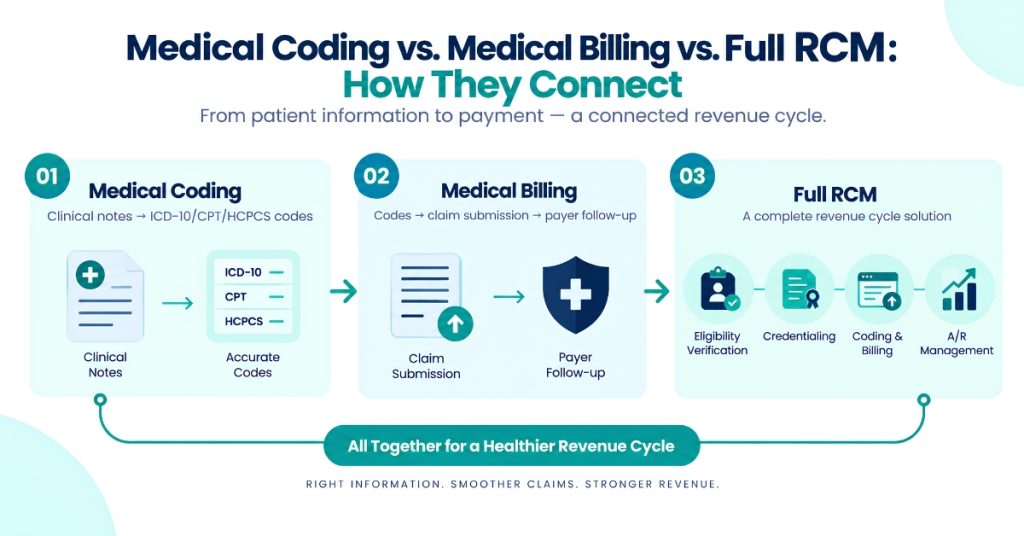
Medical coding services translate clinical documentation into ICD-10, CPT, and HCPCS codes. Accuracy here determines whether a claim will pass payer edits at all. Missing laterality or acuity details on ICD-10 codes is a leading cause of Texas MCO denials.
Medical billing services take those codes and manage the claim lifecycle: submission, payer follow-up, denial resolution, and payment posting.
RCM services are the umbrella term covering both functions plus eligibility verification, credentialing, and AR management. This is how most full-service vendors, including Vigilant Medical Billing services, structure their offering.
| Service Type | Core Function | Typical Standalone Use Case |
| Medical Coding Services | Converts clinical notes into billable codes | Practices with in-house billing staff needing coding support only |
| Medical Billing Services | Manages claim submission and payer follow-up | Practices with certified coders but no dedicated billing team |
| Full RCM Services | Combines coding, billing, credentialing, and AR management | Practices wanting one vendor accountable for the entire revenue cycle |
How to Choose the Best Medical Billing Company in Texas
Rather than comparing marketing pages, ask each vendor directly about:
- Clean claim rate and how it’s measured (first-pass vs. post-correction)
- Specialty billing experience specific to your practice type, not general claims volume
- Whether they run custom revenue cycle audits before onboarding, the way Vigilant Medical Billing does through its free practice billing audit process
- Handling of Texas-specific requirements, such as TMHP timely-filing rules, MCO authorization matching, and TDI prompt-pay compliance
Texas providers should also check any vendor’s compliance claims against primary sources. The Texas Medical Board maintains provider and practice compliance information, and TMHP publishes current Texas Medicaid billing and claims-filing requirements that any credible Texas billing vendor should reference directly rather than paraphrase secondhand.
Frequently Asked Questions about Medical Billing Companies in Texas
How much does a Texas medical billing company cost?
It depends on the pricing model. Common options are flat monthly fees, a percentage of collections (usually 4–9%, depending on specialty and volume), per-claim charges, and hybrid structures that combine a flat fee with a percentage. Because complexity and payer mix vary, most vendors, including Vigilant Medical Billing, quote after reviewing your practice’s actual data rather than publishing a flat rate.
What is the difference between medical billing and medical coding companies?
Coding and billing are actually two aspects of the same process. Clinical documentation is converted to ICD-10, CPT, and HCPCS codes by coding companies, and everything else is handled downstream by billing companies, including submission, follow-up, denial resolution, and payment posting. Today, most Texas vendors provide them both as a single RCM services contract, instead of having them as separate contracts.
Which medical billing companies work with TMHP and Medicaid MCOs in Texas?
On this list, Vigilant Medical Billing, MBC, GeBBS, and CareRCM all explicitly manage Texas Medicaid, Medicaid managed care, and MCO-specific authorization rules. That said, don’t take MCO experience for granted with any vendor. Texas Medicaid managed care runs through multiple competing organizations, each with its own authorization workflow, so confirm directly rather than assume.
Are there any Texas medical billing companies that integrate with EHR systems, such as Epic, Tebra, and athenahealth?
Most vendors operate within your existing EHR/practice management system, and won’t require you to change systems. Integration varies: some vendors sync information in real time, while others depend on manual exports. Ask about your specific EHR rather than accepting a general yes.
What is a clean claim rate, and why does it matter in Texas?
It’s the percentage of claims a payer accepts on first submission, with no errors or missing information. In Texas specifically, this number has real teeth: the state’s prompt-pay law requires insurers to pay clean electronic claims within 30 days, so a higher clean claim rate translates directly into faster cash flow and fewer hours spent on resubmissions and appeals.