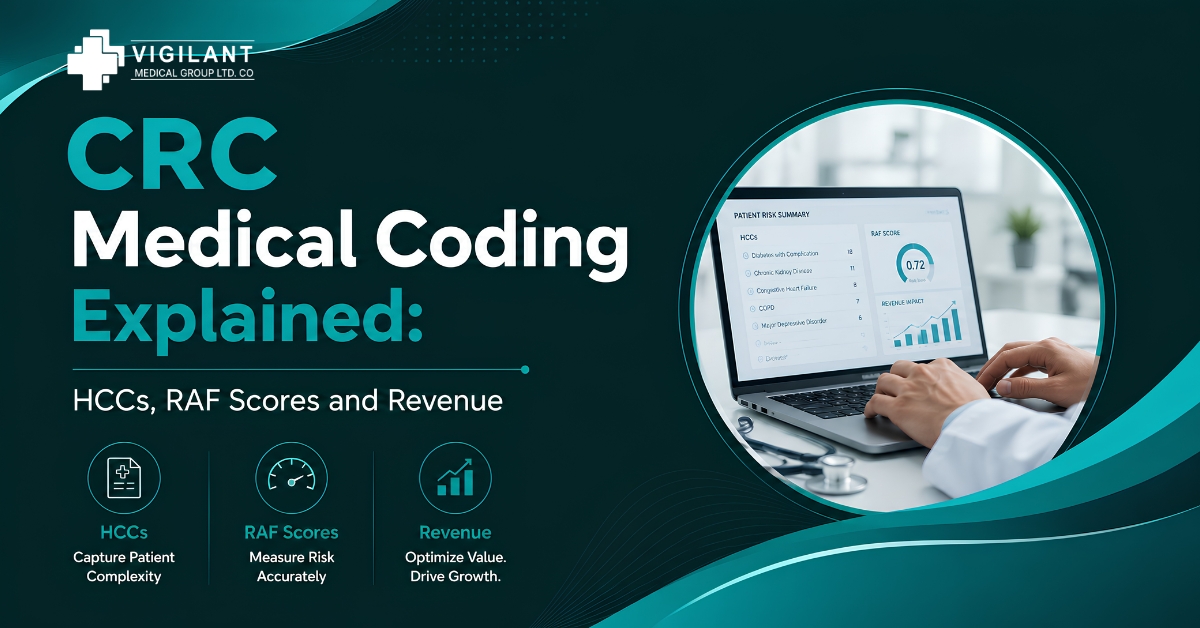
Ask most practice managers when they think about coding and the answer is usually the same. When a claim bounces. Fair enough. But there is a whole layer of coding that decides how much your practice earns before any claim goes out the door, and hardly anyone outside the medical billing world talks about it. It goes by the name risk adjustment coding, and the people trained to do it properly hold a credential called the CRC.
At Vigilant Medical Billing & Coding Services, we see the fallout constantly. Providers across Texas and beyond treating genuinely complicated patients, yet getting paid as if their panel were young and healthy. Not because the claims were wrong. Because the documentation never told the full story. So let us walk through what CRC medical coding actually means, how the whole system works, and why it deserves a permanent spot on your radar.
What Does CRC Mean in Medical Coding?
CRC stands for Certified Risk Adjustment Coder. The credential comes from the AAPC, the American Academy of Professional Coders, and it tells employers one specific thing: this coder knows risk adjustment inside and out.
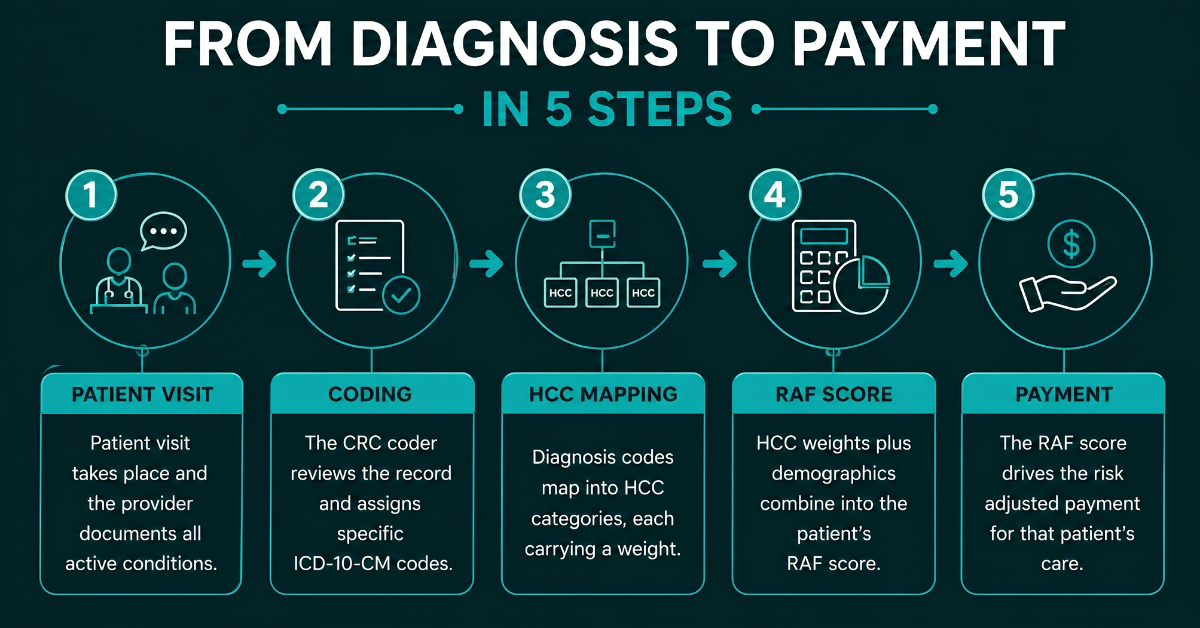
And what is risk adjustment medical coding? Picture a coder sitting with a patient’s full medical record. Their job is to pull out every condition that patient genuinely has, not just whatever brought them in that day, and translate all of it into precise ICD-10-CM diagnosis codes. Chronic illnesses. Complications. The diabetes and the kidney disease it caused. Everything documented, everything coded.
Why go to that trouble? Because health plans and government programs use those diagnosis codes to predict cost. A patient juggling five chronic conditions will need more care than a healthy thirty year old, so the plan covering that patient receives a larger payment. Payment should follow patient complexity.
This is the process behind Medicare Advantage, Medicaid managed care, and the ACA marketplace plans. Billions of dollars ride on these codes every single year. That is why an entire certification exists just for this corner of coding.
What Does a CRC Coder Actually Do?
The job goes well beyond picking codes off a list. On a typical day, a CRC coder might be:
- Reviewing charts: Combing through complete medical records, not just the visit note, hunting for documented chronic conditions that carry risk value.
- Coding diagnoses: Choosing ICD-10-CM codes at the highest specificity the record supports. A vague code often carries zero risk weight, so precision here is money.
- Validating documentation: Making sure the note actually backs up every code. No support in the record, no code on the claim. Full stop.
- Auditing: Going back over previously coded charts to catch missed conditions, or unsupported ones, before an auditor gets there first.
- Educating providers: Sitting with physicians and showing them what complete documentation looks like. Coders can only work with what providers write down.
CRC coders also train across the major risk adjustment models. CMS-HCC for Medicare Advantage. HHS-HCC for ACA marketplace plans. Rx-HCC for drug plans. Each one has its own categories, its own quirks, and its own payment math.
How Risk Adjustment Coding Works: HCCs and RAF Scores
HCC: Hierarchical Condition Categories
Thousands of ICD-10-CM codes map into a much smaller set of condition categories, grouped by how much they typically cost to manage. Diabetes with complications lands in one category. COPD in another. Each category carries a weight.
The hierarchical part matters more than people expect. Say a patient has both a mild and a severe form of the same condition in their record. Only the severe one counts. The model always pays on the most serious documented version and ignores the rest.
RAF: Risk Adjustment Factor
Every patient ends up with a RAF score. It blends demographics, things like age and gender, with the weights of every HCC documented for that patient during the year. A score of 1.0 means average. Above that, the patient is more complex than average and the payment rises to match. Below it, the opposite.
Now for the part that trips up practice after practice. The slate wipes clean every January. A condition coded last year contributes nothing this year unless someone documents and codes it again during a face to face visit. Your patient did not stop having heart failure on New Year’s Day. But if nobody recaptures that diagnosis, the payment model quietly assumes they did.
CRC vs CPC: What Is the Difference?
People ask this one constantly, so let us settle it.
The CPC, or Certified Professional Coder, is the credential most people picture when they hear medical coding. CPC coders work across CPT procedure codes, ICD-10-CM, and HCPCS. Their bread and butter is fee for service billing. What was done during the visit, and what should be charged for it.
The CRC runs narrower and deeper. Almost everything in it revolves around diagnosis coding, the risk adjustment models, documentation rules, and compliance. A CRC coder is rarely asking what procedure happened. Their question is different: does this record fully and honestly capture how sick this patient is?
Neither one beats the other. They cover different territory. A practice living on fee for service claims leans on CPC skills daily. A practice with a heavy Medicare Advantage panel, or one signing value based contracts, simply cannot function well without CRC level expertise somewhere in the chain.
Why CRC Level Coding Matters for Your Practice’s Revenue
For years, risk adjustment felt like the payer’s problem. Those days are gone. Value based care, capitation, shared savings arrangements, all of them tie your payments and benchmarks directly to how accurately your diagnosis coding reflects your patients.
Weak risk adjustment coding hurts from three directions at once:
- Undercoding drains revenue: Chronic conditions slip through undocumented, or get coded so vaguely they carry no weight. RAF scores land below the true patient burden and payments shrink to match. You end up treating complex patients on simple patient budgets.
- Overcoding costs even more: Any code without solid documentation behind it is an audit finding in waiting. CMS runs Risk Adjustment Data Validation audits, RADV for short, and unsupported codes can mean repayments, penalties, and a very uncomfortable year.
- Bad data distorts everything: RAF scores feed into quality metrics and cost benchmarks too. When your patients look healthier on paper than in your exam rooms, your outcomes look worse than they deserve to. The clinical care was fine. The data was not.
Common Risk Adjustment Coding Mistakes We See
Review enough charts and the same handful of problems shows up everywhere, in small clinics and large groups alike:
- Unspecified codes: Coding plain diabetes when the record clearly supports diabetes with chronic kidney disease. The vague code may carry little or no risk weight. The payment gap is real money.
- Missed annual recapture: Chronic conditions documented last year, then never touched again. The condition stayed. The revenue left.
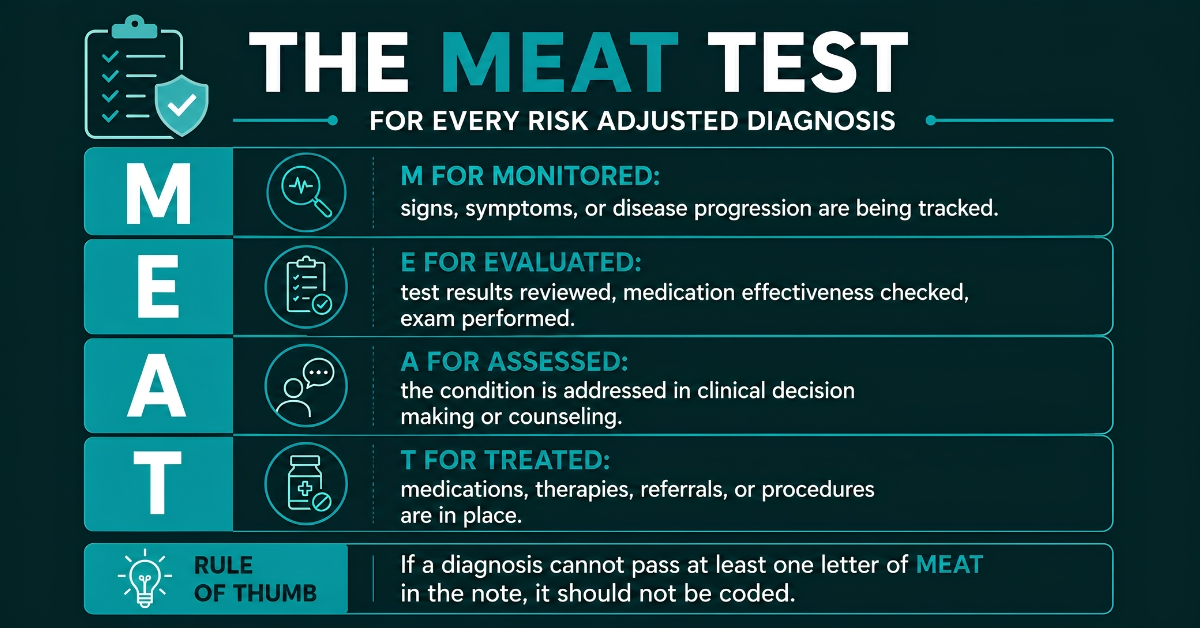
- Documentation that cannot back the code: A diagnosis sits in the code list but the note never shows it being monitored, evaluated, assessed, or treated. Auditors call this the MEAT standard, and codes that fail it do not survive review.
- Copy and paste problem lists: Problem lists dragged forward year after year without cleanup, so conditions resolved long ago keep getting coded. That is a compliance risk dressed up as convenience.
- Wrong skill set on the chart: Coders trained purely on fee for service claims applying that mindset to risk adjustment work, skipping conditions that have nothing to do with the visit reason. Different job, different eyes.
How Vigilant Medical Billing & Coding Services Handles Risk Adjustment
At Vigilant Medical Billing & Coding Services, risk adjustment is not something we bolt onto claims processing as an afterthought. Our coders check documentation for specificity, flag chronic conditions coming due for annual recapture, and validate every single diagnosis against the record before anything goes out. We also work with your providers directly, walking them through exactly what auditors look for, so the documentation improves at the source rather than getting patched downstream forever.
What you get is coding that holds up under a RADV audit and revenue that finally matches the complexity of the patients you actually treat. No inflation. No leakage. Just an honest record, coded properly.
If your practice serves Medicare Advantage patients or is heading into value based contracts, your diagnosis coding is already shaping your bottom line whether you watch it or not. Contact Vigilant Medical Billing & Coding Services today for a risk adjustment coding review and find out what your documentation is really worth.
Final Thoughts
CRC medical coding sits right where clinical documentation meets payment accuracy. It is detailed work, heavy on rules, and easy to underestimate until the money goes missing. Practices that take it seriously get fair payments, cleaner audits, and data they can actually trust when making decisions. And as risk based contracts keep spreading, the gap between practices that treat this as a core discipline and those that treat it as someone else’s problem will only widen.
Frequently Asked Questions
What is CRC in medical coding?
CRC stands for Certified Risk Adjustment Coder, a credential issued by the AAPC. It certifies expertise in reviewing medical records and assigning ICD-10-CM diagnosis codes for risk adjustment models such as CMS-HCC, HHS-HCC, and Rx-HCC.
What does a CRC coder do?
A CRC coder reviews patient charts, assigns specific diagnosis codes for chronic and complex conditions, confirms the documentation supports every code, audits previously coded records, and helps providers improve their documentation.
What is the difference between CPC and CRC certification?
The CPC is a general coding credential built around fee for service billing and covers CPT, ICD-10-CM, and HCPCS codes. The CRC is a specialty credential devoted entirely to diagnosis coding for risk adjustment and the payment models built on top of it.
What is an HCC in risk adjustment?
HCC stands for Hierarchical Condition Category. It is a grouping system that maps thousands of diagnosis codes into categories of similar clinical cost, and each category carries a weight that feeds a patient’s risk score.
What is a RAF score?
A Risk Adjustment Factor score reflects how complex a patient is expected to be to treat. It combines demographics with the weights of every documented HCC condition. A score of 1.0 is average, higher means more complex, and the score drives risk adjusted payments.
Do risk adjustment diagnoses need to be coded every year?
In most models, yes. Risk scores reset each calendar year, so chronic conditions have to be documented and coded again during a face to face encounter. Skip the recapture and the condition drops out of the patient’s risk profile, even though the patient still has it.
Is CRC certification worth it?
For coders, very much so. Risk adjustment is one of the fastest growing corners of medical coding, and credentialed risk adjustment coders are in demand with health plans, physician groups, and billing companies. For practices, having CRC level expertise on your side protects revenue and compliance in one move.