















Expert EMS Billing Services with 99% Billing Accuracy

Last year, EMS practices lost $541.5 million to documentation errors and medical-necessity failures. Do you want to be one of them this year? If not, trust our EMS billing services experts. We have EMS-trained billing and documentation experts to protect every dollar you earn.

99%

Claim Accuracy

Rated 4.8/5

They know EMS coding, medical necessity, & modifiers.

What Makes EMS Billing Different from General Medical Billing?

 EMS billing is about transport, medical necessity, and field documentation, not just diagnosis codes and routine claim submission like other specialties.
Here, every ambulance claim must connect the patient’s condition, level of service, pickup and destination, mileage, and payer rules in one complete billing record.

Why EMS billing needs a specialized workflow

General medical billing usually starts after a scheduled visit. EMS billing starts in the field, where urgent conditions, incomplete demographics, and real-time transport decisions shape reimbursement. That is why EMS providers need billing teams who understand ambulance documentation, compliance logic, and payer scrutiny, and not just general medical billing workflows.

586%

Increase in Traffic From Generative AI Sources

Thompson Tractor

Heavy Equipment | 1K – 5K | B2B

EMS-specific billing logic

One transport. Multiple billing checkpoints.

PCR narrative, mileage, modifiers, destination, & signatures must all align for a clean EMS claim.

EMS Billing Workflow

Medical Necessity | Transport Logic | Compliance

Get Complete Support with Our EMS Billing Services

In EMS, reimbursement is won or lost in the details behind the transport. The chart has to support not only what happened, but why the trip qualified, how it was coded, and how the payer reads it. Our EMS medical billing services are built to protect that chain from documentation to payment, so providers lose less revenue to preventable billing failure.

Our Services

Our Expertise

Our Expertise

Many EMS billing problems begin before the claim is even created. In ambulance billing, missing coverage details, inactive insurance, or the wrong primary payer can lead to denials that take weeks to fix. This is especially common when patient information is collected during urgent field encounters.
Our insurance verification process helps reduce those issues by confirming payer details early and checking the billing factors that matter most for EMS reimbursement.
We help your EMS team review:

  • Active insurance coverage on the date of transport
  • Primary, secondary, and crossover payer order
  • Medicare, Medicaid, and commercial plan details
  • Patient identifiers and demographic accuracy
  • Authorization or repetitive transport requirements
  • Coverage issues tied to destination or transport type

With stronger front-end verification, your EMS claims move forward with fewer avoidable delays and fewer eligibility-based denials.

Our Expertise

EMS coding is not routine charge entry. Every claim must reflect the actual level of service, loaded mileage, transport circumstances, and medical necessity supported in the PCR. If one of those details is missing or coded incorrectly, the claim may be underpaid, denied, or flagged for review.

Our EMS billing services specialists translate field documentation into accurate ambulance charges using a structured coding workflow built specifically for EMS providers.

We help your EMS team review:

  • Correct base rate for BLS, ALS, SCT, or specialty transport
  • Loaded mileage units and trip accuracy
  • Origin and destination modifiers
  • ICD-10 diagnosis linkage to the transport reason
  • Medical necessity support from the PCR narrative
  • Required signatures, PCS details, and supporting data

This process helps create claims that are technically sound, better supported, and easier for payers to process correctly.

Our Expertise

A claim should not go out just because the chart is complete. In EMS billing, the claim must also pass payer edits, match the transport record, and include all required billing elements before submission. Without that control step, errors move downstream and become denials, rejections, or lost time in AR.

Our claims submission workflow focuses on clean claim performance by reviewing each ambulance claim before it reaches the payer.

We help your EMS team review:

  • Claim data matched against PCR details
  • Date of service, pickup, and destination accuracy
  • Modifier, mileage, and charge consistency
  • Required claim fields and payer-specific edits
  • Supporting information for medical necessity
  • Submission routing for Medicare, Medicaid, & commercial plans

By catching issues before filing, we help reduce first-pass claim failures and improve reimbursement speed across your EMS revenue cycle.

Our Expertise

Denied ambulance claims are rarely random. Most denials point back to a root issue such as weak medical necessity wording, modifier errors, missing mileage support, or payer-specific claim logic. If those causes are not identified and corrected, the same denials continue month after month.

Our denial management process does more than resubmit claims. We investigate why the denial happened, correct the source issue, and build a stronger appeal or corrected claim strategy.

We help your EMS team review:

  • Medical necessity denials
  • Documentation and signature-related denials
  • Coding, modifier, and mileage denials
  • Underpayments and partial claim processing issues
  • CARC/RARC trends by payer
  • Appeal opportunities and denial pattern reporting

This gives your team a more disciplined recovery process and helps prevent recurring denial categories from draining revenue.

Our Expertise

Payment posting is where many EMS providers discover whether claims were paid correctly. If ERAs and EOBs are posted without close review, underpayments, incorrect adjustments, and missed patient balances can go unnoticed. Over time, that creates weak reporting and lost reimbursement opportunities.

Our payment posting workflow is designed to capture the full financial picture of each ambulance claim and flag issues that need follow-up.

We help your EMS team review:

  • ERA and EOB posting accuracy
  • Contractual adjustments and payer reductions
  • Underpaid or partially paid claims
  • Secondary billing opportunities
  • Patient responsibility and balance transfer logic
  • Reconciliation between posted payments and submitted charges

Accurate posting helps turn raw payment data into actionable revenue insight, so your EMS organization can respond faster and manage reimbursement with more confidence.

Our Expertise

In EMS billing, unpaid claims can age quickly if they are not worked in a structured way. Some claims need documentation review, some need appeals, and others need payer contact before filing limits expire. Without focused AR follow-up, old balances pile up, and revenue becomes harder to recover.

Our AR follow-up process prioritizes the claims most likely to impact cash flow and works them using payer-specific follow-up steps.

We help your EMS team review:

  • Aging claims by payer and balance age
  • Claims nearing timely filing deadlines
  • Unresolved denials and no-response claims
  • Claims needing corrected filing or rebilling
  • Payer status calls and escalation follow-up
  • Recoverable balances tied to underpayments 

This approach helps reduce aging AR, improve collections, and keep ambulance revenue from getting stuck in the back end of the billing cycle.

EMS Billing Expertise Across Every Level of Transport

Emergency Ambulance Transport

Emergency transport billing involves more than dispatch priority. The claim must support medical necessity, service level, and transport details with a clear match between the PCR, mileage, and destination data. We help providers bill urgent trips with stronger documentation-to-claim accuracy.

Non-Emergency Transport

Non-emergency claims often fail because of PCS gaps, repetitive transport rules, or weak support for mobility limits. We help build these claims around medical necessity, covered destination logic, and payer-specific documentation so valid transports are not lost to avoidable denials.

BLS Transport

BLS billing can break down when the documentation does not clearly support stretcher transport or covered need. We help strengthen base-rate accuracy, mileage validation, and origin-destination reporting so BLS claims are cleaner and easier for payers to process.

ALS Transport

ALS claims must support the billed service level with clear chart evidence of assessment, intervention, or higher-acuity care. We help connect treatment details, crew level, and coding logic so ALS claims are properly supported before submission.

Critical Care Transport

Critical care billing requires stronger claim support than standard ambulance transport. These claims often involve ventilator support, complex monitoring, or specialty interventions during transfer. We help providers document and bill that higher level of complexity with more confidence.

Interfacility Transport

Interfacility claims depend on why the patient was moved, what transport level was required, and whether both facilities are correctly documented. We help providers support transfer necessity and transport-level accuracy so these claims hold up better under payer review.

Rescue and Trauma Response

Trauma response claims can be clinically urgent but still weak from a billing standpoint if the chart does not translate that urgency clearly. We help connect scene findings, treatment intensity, and transport circumstances into stronger claim support.

Cardiac Emergency Response

Cardiac transports often involve time-sensitive care, but reimbursement still depends on detailed support for symptoms, monitoring, interventions, and transport needs. We help providers strengthen ALS billing logic and reduce documentation gaps that can lead to denials.

Air Ambulance Services

Air ambulance billing faces higher scrutiny because of transport cost, distance, and necessity. We help providers support why air transport was required, verify payer-specific rules, and build claims that are better prepared for review and reimbursement.

Easy Integration with 50+ EMS ePCR & Billing Systems

Our billing workflow connects with leading EMS ePCR, CAD, clearinghouse, and billing platforms to keep transport data, PCR documentation, mileage, signatures, and claim details moving smoothly from field charting to reimbursement.

How Our EMS Billing Processt Process Works Revenue at Every Step

From field documentation to final payment recovery

Trip Intake & Billing Readiness

We begin by organizing the transport record before the claim is built. Our team reviews patient demographics, trip details, destination data, insurance information, and signature status to catch gaps early. This first control step helps prevent claims from entering the cycle with missing or unstable billing data.

PCR-to-Claim Validation

Next, we compare the PCR against the billable transport record. We check whether the narrative, condition findings, mileage, service level, and trip circumstances support the claim being created. This helps us spot weak chart-to-claim links before they become denials or downcoded payments.

EMS Coding & Charge Construction

Our billing specialists convert the transport record into a structured claim using the correct ambulance base rate, modifiers, diagnosis linkage, and loaded mileage. We also review whether the billed level matches the documented care. This step is designed to keep the charge build accurate, defensible, and payer-ready.

Payer Logic Review & Clean Claim Submission

Before filing, each claim goes through a payer-focused review. We check for billing conflicts tied to coverage order, transport type, destination rules, repetitive-trip support, and required claim elements. Claims are then submitted with cleaner formatting and stronger supporting logic to reduce first-pass failure.

Payment Review & Variance Control

When payments return, we do more than post them. We review allowed amounts, reductions, denials, and partial processing to identify whether the claim was paid correctly. This helps uncover underpayments, recurring payer behavior, and hidden reimbursement leakage that routine posting often misses.

AR Recovery & Revenue Feedback Loop

Our process continues after submission and posting. We work on unpaid and underpaid claims based on age, denial reason, and payer response pattern. Just as important, we feed those findings back into front-end billing controls, so the same revenue problems are less likely to repeat in future claims.

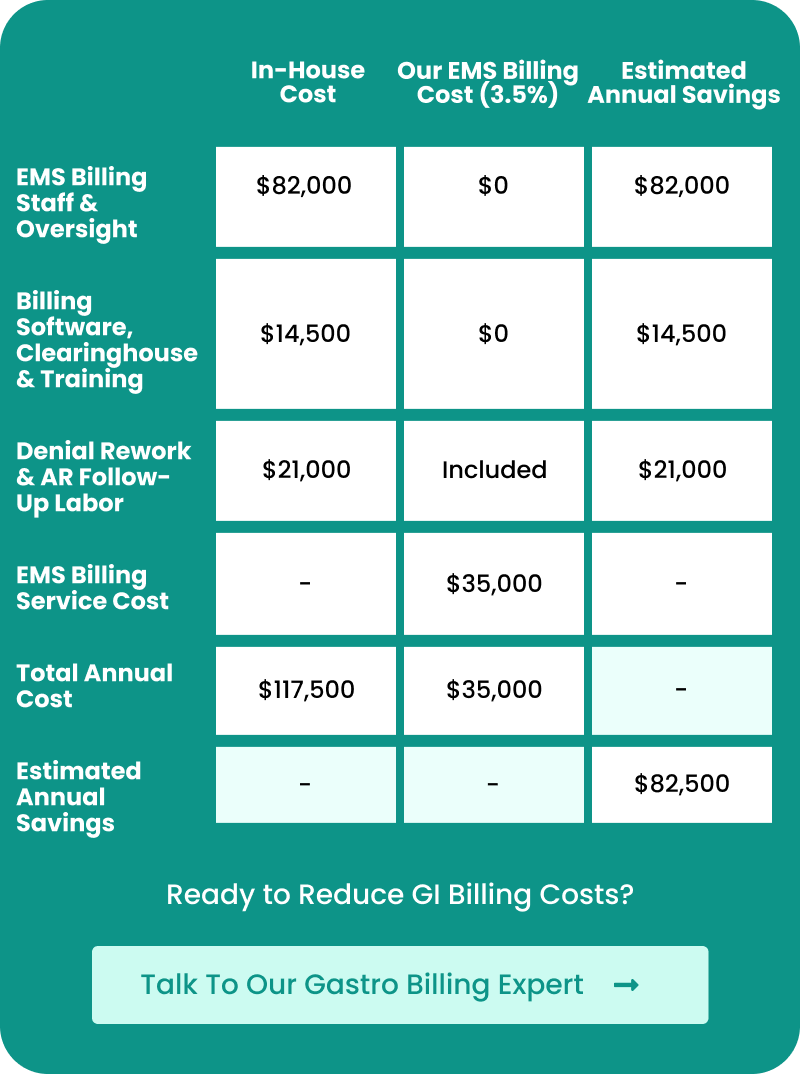
EMS Billing Cost Comparison Guide

See How Outsourced EMS Billing Can Reduce Overhead and Revenue Leakage

Practices Billing Saver Guide

Ready to Save on Your EMS Billing?

Compliance-Ready EMS Billing Support

Our EMS billing services follow compliance-focused workflows built for ambulance claims and protected patient data. Each account is handled by EMS-trained billing and coding specialists who understand transport documentation, medical necessity rules, payer requirements, modifier use, and the accuracy standards needed for a secure revenue cycle.

Group-311.png
ONC
AAPC
CCS
CMRC
CPB

Our Vigilant Billing Solution

Costly EMS Billing Denials and Our Solutions

Medical Necessity Is Not Clear

A trip may be clinically valid, but payers deny it when the PCR does not explain why ambulance transport was required. We review the narrative, patient condition, mobility status, interventions, and transport reason before billing so the claim supports medical necessity clearly.

PCR Does Not Support the Billed Level

ALS or higher-level claims are denied when the chart does not show the assessment, monitoring, or treatment needed for that level. We compare crew level, interventions, vitals, and care notes against the billed service level to prevent overcoding, downcoding, and payer disputes.

Origin-Destination Modifier Errors

Wrong pickup or drop-off modifiers can make a valid transport look incorrect to the payer. We verify facility type, pickup location, discharge destination, and modifier logic before submission to reduce location-based denials.

Loaded Mileage Mismatch

Mileage denials happen when the billed miles do not match the documented patient-loaded trip. Our experts validate loaded mileage against the transport record and correct unit entry before the claim is filed.

Missing PCS or Signature Support

Non-emergency and repetitive transports often deny when PCS forms, patient signatures, or supporting records are missing. We flag missing forms early and organize required support before billing, so claims are not sent out incomplete.

Payer-Specific Rule Conflicts

Medicare, Medicaid, and commercial insurance billing often apply different rules for the same EMS service. We apply payer-specific checks for coverage, documentation, modifiers, and filing rules before submission and during AR follow-up.

Compare and Decide Better

Our EMS Billing Company

In-House EMS Billing

Other Billing Companies

Across USA

Multi-State EMS Billing Expertise

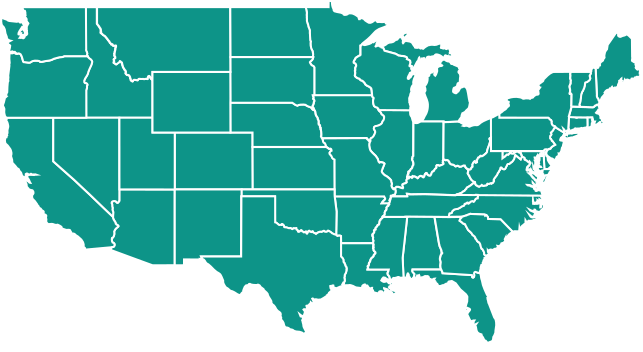
EMS billing rules are not the same in every state. Medicaid requirements, ambulance modifiers, prior authorization rules, PCS documentation, fee schedules, and payer policies can change by location. Our team understands these state-level differences and helps EMS providers submit cleaner, more compliant claims across multiple markets.

Get Instant FREE EMS Billing Pricing Quote

Up to

$50k

Monthly EMS Collections sliderImage

$25K

$100k

$5 Million

$10 Million

Mark Ellison

Operations Director, RapidLine EMS

“Before working with Vigilant Billing, our biggest issue was denied ambulance claims tied to weak PCR support and delayed AR follow-up. Their EMS billing team reviewed our documentation, cleaned up modifier and mileage errors, and worked unpaid claims with a clear payer-specific process. We now have fewer preventable denials and much better control over our revenue cycle.”

Frequently Asked Questions

How is EMS billing different from standard medical billing?

EMS billing depends on transport-based logic, including medical necessity documentation, origin-destination modifiers, loaded mileage, and PCR documentation rather than just diagnosis and procedure codes.

A complete claim requires PCR narrative, patient condition, transport reason, mileage, service level, signatures, and any supporting PCS for non-emergency transports.

By validating PCR-to-claim alignment, checking modifiers, verifying medical necessity, and applying payer-specific edits before submission.

Yes, we handle both Medicaid and Medicare ambulance billing including Medicare fee schedule rules, Medicaid state-specific requirements, and crossover claims.

How is EMS billing pricing structured?

Most EMS billing services follow a percentage-based model tied to collected revenue, not just claims submitted.

Typically, core EMS billing services are included, but some providers may charge for software, reporting, or special audits depending on scope.

 It removes staff overhead, software expenses, training costs, and reduces revenue loss from denials and underpayments.

Yes, pricing can vary depending on transport volume, payer mix, and service types like ALS, CCT, or air ambulance.

Do you integrate with EMS ePCR systems?

Yes, our billing workflows are aligned with ePCR platforms to pull accurate transport, patient, and treatment data directly into claims.

We review narratives, check required fields, validate mileage, and ensure documentation supports the billed service level.

Yes. Incomplete or unclear PCRs can lead to EMS claim denials. Our team reviews ePCR data before billing, identifies missing details, and helps correct documentation gaps so claims are submitted with stronger support.

Yes, we identify recurring documentation gaps and guide providers to strengthen PCR accuracy over time.

How do you ensure EMS billing compliance?

Our emergency medical services billing ensure compliance by following HIPAA standards, CMS guidelines, and payer-specific rules for ambulance billing, coding, and documentation.

 Incorrect modifiers, unsupported ALS billing, missing medical necessity, inaccurate mileage, and incomplete documentation.

 Yes, Our Ambulance billing company review claims for documentation integrity and compliance to prepare for payer audits and reviews.

We apply state-specific Medicaid rules, transport policies, and billing requirements for multi-state EMS providers.

Free Medical Billing Audit

Rebranding Celebration Offer

Get a free billing audit done for your practice by our RCM experts

LIMITED TIME OFFER

We will discuss ways to refine your practice’s billing process
to net the maximum revenue