
FQHC Billing Services Built for Federally Qualified Health Centers
Our FQHC billing specialists understand PPS encounters, Medicaid wraparound payments, and revenue-focused claim accuracy.

FQHC billing services are specialized billing and coding services for Federally Qualified Health Centers. They cover more than simple claim submission. They require the correct handling of encounter-based payments, sliding fee programs, CMS rules, and visit documentation so each claim reflects the care provided and the reimbursement your center deserves.
Vigilant Medical Group helps FQHC providers bill with the detail their care model requires. Our team reviews every claim with attention to visit type, provider eligibility, payer rules, required codes, and supporting documentation. This helps reduce avoidable denials and protects revenue that is often lost through small billing errors.
With Vigilant Medical Group, your FQHC gets billing support that understands community-based care, not just standard medical claims. You focus on serving patients. We help keep the reimbursement cycle clean, steady, and accountable.
Get a Free Consultation
What Our Clients Say About Us
Rated 4.8/5

Based on 200+ client reviews Reliable FQHC billing support

Our FQHC claims were denied because PPS encounter details did not match payer rules. They reviewed our coding and claim format, fixed the gaps, and helped claims move again
Dr. Karen Miles HopeBridge Family Health Center
Our aging claims were building up fast. Vigilant Group sorted our AR by payer, denial reason, and priority, giving us a clear path to recover old revenue.
Robert Hayes, Operations Manager , CedarWell Health Services
We needed more than general billing support. Vigilant Medical Group handled our claims with PPS awareness, payer knowledge, and steady follow-up. The support felt focused and reliable.
Dr. Samuel Carter OpenDoor Community Health
We struggled to track Medicaid wraparound payments. They reviewed payment gaps and expected reimbursement, helping us identify unpaid amounts and recover more accurately.
James Porter, Clinic Director ValleyCare Community Clinic
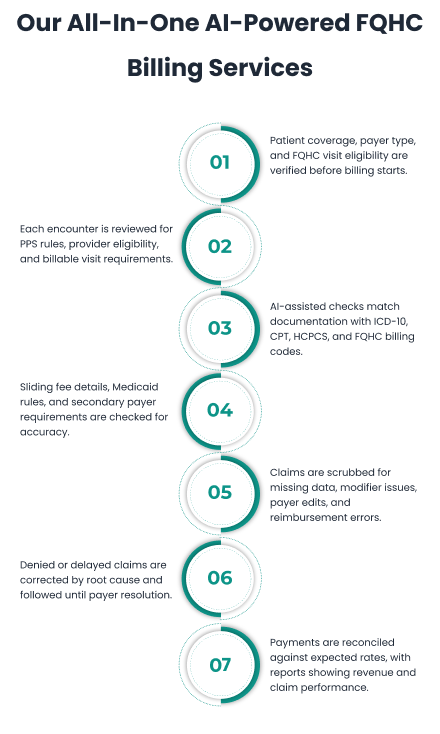
Our All-In-One AI-Powered FQHC Billing Services
Each encounter is reviewed for PPS rules, provider eligibility, and billable visit requirements.
Sliding fee details, Medicaid rules, and secondary payer requirements are checked for accuracy.
Denied or delayed claims are corrected by root cause and followed until payer resolution.
Patient coverage, payer type, and FQHC visit eligibility are verified before billing starts.
AI-assisted checks match documentation with ICD-10, CPT, HCPCS, and FQHC billing codes.
Claims are scrubbed for missing data, modifier issues, payer edits, and reimbursement errors.
Payments are reconciled against expected rates, with reports showing revenue and claim performance.
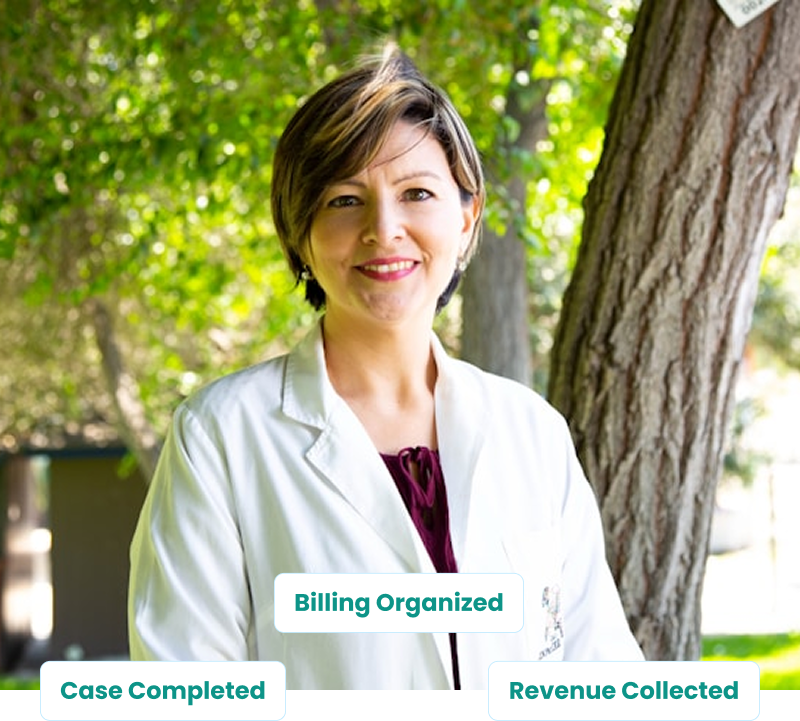
Case Completed
Billing Organized
Revenue Collected
Your FQHC Revenue Needs More Than Standard Medical Billing
FQHC claims are judged by rules that general billing teams often miss. Visit type, PPS rate logic, provider status, and payer requirements must line up before a claim can pay correctly. Vigilant Medical Group brings trained FQHC medical billing specialists and AI-supported claim review together to catch weak points early and keep your revenue cycle moving with fewer avoidable setbacks.
FQHC Billing Needs a Different Revenue Strategy. We Build It Around Your Care Model.
FQHC in medical billing is not standard outpatient billing with a different label. Your reimbursement depends on how the visit is classified, how the encounter is supported, and whether the payer recognizes the service under FQHC rules. That is where many billing teams lose revenue without noticing it.
We help FQHC providers build cleaner claims from the start. We look at the visit, the provider type, the payer rule, and the reimbursement path before the claim is treated as ready. This helps reduce underpaid encounters, avoidable denials, and missed revenue tied to small technical errors.
Our team also uses AI-assisted claim review to flag weak documentation, payer mismatches, and coding gaps before submission. You get billing support that understands FQHC reimbursement behavior, not just general RCM work.
We help your center protect cash flow while keeping billing aligned with the way FQHC care is actually delivered.
What Makes FQHC Billing Uniquely Different?
Encounter-Based Payment Logic
FQHC claims are often paid around qualified visits, not only individual services.
PPS and APM Rate Rules
Reimbursement depends on payer-specific rate methods and visit qualification.
Provider Type Matters
The rendering provider must match FQHC billing rules for the visit to pay correctly.
Medicaid Risk
Payments must be checked carefully so unpaid wraparound amounts are not missed.
Sliding Fee Impact
Patient responsibility must reflect approved discount rules without disturbing claim accuracy.
Documentation Must Support the Visit
The note must prove why the encounter qualifies under FQHC billing requirements.
Who We Serve
FQHC Billing Services for Every Community-Based Care Model

Federally Qualified
Health Centers
PPS-based billing for full-service FQHC organizations.

Non-Grant FQHC
Centers
FQHC-standard centers with unique payer requirements.

Community Health
Centers
Primary care clinics serving underserved populations.

Migrant Health
Centers
Clinics with high-volume, eligibility-sensitive billing needs.

Healthcare for the
Homeless Programs
FQHC sites serving unhoused patient communities.

Public Housing Primary
Care Clinics
Care centers supporting public housing residents.

School-Based Health
Centers
FQHC-linked pediatric and preventive care sites.

FQHC Dental & Behavioral
Health Clinics
Integrated care teams needing accurate encounter billing.
Is Your FQHC Specialty Care
Being Paid Correctly?
Sub-specialty FQHC billing can break down when payer rules do not match how care is delivered. Vigilant Medical Group has specialty-trained experts to help all FQHC specialty centers identify their billing gaps, correct underpayment patterns, and recover cleaner revenue with specialty-aware FQHC expertise.

Denied FQHC claims draining revenue?
We find the billing pattern behind the denial.


Common Denial Reasons in FQHC Billing vs Our Solutions
Nearly 15% of private-payer medical claims are initially denied, and FQHCs cannot afford repeat billing patterns that slow payment. But don’t worry, we identify the root cause behind each denial, correct the claim logic, and help your center recover revenue with stronger FQHC billing control.
The FQHC Denials You Encounter Daily & Our Solutions:
- Wrong FQHC Visit Code
When the visit code does not match the service type, payers reject or underpay the claim. We align FQHC visit codes, revenue codes, and payer rules before submission.
- Provider NPI Mismatch
Claims can be denied when rendering provider details do not match the payer enrollment records. We review provider setup, taxonomy, and billing identifiers to prevent credentialing-related denials.
- Same-Day Visit Conflicts
Multiple visits on the same date can trigger denials when payer rules are not followed. We check same-day billing rules and separate billable encounters only when supported.
- Eligibility Data Errors
Outdated coverage, wrong payer order, or inactive benefits can stop payment. We verify payer status and coverage details before claims are released.
- Incorrect Corrected Claims
Many old claims stay unpaid because corrected claims are sent without the right reference data. We rebuild corrected claims with proper payer control numbers and resubmission details.
- Weak Visit Documentation
A claim may fail when the note does not clearly support the billed encounter. We flag missing clinical support before the claim reaches the payer.
Our Expertise in FQHC Coding Services
FQHC coding is not just about selecting a visit code. The code must support the qualifying encounter, match the clinical note, and protect the payment path behind the claim. That’s why we review FQHC claims through three coding layers: the PPS payment code, the supporting CPT/HCPCS services, and the ICD-10 diagnosis story. This helps your center code all specialty visits with stronger accuracy.
Our Coding Expertise Includes the Most Complex FQHC Code Series:
HCPCS G0466–G0470 PPS Visit Codes
We assign FQHC payment codes based on patient type, visit category, and qualifying encounter rules, so claims support PPS billing logic.
CPT 99202–99499 E/M Coding
Our coders review MDM, time, patient status, and provider documentation to capture office and outpatient work correctly.
ICD-10 F01–F99 Behavioral Health Codes
We code mental health conditions with note-level specificity to support integrated behavioral health encounters.
FQHC System Integrations Designed Around Your Existing Workflow
Our system connects smoothly with 50+ FQHC EHR, PMS, clearinghouse, and reporting platforms without forcing your team to rebuild its daily workflow. Our billing team adapts to your current setup instead of making your staff adjust to ours.
Our integration support is built for FQHC billing realities, including encounter data, payer rules, provider records, claim status, payment activity, and revenue reports, which must all stay aligned across systems. We help reduce data gaps, duplicate work, and claim delays by keeping billing intelligence connected to the tools your team already uses.

Latest 2026 FQHC Billing Changes:
PPS Base Rate Increase
The 2026 Medicare FQHC PPS base rate is now $207.72, so payment checks must match updated rate logic.
G2025 Telehealth Payment Update
FQHC telehealth billing continues under G2025, with the 2026 payment rate set at $97.53.
Mental Health Telehealth Flexibility
The in-person mental health visit requirement is delayed until after January 1, 2028.
New APCM Add-On Codes
CMS added optional codes for BHI and Psychiatric CoCM support under advanced primary care management.
IOP Payment Rate Updates
FQHCs offering intensive outpatient services need updated rate checks for 2026 billing.
Higher Risk of Underpayment
Even paid claims need review when new rates, payer rules, and service codes change.
How Vigilant Handles These 2026 Changes
Vigilant Medical Group helps FQHC centers adjust billing before rate changes turn into missed revenue.
Our team reviews 2026 payer behavior, updated CMS rules, and FQHC-specific reimbursement logic so claims are not billed with outdated assumptions.
We focus on all the parts that affect payment and underpayment detection after adjudication.
Your center gets billing support that does more than react to denials. We help you stay ahead of FQHC reimbursement changes and protect every qualified encounter.
In-House vs. Outsourced
Why Choose Outsourced FQHC Billing Services Over In-House Billing?
In-house teams often know the clinic well, but FQHC reimbursement demands a sharper financial lens. Small billing habits can quietly affect PPS yield, Medicaid balance recovery, and monthly cash visibility. Outsourced FQHC billing gives your center a focused partner that studies those revenue signals daily and turns them into cleaner, more predictable collections.
| Aspect | In-House FQHC Billing | Outsourced FQHC Billing Companies |
|---|---|---|
| Team Focus | Staff often manage billing along with clinic admin, patient questions, and daily interruptions. | A dedicated billing team focuses on claims, denials, payments, and revenue movement. |
| FQHC Rule Knowledge | Accuracy depends on how well internal staff understand PPS, encounter rules, and payer updates. | Specialists work with FQHC billing rules every day and apply them across claims. |
| Encounter Validation | Billable visits may be missed when documentation, provider type, or visit category is unclear. | Encounters are reviewed for payment fit before claims are released. |
| Medicaid Wraparound | Wraparound gaps can be hard to track when payments are reviewed manually. | Payments are checked against expected reimbursement to catch underpaid claims. |
| Same-Day Visits | Multiple visits on one date can create confusion and payer denials. | Same-day billing is reviewed for separation rules and documentation support. |
| Staffing Pressure | Absences, turnover, and training gaps can slow billing and follow-up. | Work continues through a trained team without depending on one staff member. |
| Technology Use | Systems may be used mainly for entry, posting, and basic reports. | AI-assisted checks and billing analytics help flag errors earlier. |
| Denial Control | Denials are often handled one claim at a time when the staff has capacity. | Denials are grouped by root cause so repeat issues can be corrected faster. |
| Payment Accuracy | Paid claims may not always be checked for underpayment or rate mismatch. | Payments are reviewed against expected FQHC reimbursement patterns. |
| Provider Time | Leadership may spend time reviewing billing issues instead of clinic growth. | Billing oversight becomes clearer, with reporting that supports faster decisions. |
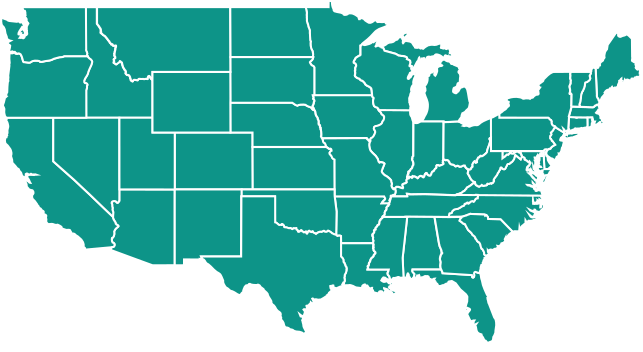
State-Specific FQHC Billing Services
FQHC reimbursement changes from state to state. A claim that works in one Medicaid program may need a different billing path in another. Vigilant Medical Group helps FQHC centers manage state-level billing differences with payer-aware review, Medicaid plan knowledge, and reimbursement checks built around each location. Our team supports FQHC billing needs across all states, including;
- California
- Texas
- Florida
- New York
- Illinois
- Pennsylvania
FQHC Billing Savings Guide
Save More by Reducing Internal Billing Load, Denial Rework, and Underpaid Claims
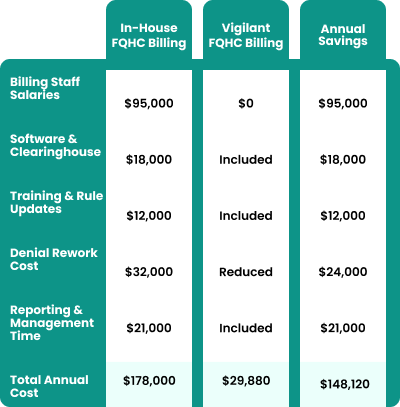
In-House FQHC Billing
Vigilant FQHC Billing
Annual Savings
Billing Staff Salaries
$95,000
$0
$95,000
Software & Clearinghouse
$18,000
Included
$18,000
Training & Rule Updates
$12,000
Included
$12,000
Denial Rework Cost
$32,000
Reduced
$24,000
Reporting & Management Time
$21,000
Included
$21,000
Total Annual Cost
$178,000
$29,880
$148,120
Ready to Improve Your FQHC Billing Margin?
What Our FQHC Billing Clients Value Most
“Patient balances were becoming a real concern for our front desk. Sliding fee adjustments were not posting consistently, and some accounts showed amounts patients should not have owed. Vigilant Medical Group reviewed our discount logic, financial classes, and payer responsibility setup. They helped us correct the balance flow and made our billing feel much more patient-safe.”
Dr. Renee Collins
Chief Medical Officer, Lakeside Community Care


Find What Your FQHC Practice Is Missing
Your claims may be paying, but not always at the value they should. Let our FQHC billing team review your revenue flow, spot silent underpayments, and show where better control can improve collections.