Few specialties felt the No Surprises Act more than anesthesia. Out-of-network anesthesiologists and CRNAs can no longer bill patients the balance at in-network facilities, and health plans now pay many claims at or near their qualifying payment amount (QPA). Groups that know how open negotiation and independent dispute resolution (IDR) work still collect fair rates. Groups without that knowledge often leave a big share of their revenue with the plans.
Key takeaways
- Anesthesia is an ancillary service under the No Surprises Act, so there’s no balance billing and no notice and consent at in-network facilities.
- Plans often pay at or near the QPA. Open negotiation must start within 30 business days, and IDR must be filed within 4 business days after it ends.
- Providers won about 85% of IDR payment determinations in the second half of 2025.
- Denials of payment on covered services can go to IDR. Coverage denials go through the plan’s appeals process instead.
- For open negotiation periods starting on or after November 1, 2026, anesthesia claims in the same code range can be batched, up to 50 line items.
Why the No Surprises Act hits anesthesia harder than most specialties
Patients rarely choose their anesthesia provider. They pick a surgeon and a hospital or ambulatory surgery center (ASC), and anesthesia comes with the case. That’s why anesthesia counts among the ancillary services under the No Surprises Act, and why the anesthesia surprise billing rules are stricter than those for many other specialties. Three rules follow from that:
- No balance billing. At an in-network facility, an out-of-network anesthesia provider can only collect the patient’s in-network cost sharing.
- No notice and consent. Some non-emergency providers can ask patients to waive their protections. Anesthesia can’t, even on scheduled cases.
- Payment comes from the plan. Anything above the patient’s share is the plan’s to pay, and its first offer is often based on the QPA.
So when it comes to anesthesia balance billing, the answer is simple: it’s off the table at in-network facilities. For a group that’s out of network with a major plan, the gap between the plan’s QPA-based payment and a fair rate becomes the whole business case. Everything else on this page is about closing that gap, claim by claim.
How plans pay out-of-network anesthesia claims
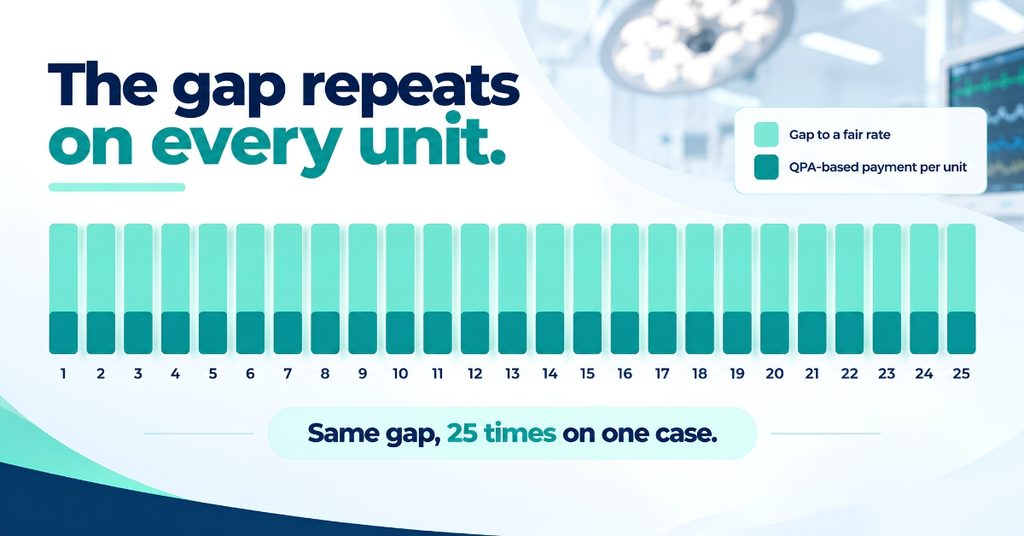
Anesthesia claims are built from base units, time units and a conversion factor. When a plan pays at the anesthesia QPA, it’s effectively applying its median in-network conversion factor for your area to your units. Commercial anesthesia contracts vary widely, so that median can sit far below what your group was paid before the law, or what a competitor negotiated.
Take a lumbar fusion with instrumentation (CPT 00670, 13 base units) that runs three hours, for 25 units in total. If the plan values each unit well below a fair market rate, that gap repeats on all 25 units, and then again on every case that month. That’s why anesthesia out-of-network reimbursement adds up so quickly, in either direction.
The upside is real. For one Arizona anesthesia group, independent reviewers decided disputes between July and September 2026 and awarded $264,718 on claims for which the plans had initially paid $12,274. That’s more than 21 times the first payments. Results vary from claim to claim, but they show how far below fair value initial payments can be.
Your three paths to fair payment
1. Accept the initial payment
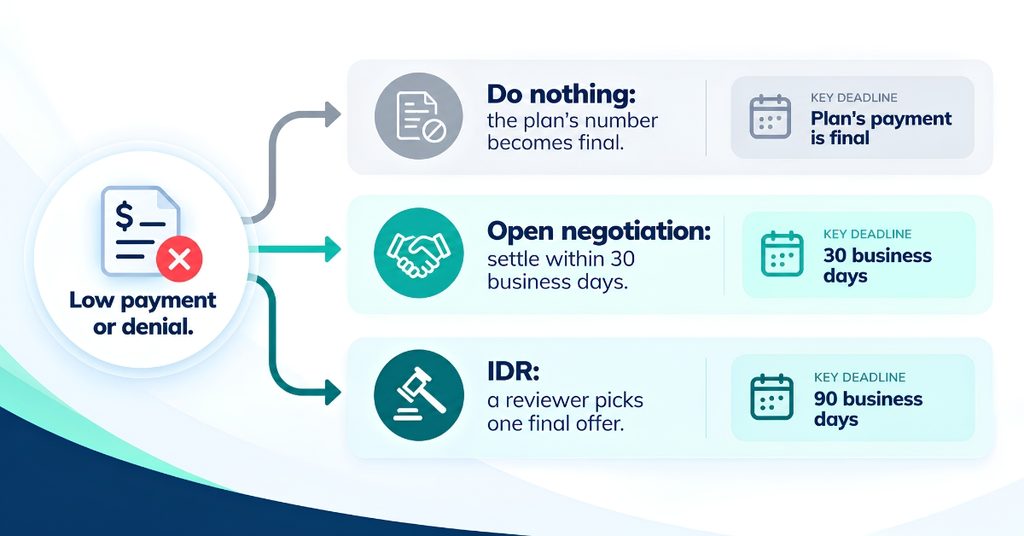
This is what happens by default when nobody is watching the remits. If open negotiation isn’t started within 30 business days of the initial payment or denial, the plan’s number becomes final, and the right to dispute the amount is gone. For many groups, this quiet default is where most out-of-network revenue is lost, one unworked remit at a time.
2. Open negotiation
Within 30 business days of the initial payment or denial, send an open negotiation notice with your counteroffer. The negotiation period then runs for 30 business days. Some plans settle at this stage, especially when the notice lays out the case details and your historical rates. A settlement here saves both sides the time and fees that IDR involves.
3. Independent dispute resolution
If negotiation fails, you have 4 business days to file for anesthesia IDR. Each side submits a final offer, and a certified IDR entity picks one of them. In federal data for the second half of 2025, providers won about 85% of payment determinations. Our independent dispute resolution guide walks through every step and deadline in more detail.
What makes an anesthesia IDR offer win
The IDR entity has to consider the QPA, but it also weighs the provider’s training and experience, case acuity, market share, and contracting history. A strong anesthesia offer gives the reviewer a reason to look past the QPA on each of those. In practice, the offers that win tend to document four things clearly:
- Case complexity: ASA physical status (P3 to P5), qualifying circumstances such as emergency or extreme age, and total anesthesia time.
- Care team model: Whether the anesthesiologist personally performed the case (AA) or medically directed CRNAs (QK, QY, QX).
- Coverage burden: 24/7 call coverage, plus the trauma and OB coverage the facility depends on.
- Market data: What your group was paid in-network before, and what comparable groups in your market are paid.
What about denied anesthesia claims?
A denied out-of-network anesthesia claim isn’t a dead end. If the plan denied payment for a covered anesthesia service at an in-network facility, that denial starts the same 30-business-day open negotiation clock as a low payment. The claim can then go to IDR, just like an underpaid one. Many groups miss this and write those claims off.
Coverage denials are different. If the plan says the service wasn’t medically necessary, or the patient wasn’t eligible, the claim goes through the plan’s appeals process first. The claim adjustment reason codes (CARC) and remittance advice remark codes (RARC) on the remit tell you which kind of denial you’re dealing with. Check them before writing off any out-of-network anesthesia denial.
Batching anesthesia claims
Anesthesia batching in IDR is a clear advantage. Under the 2026 IDR operations rule, anesthesia claims from the same plan that fall within the same CPT Category I anesthesia code range can be batched across patients, with up to 50 line items per dispute. These rules apply to open negotiation periods that begin on or after November 1, 2026.
Batching cuts the fees per claim, but it only works if every claim in the batch is tracked, eligible, and properly supported. An ineligible claim can slow the whole batch down, so screening has to come first. That’s where most of the work sits, and it’s why batching rewards the groups that keep clean records.

State law: Nevada, Arizona and Texas
Self-funded employer plans cover a large share of workers in Nevada, Arizona and Texas, and they fall under the federal IDR process. Some fully insured plans in states with their own surprise billing laws, Texas among them, follow a state process instead. Before filing, confirm which forum applies to each claim, so fees aren’t lost on ineligible disputes.
A checklist for anesthesia groups
Most lost out-of-network revenue comes down to missed steps, not lost disputes. This checklist keeps out-of-network anesthesia billing on track, whether the out-of-network provider is an anesthesiologist or a CRNA. Work through it every week, and very few claims should slip past their deadlines:
- Pull every out-of-network remit weekly and log the initial payment date.
- Flag claims paid at or near the QPA, and denials of payment, as dispute candidates.
- Send open negotiation notices within 30 business days.
- Batch eligible claims by plan and anesthesia code range.
- Document ASA physical status, time and care team on every claim.
- Track awards and the plan’s 30-calendar-day payment deadline.
- Report IDR revenue separately, so you can see what the process returns.
Related: Independent Dispute Resolution Services
How Vigilant Medical Billing & Coding Services helps anesthesia groups
Vigilant Medical Billing & Coding Services works with anesthesia groups covering hospitals and ASCs in Las Vegas, and with practices across Arizona and Texas. On the in-network side, we handle units, modifiers and medical direction. On out-of-network claims, we review your fee schedule against the market, run open negotiation and IDR, and build the case for every dispute. We cover all IDR filing and arbitration fees, win or lose
About Vigilant Medical Billing & Coding Services
Vigilant Medical Billing & Coding Services is an anesthesia and physician revenue cycle management company headquartered in Mesquite, Texas. Its services include:
- Billing and coding for anesthesia groups
- Credentialing for anesthesiologists and CRNAs, and for certified anesthesiologist assistants (CAAs) in states that allow them
- Coverage planning and stipend numbers for hospitals and surgery centers
- No Surprises Act open negotiation and independent dispute resolution
The company’s leadership has worked in anesthesia revenue cycle management since 2016. Across its clients, net collections run at 98.8% and the denial rate is 1.12%. The company wins 88% of IDR disputes, and credentialing typically takes 4 to 6 weeks.
Frequently asked questions
Does the No Surprises Act apply to anesthesia?
Yes. Under No Surprises Act anesthesia rules, anesthesia is treated as an ancillary service. Out-of-network anesthesia providers at in-network hospitals and ambulatory surgery centers can’t balance bill patients and can’t use notice and consent. Patients pay only their in-network cost sharing, and the provider settles the rest with the plan through open negotiation and IDR.
Can an anesthesiologist balance bill a patient?
Not for services the No Surprises Act covers. If the facility is in network with the patient’s plan, an out-of-network anesthesiologist or CRNA can only collect the in-network cost sharing from the patient. The rest has to be resolved with the plan, either through open negotiation or, if that fails, through independent dispute resolution.
How do anesthesia groups dispute low out-of-network payments?
In two steps. First, send an open negotiation notice within 30 business days of the initial payment or denial. The negotiation period then runs for 30 business days. If no agreement is reached, file for independent dispute resolution within the next 4 business days. Miss either deadline, and the plan’s payment stands as final.
Can anesthesia claims be batched in IDR?
Yes. Under the 2026 IDR operations rule, anesthesia claims from the same plan within the same CPT Category I anesthesia code range can be batched across patients, up to 50 line items per dispute. This applies to open negotiation periods that begin on or after November 1, 2026. Batching lowers the fees you pay per claim.
Can a denied anesthesia claim go to IDR?
Yes, if the plan denied payment for a covered anesthesia service protected by the No Surprises Act. The notice of denial starts the 30-business-day open negotiation period, just like a low payment. Coverage denials are different. If the issue is medical necessity or patient eligibility, the claim has to go through the plan’s appeals process first.
Is the QPA the most an anesthesia group can recover?
No. The QPA is one factor in IDR, not a ceiling. The certified IDR entity also weighs case acuity, provider experience, market share, and contracting history. In federal data for the second half of 2025, most awards came in above the QPA, and providers won about 85% of all payment determinations.
Sources
- CMS, No Surprises Act independent dispute resolution: https://www.cms.gov/nosurprises/help-resolve-payment-disputes
- CMS, Federal IDR Public Use File supplemental background, July to December 2025: https://www.cms.gov/priorities/innovation/data-and-reports/2026/federal-idr-supplemental-background-2025-q3-2025-q4
- Federal Register, Federal Independent Dispute Resolution Operations final rule (June 4, 2026): https://www.federalregister.gov/documents/2026/06/04/2026-11140/federal-independent-dispute-resolution-operations