
Key Highlights
- Primary dental insurance is the plan that gets billed first — before any other coverage is touched.
- The 100-80-50 rule is at the heart of how most PPO dental plans work: 100% for preventive, 80% for basic, 50% for major procedures.
- More than 240 million Americans are covered by dental insurance, yet close to 70 million still aren’t (CareQuest, 2024).
- The U.S. dental insurance market sat at $97.7 billion in 2025 and is on track to hit $123.3 billion by 2034.
- Most plans cap out at $1,000–$2,000 per year — which is why correct billing coordination matters so much.
- Dental PPOs hold over 89% of the U.S. dental insurance market.
- When a child is covered by both parents’ plans, the ‘birthday rule’ is what determines which parent’s plan is primary.
Americans covered by dental insurance in some form (CareQuest, 2024)
U.S. dental insurance market size in 2025 (Precedence Research)
Share of the market held by dental PPO plans in 2024
1. What Is Primary Dental Insurance?
Dental insurance can feel like one of those things that’s never fully explained until something goes wrong. A claim gets submitted, a confusing bill arrives in the mail a few weeks later, and suddenly the question being asked is: wait, which insurance was supposed to be billed first?
That’s exactly where the concept of primary dental insurance comes in and once it’s understood, a lot of the confusion tends to fall away pretty quickly.
In the simplest terms, primary dental insurance is the plan that is billed first whenever a dental claim is filed. It’s the coverage that’s reached for before anything else is touched. If just one plan is held, then that plan is primary by default there’s nothing else to sort out. But when two or more plans are in the picture at the same time, the question of “which goes first?” becomes genuinely important.
Nearly 70 million Americans still don’t have any dental insurance at all — even as coverage extends to more than 240 million people across the country (CareQuest Institute for Oral Health, 2024). For those who do have a plan, knowing how to use it correctly can make a real difference in what actually gets paid.
2. How Primary Dental Insurance Works
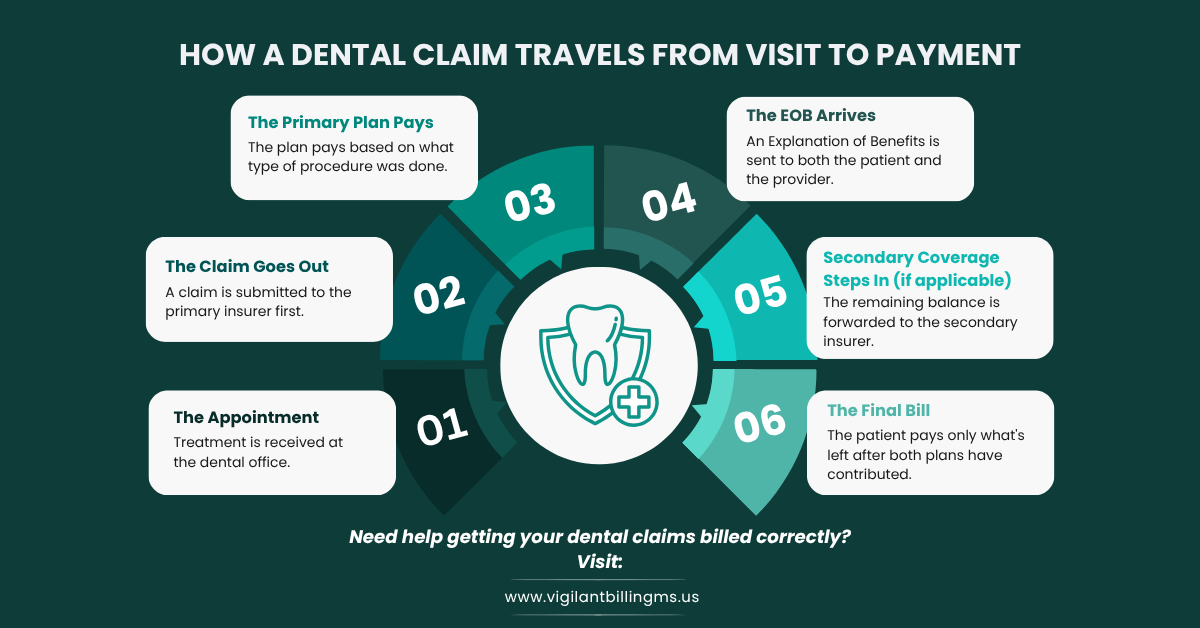
It might help to walk through what actually happens after a dental appointment is over because that’s where things can get a little murky if the right steps aren’t followed.
Once a patient has been seen by the dentist and treatment has been received, a claim is put together and sent off to the insurance carrier. Here’s the order in which things are meant to happen when primary coverage is in play:
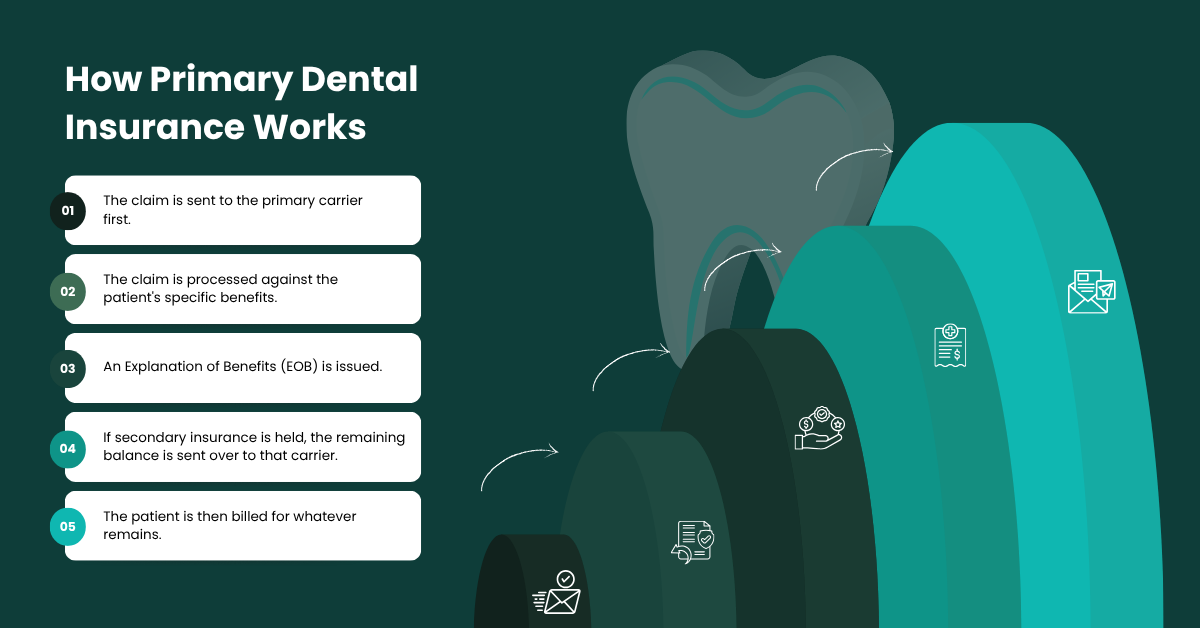
Note: Step 4 only applies if the patient holds secondary insurance. If no secondary insurance exists, the patient proceeds directly to billing after Step 3.
3. The 100-80-50 Coverage Structure
If there’s one thing worth memorizing about how primary dental insurance works, it’s the 100-80-50 rule. This is the coverage structure that’s followed by the vast majority of PPO dental plans and once it’s understood, reading an Explanation of Benefits suddenly makes a lot more sense.
It is more or less than what it sounds. The coverage is divided into three levels dependent on the nature of the procedure undergoing, and each level is at a specific percentage covered. Large carriers such as Delta Dental, MetLife, Humana, and Anthem all adhere to this format with or without a few plan-specifics.
100% PREVENTIVE CARE Cleanings · Exams · X-rays Fluoride · Sealants | 80% BASIC PROCEDURES Fillings · Extractions Root Canals · Gum Treatment | 50% MAJOR PROCEDURES Crowns · Bridges · Dentures Implants · Oral Surgery |
COVERAGE SPLIT AT A GLANCE — 100 / 80 / 50 RULE Preventive: insurance pays 100%, you pay 0% Basic: insurance pays 80%, you pay 20% Major: insurance pays 50%, you pay 50% Source: MetLife, Delta Dental, Humana — standard framework for most PPO plans, 2025 |
A couple of things are worth knowing here. First, preventive care — things like cleanings, routine x-rays, and annual exams is almost always deductible-free. That means the 100% coverage kicks in immediately, no waiting period and no annual deductible to meet first. Second, the annual maximum, the limit to which the plan will make payments in a given calendar year, usually ranges between $1,000 and $2,000 on the majority of plans. That amount may seem quite small, but here is a piece of comfort, the percentage of policyholders within a specific year who manage to reach this limit is only 2-4% (Humana, 2024). For most people, the plan never gets maxed out.
5. Types of Dental Insurance Plans
Not all primary dental insurance plans are built the same way. The same underlying coverage structure might be offered through very different plan types — and the type matters a lot when it comes to which dentists can be seen, whether a referral is needed, and how much flexibility is built in.
Here are the four most common types currently found on the market:
| Plan Type | Network | Primary Dentist? | Referral Needed? | Best For |
|---|---|---|---|---|
| Dental PPO | Preferred (out-of-network allowed) | No | No | Flexibility & broad coverage |
| Dental HMO | In-network only | Yes | Yes | Low premiums, predictable costs |
| Dental Indemnity | Any licensed dentist | No | No | Maximum freedom of choice |
| Dental EPO | In-network only (emergencies excl.) | No | No | Lower premiums, no PCP required |
Of these, the dental PPO is by far the most popular — it held an 89.5% market share across all dental insurance types in 2024 (Precedence Research). The combination of no required referrals, access to out-of-network providers, and the familiar 100-80-50 structure has made PPOs the go-to choice for most American families and employers.
6. Primary vs. Secondary Dental Insurance
Here’s where things get a little more interesting especially for patients who are covered under more than one plan at the same time.
When two dental plans are held simultaneously which is common among couples where both partners have employer-sponsored coverage, or families where children are placed on both parents’ plans the question of “which one pays first?” stops being theoretical and becomes very practical. Getting the billing order wrong can mean denied claims, delayed payments, and bills that are higher than they need to be.
The table below lays out exactly how primary and secondary dental insurance differ and why both matter:
| Feature | Primary Dental Insurance | Secondary Dental Insurance |
|---|---|---|
| Order of billing | Billed first, always | Billed only after primary has paid |
| What it covers | Full benefit per plan terms — deductibles, coinsurance, and maximums all apply | The remaining balance left after primary pays, subject to its own rules |
| Annual maximum | Applies on its own ($1,000–$2,000 is typical) | Also applies independently — the two are NOT combined into one bigger pot |
| Deductible | The patient's deductible must be met first | A separate secondary deductible may also be required |
| Can it hit 100%? | Only for preventive care, which is usually covered fully | Together, two plans can slash your bill — but the total paid can never go over 100% of the actual cost |
| Determined by | Birthday rule, employment status, or formal COB guidelines | Automatically whichever plan is not designated primary |
| Example: Crown ($1,200) | Pays 50% = $600 | May cover part or all of the remaining $600 |
| Who benefits most? | Every policyholder — even those with just one plan | Patients with dual coverage and children on two parents' plans |
One thing that trips people up fairly often: even when two plans are held, the total paid by both combined can never go above 100% of the actual cost of the procedure. Insurance doesn’t become a money-making situation it just reduces what’s owed. But when both plans are coordinated correctly, the savings can still be substantial.
Errors in coordination of benefits between primary and secondary insurers are among the most common and most expensive billing mistakes seen in dental practices. If that’s something your practice is navigating, expert support is available at www.vigilantbillingms.us.
7. Who Determines Which Plan Is Primary?
This is one of the most common questions that comes up whenever dual coverage is on the table and it’s a fair one, because the answer isn’t always obvious. The good news is that it’s not left to chance or personal preference. A structured set of rules, known as Coordination of Benefits (COB) guidelines, is used by insurance carriers to settle the question.
The Birthday Rule For Children
When a child is enrolled under both parents’ dental plans which happens more often than you might expect the plan of the parent whose birthday falls earlier in the calendar year is treated as primary. Month and day are what matter here, not the birth year.
So if a mother’s birthday is March 4th and a father’s is September 12th, the mother’s plan is automatically designated as primary for the child regardless of which plan was set up first, or which one offers better coverage. This is called the birthday rule, and it’s the standard approach used across most states.
Employee vs. Dependent For Adults
When an adult is covered both through their own employer’s plan and as a dependent on a spouse’s plan, the plan obtained through their own job is considered primary. The spouse’s plan becomes secondary. It’s the “your own plan comes first” principle.
Active vs. Retired Status
If one plan is tied to current active employment and another comes from a retirement or COBRA continuation plan, the active employment plan takes priority as primary. The reasoning is straightforward: active coverage is considered more current and binding.
In case of two carriers having real disagreements concerning which one plan should take the first rank, these COB regulations put forward by the National Association of Insurance Commissioners (NAIC) are normally invoked to resolve the issue. Such model regulations have been adopted by most states and hence the process is not as inconsistent as it may appear.
8. Key Insurance Terms Worth Knowing
Insurance language may seem as though it has been carefully crafted to be difficult to understand. Here is a simple language summary of the vocabulary that is most likely to arise when primary dental insurance is being addressed, whereby the next time that an EOB appears in the mail, it really makes sense.
- Premium: The amount paid every month (or year) just to keep the coverage active. For individuals, this typically runs $20–$50/month. Family plans tend to run $50–$150/month.
- Deductible: The fixed amount that has to be paid out-of-pocket before the plan starts covering basic and major procedures. Most individual plans set this at $25–$75 per year. Preventive care is usually deductible-free.
- Coinsurance: The patient’s share of the bill after the deductible has been met. On an 80% basic coverage plan, the patient’s coinsurance share is 20%.
- The cap on how much the plan will pay in a calendar year most commonly $1,000–$2,000. After this ceiling is hit, all remaining costs are the patient’s responsibility.
- Waiting Period: A window of time, often 6 to 12 months, that has to pass before the plan starts covering basic or major procedures. Preventive care almost never comes with a waiting period.
- Coordination of Benefits (COB): The regulations that regulate the sharing of the bill when the patient has two insurance plans.
- Explanation of Benefits (EOB): This is the document which the insurer transfers to the claim holder once the claim has been processed. It demonstrates paid, adjusted and outstanding costs of the patient.
- In-Network vs. out-of-Network: In-network dentists have contracted with the insurer to have a fee schedule. Out-of-network normally implies increased out-of-pocket expenses on the side of the patient.
An Explanation of Benefits (EOB) should be reviewed after every single dental visit even a routine cleaning. It’s the fastest way to catch a billing error before it turns into a problem. For dental practices that want this kind of oversight built into their workflow, Vigilant Medical Billing Group offers end-to-end claim auditing and EOB reconciliation as part of their core services.
9. Market Statistics & Industry Data
The statistics surrounding the dental insurance business are worth knowing not merely as a backdrop, but as an indicator of the extent to which primary dental insurance is being depended upon, and which issues are the areas of actual stress.
- $97.7 billion: It is estimated to reach 123.3 billion by 2034 and that its growth will be 2.62% CAGR (Precedence Research, 2025).
- 89.54%: Among all types of dental plans, dental PPOs are commanding a majority of the market share as of 2024 which is 89.54 percent.
- 49.69%: The share of all insured dental procedures that were preventive in nature in 2024 — making cleanings and exams the single largest covered service category.
- ~60%: The portion of the dental insurance market tied to employer-sponsored plans (CoinLaw, 2025).
- $350–$550: The typical annual premium for an individual dental plan. Family plans average around $680/year (PolicyAdvice / Humana, 2024).
- 15%: The estimated share of dental claims that were denied in 2024 up around four percentage points since 2022. This is a meaningful rise, and it’s one of the strongest arguments for accurate primary insurance billing (2740 Consulting, 2025).
- 2–4%: The share of policyholders who actually hit their annual maximum in any given year (Humana, 2024). Most plans have more runway left in them than people realize.
- 34 million+ school hours: Lost annually in the U.S. because of untreated dental conditions at a productivity cost that’s been placed at over $45 billion per year (Toward Healthcare, 2025). Oral health matters beyond the dental chair.
For more detailed data and trend reporting, the American Dental Association Health Policy Institute and the National Association of Dental Plans (NADP) publish extensive annual research that’s freely available online.
10. Frequently Asked Questions
What exactly is primary dental insurance?
It’s the plan that gets billed first when a dental claim is submitted.
Can someone have two ‘primary’ dental plans at once? No. Only one plan can hold the primary spot at a time.
How is it decided which parent’s plan is primary for a child?
The birthday rule is followed. The parent whose birthday falls earlier in the calendar year (going by month and day, not birth year) has their plan treated as primary for the child.
What happens when the wrong plan gets billed as primary?
Claims can be delayed, denied outright, or result in the patient being charged more than they should owe
Is dental insurance the same as regular health insurance?
No, they’re entirely separate products. A standard medical health insurance plan doesn’t include dental coverage unless it’s a Medicare Advantage plan with bundled benefits. Dental insurance is purchased and billed on its own.
Where can help be found for dental billing coordination?
Specialist dental billing companies like Vigilant Medical Group (vigilantbillingms.us) handle primary/secondary billing coordination, claim submission, denial management, and EOB reconciliation as their core service.
Incorrect coordination between primary and secondary dental insurance is one of the most common and most quietly expensive billing mistakes seen in dental practices. With claim denial rates sitting at around 15% in 2024, having someone in your corner who knows how to navigate this isn’t a luxury. It’s a necessity.
Claims management, denial follow-up, and benefits coordination all of it is handled, so your team doesn’t have to.
GET EXPERT DENTAL BILLING SUPPORT
Dental Billing · Claims Management · Denial Management