Open enrollment period has started, and your inbox is flooded with plan options from insurance companies you hardly recognize. Which one actually delivers quality coverage? Most Americans face this same confusion.
Healthcare payer companies aren’t just names on your insurance card, they control which doctors you can see, which treatments get approved, how fast claims are processed, and ultimately, how much you pay out of pocket. Yet few people understand how these companies actually work.
This guide breaks down the top 10 healthcare payer companies in the U.S. who they are, how they operate, and why they matter to you.
Quick answer: A healthcare payer company refers to any organization that provides funding for medical expenses through three sources which include medical care private insurers, Medicare/Medicaid managed care organizations, and self-insured. These organizations establish a connection between you and your physician by bargaining for medical service costs while determining which services will receive insurance reimbursement.
What Is a Healthcare Payer — and Why Should You Care?
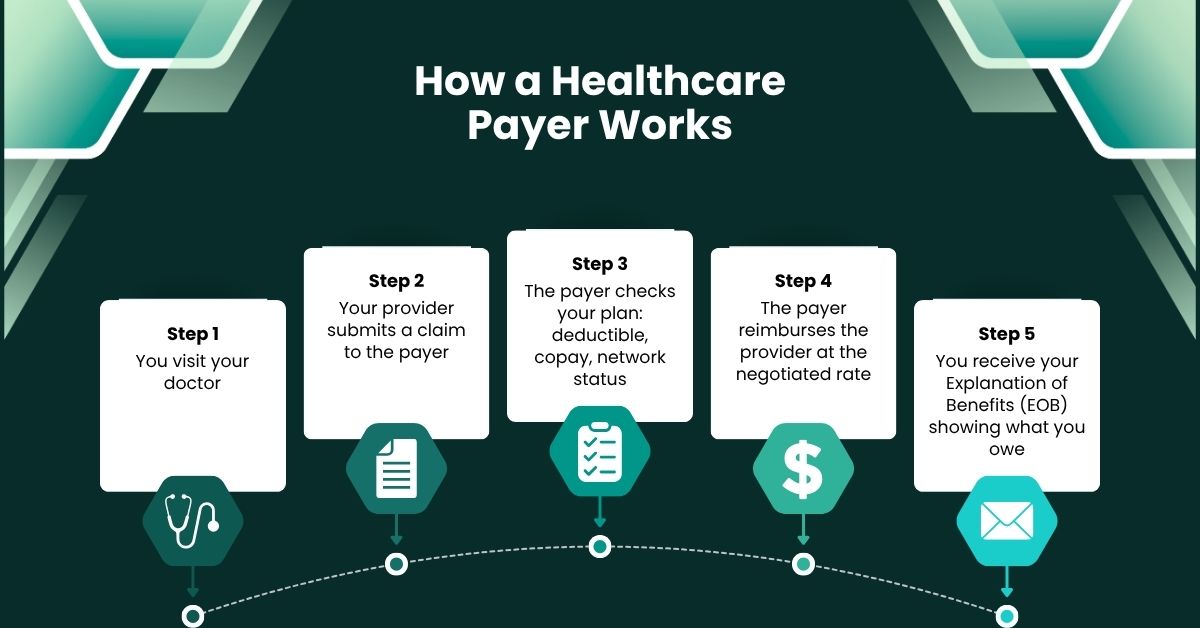
A healthcare provider delivers care. Your doctor, together with your hospital and your physical therapist, delivers healthcare services. A healthcare payer pays for that care. The medical provider files an insurance claim after you provide your insurance card during your doctor visit. The payer determines the reimbursement amount for the doctor based on their contractual agreement while you assume responsibility for the remaining costs. Payers have authority to determine
Payers also decide:
- Which drugs are on the formulary (and what tier which affects your copay)
- Whether a specialist referral requires prior authorization
- Which hospitals are in-network (and therefore cheaper for you)
- Whether a procedure is ‘medically necessary’ — or denied
- How your care is managed if you have a chronic condition
- The U.S. healthcare payer market is dominated by 10 companies that collectively cover the vast majority of insured Americans.
- UnitedHealth Group is the largest payer by far its Optum subsidiary means it also controls significant portions of care delivery.
- Kaiser Permanente is the only major payer that employs its own doctors, creating a fully integrated care model with consistently high quality scores.
- Medicare Advantage is the fastest-growing segment with over 33 million Americans now enrolled
- Choosing a plan by premium alone is a mistake network access, drug formulary tiers, and NCQA quality ratings matter far more in real-world costs.
- Vertical integration (insurers owning pharmacies, clinics, and PBMs) is reshaping competition and drawing increasing regulatory scrutiny.
U.S. Health Insurance Membership at a Glance
Top 10 Healthcare Payers Ranked by Members Covered | 2024 Estimates
| Rank | Insurer | Members Covered | Note |
|---|---|---|---|
| #1 | UnitedHealth Group | ~50 million | |
| #2 | Elevance Health | ~47 million | |
| #3 | CVS Health / Aetna | ~39 million | |
| #4 | Cigna | ~19–20 million | |
| #5 | Humana | ~17 million | |
| #6 | Centene Corporation | ~28 million | mostly Medicaid |
| #7 | Kaiser Permanente | ~12–13 million | |
| #8 | Health Care Service Corporation | ~17 million | |
| #9 | Molina Healthcare | ~5 million | |
| #10 | Blue Cross Blue Shield Association | ~115 million | across independent plans |
Sources: Company filings, CMS, BCBSA. All figures are approximate.
The Top 10 Healthcare Payer Companies in the U.S.
1. UnitedHealth Group
Largest U.S. payer by revenue — $372B+ in 2023
Official website: www.uhc.com
If you’ve ever had employer-sponsored insurance, you’ve probably crossed paths with UnitedHealthcare because it functions as an insurance provider for all employees who receive employer-sponsored health coverage. The organization provides health insurance to more than 50 million people across America which makes it the largest health insurance provider in the United States. UnitedHealth Group operates differently from an insurance company because its business model uses Optum as its operational foundation. Optum operates as an independent business unit while it provides complete healthcare services which include pharmacy operations, physician staffing, urgent care center management, and hospital data analysis services.
2. Elevance Health (formerly Anthem)
Serves 40M+ members in 14 states under the Blue Cross Blue Shield brand
Official website: www.elevancehealth.com
Anthem changed its name to Elevance Health in 2022 to identify itself as a complete health solutions provider instead of an insurance company. Most California New York Georgia Ohio and Texas residents will encounter this insurance company because it serves as the automatic provider for their workplace health benefits. Elevance provides Blue Cross and Blue Shield services across 14 states which makes it one of the most widely operating health insurance companies in the United States. The Amerigroup Medicaid segment of the company establishes it as a major participant in the government-sponsored healthcare market.
3. CVS Health / Aetna
The $69B merger that changed how insurance and retail pharmacy coexist
Official website: www.aetna.com
The public reacted to CVS Health’s acquisition of Aetna in 2018 with confusion. People asked this question because they wanted to know the connection between a pharmacy chain and health insurance. The answer, it turns out, is everything. Aetna’s 25 million plus members currently use CVS pharmacies and MinuteClinics and HealthHUBs for their health needs because these services help the company identify health problems before they need expensive hospital treatment. Aetna members who use this system will benefit through decreased prescription costs at CVS and better access to flu vaccinations and basic medical care and customized health communication based on their health information.
4. Cigna / Evernorth
Dominant in large employer and multinational benefits
Official website: www.cigna.com
Cigna serves as the most common insurance provider for employees who work at multinational companies. Cigna reorganized its operations in 2022 by maintaining its employer insurance business as Cigna while establishing Evernorth as a new company to handle its pharmacy and behavioral health and care operations. Evernorth’s Express Scripts functions as one of the three leading pharmacy benefit managers in the United States, which enables Cigna to control your outpatient costs and your monthly pharmacy expenses.
The top 10 healthcare payer companies that control about 70% of the U.S. health insurance market, provide coverage to more than 200 million Americans. This concentration of the market makes most of the patients deal with only a few major insurance companies.
5. Humana
The #2 Medicare Advantage insurer in the U.S.
Official website: www.humana.com
Humana established its operational path which it successfully maintained until it became the leading force in its business sector. Humana focused its business operations on Medicare Advantage which generated profitable results for the company because other major payer organizations operated across multiple markets. The company provides Medicare Advantage services to more than 5 million members which makes it the second largest Medicare Advantage provider in the United States. Humana Medicare Advantage plans provide additional benefits which traditional Medicare plans do not include such as dental cleanings, eyeglasses, hearing aids, and gym memberships. In 2024 Humana ranked among the top payers for member satisfaction in J.D. Power’s Medicare Advantage study.
6. Centene Corporation
Nation’s largest Medicaid managed care organization
Official website: www.centene.com
Centene operates in multiple states yet lacks public awareness which Aetna and BlueCross possess. The company operates Medicaid programs across 29 states which provide services to millions of low-income adults and children and disabled individuals. Through its subsidiaries like WellCare the company operates in the ACA Marketplace and Medicare programs. State governments hire Centene to administer Medicaid because managing this population is complex. Chronic disease management, social determinants of health, high-risk pregnancies, and behavioral health all require specialized infrastructure that smaller plans can’t provide at scale.
7. Kaiser Permanente
The only major insurer that employs its own doctors
Official website: www.kaiserpermanente.org
Kaiser Permanente operates as a distinct medical insurance provider because the organization intentionally developed its unique business model. Kaiser Permanente established its foundation in 1945 through an innovative concept that combined insurance and medical services under one organizational structure. Today Kaiser serves more than 12 million members who reside mainly in California while the company operates in Colorado, Georgia, Hawaii, Maryland, Oregon, Virginia, and Washington. Kaiser’s integrated model provides an electronic health record system which all your medical providers including primary care doctors, specialists, hospitals, labs, and pharmacies will use. For members comfortable staying within Kaiser’s system, outcomes research consistently shows higher quality scores and fewer redundant tests.
You should examine your health plan costs beyond your premium because your current doctors and essential medications must be evaluated for their network and formulary status. Your preferred providers will result in higher expenses for you when they operate outside your insurance network despite your lower premium costs.
8. Health Care Service Corporation (HCSC)
The largest member-owned health insurer in the U.S.
Official website: www.hcsc.com
HCSC operates Blue Cross and Blue Shield plans in five states — Illinois, Montana, New Mexico, Oklahoma, and Texas. What separates HCSC from every other payer on this list is its ownership structure: it’s a mutual company, meaning it’s owned by its policyholders, not investors.
Because HCSC isn’t answerable to Wall Street, it can invest profits back into member programs and community health initiatives rather than returning capital to shareholders — one reason it has among the stronger community health investment records of any large regional payer.
9. Molina Healthcare
Focused exclusively on Medicaid, Medicare, and Marketplace members
Official website: www.molinahealthcare.com
Since Dr. C. David Molina established his Long Beach California clinic in 1980, Molina Healthcare has maintained its dedication to providing services for individuals who use government assistance programs. Today, Molina covers roughly 5 million members across 19 states. Molina Healthcare has expanded into new markets through state-by-state growth, whereas Centene has expanded its business through aggressive acquisition.
10. Bl
ue Cross Blue Shield
The 33 independent locally operated companies of Blue Cross Blue Shield which function as separate entities create the largest health insurance network in the United States. BCBS provides nationwide healthcare coverage for 118 million members across all 50 states, Washington D.C., and Puerto Rico with more than 2 million doctors and hospitals in their network, more than any insurer. The BCBS association and its member organizations control approximately 38 percent of the United States health insurance market, The BlueCard program enables members to obtain in-network medical services across all 50 states, which allows BCBS to deliver the most efficient nationwide coverage solution among all insurance providers.
Official website: www.bcbs.com
Frequently Asked Questions
What is the difference between a healthcare payer and a healthcare provider?
A provider is the person or organization that delivers care i-e your doctor, hospital, or urgent care clinic. A payer is the organization that finances that care.
Is a bigger healthcare payer always better?
Larger payers can negotiate better rates with hospitals and have more robust care management programs.
What does a healthcare payer actually do day to day?
Payers process thousands of claims daily, negotiate contracts with provider networks, manage care programs for high-risk members, determine coverage for new treatments, and handle member appeals.
The Bottom Line
Healthcare payers are some of the most consequential companies most Americans know almost nothing about. They’re not glamorous. They’re not the doctors performing surgery or the researchers developing new drugs. But they decide who gets access to those surgeons and those drugs and at what cost.
Knowing who your payer is, what their strengths are, and where they tend to fall short is genuinely useful knowledge. Not just at open enrollment, but when you’re fighting a denial, trying to find a specialist, or helping an aging parent navigate Medicare.
Use HealthCare.gov for ACA Marketplace plans, Medicare.gov for Medicare options, and NCQA’s plan ratings to compare quality scores before you decide.
- At Vigilant Medical Group, we specialize in medical billing across all major payers. From United Health to BCBS. Whether you are dealing with claim denials, prior authorization delays, or underpayments, We know how to get you paid faster and more accurately.