
In the United States alone, healthcare providers are losing millions in revenue that could be reimbursed annually not due to bad clinical care, wrong diagnosis or coding mistakes, but due to one administrative deadline that was missed. That deadline is referred to as the Timely Filing Limit(TFL), and among providers who deal with Aetna, it is one of the most financially significant policies in the whole revenue cycle.
When a claim is submitted even one day beyond Aetna’s filing window, it is automatically denied with denial code CO-29, and in nearly all cases, that denial is permanent. The provider cannot reverse it through a standard appeal, and billing the patient for the outstanding balance is generally prohibited under the terms of the provider contract.
This blog covers everything, how the policy of Aetna has evolved over the years, what are the existing deadlines in each type of plan, what happens when the clock runs out and most importantly, how practices of all sizes can develop bulletproof systems to make sure a deadline is never missed again.
What Is a Timely Filing Limit?
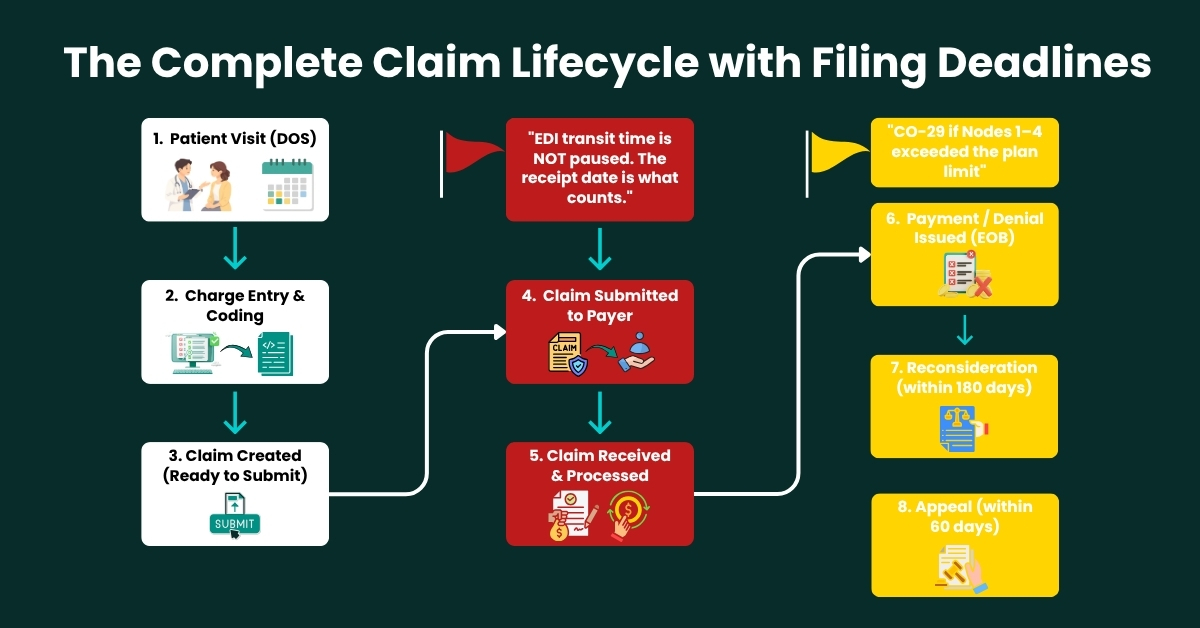
A timely filing limit (TFL) is the maximum number of calendar days a healthcare provider has to submit a claim to an insurance payer following the date of service. The clock starts on the date the patient was seen, not the date the bill was generated, not the date the claim was created in your billing software, and critically, not the date you clicked ‘submit.’
Aetna measures its timely filing deadline based on the date the claim is received by its system either through the EDI electronic gateway or, for paper claims, the date of arrival at Aetna’s physical mailroom. This distinction creates a hidden risk for practices that submit close to the deadline and assume a same-day credit applies.
Once a claim passes the filing window without being received in a processable state by Aetna, it is denied. A resubmission of that same claim does not reset the original clock, the clock was started on the date of service and only stops when a valid, accepted claim (not merely a submitted one) is registered in Aetna’s system.
A rejected claim is not the same as a denied claim.
A rejection means the claim was returned before entering Aetna’s adjudication queue, often due to a formatting error, invalid member ID, or missing required field. Because a rejected claim was never ‘received and accepted,’ the original filing clock is still running. Providers who confuse rejections with denials sometimes wait too long to resubmit and inadvertently let the deadline pass.
How Aetna's Filing Policy Has Evolved
Understanding Aetna’s current filing rules is easier when viewed against the background of how those rules have changed over time. Two policy shifts stand out as the most impactful for providers:
The 2022 Non-PAR Provider Change
As of January 1, 2022, Aetna cut the timely filing cap on non-participating (non-PAR) providers by half, down to 12 months from 27 months, on traditional medical claims only. This was a major narrowing of a window that had in the past been one of the broadest in terms of out-of-network providers.
Practices that were still operating under the assumption of a 27-month window continued submitting claims on old timelines well into 2023 before the denials made the policy change apparent. For specialty practices and hospitals with high out-of-network volumes, the financial impact was substantial.
Aetna Better Health of Florida: The 180-Day Standard
Aetna’s official provider documentation for Aetna Better Health of Florida (Medicaid) specifies a 180-day filing limit for participating providers from the date of service, and a 180-day window from the date of discharge for inpatient services. This serves as the reference standard for Medicaid-based Aetna products, though other states may operate under slightly different state-mandated rules.
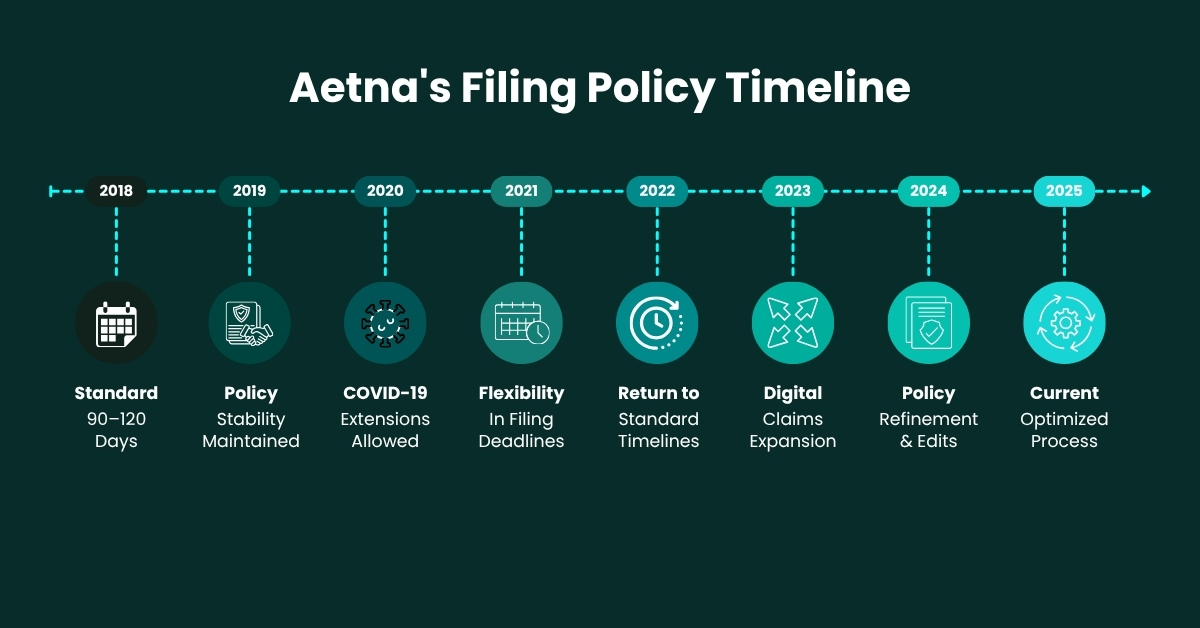
Aetna Timely Filing Limits by Plan Type
Aetna administers multiple product lines, and the filing deadline differs meaningfully across them. The table below reflects current 2025 standards based on Aetna’s provider documentation and multiple verified billing resources. Note that your specific provider contract may override these general standards and always cross-reference with your signed agreement.
| Plan Type | Filing Limit | Non-PAR Window | Corrected Claim | Denial Code |
|---|---|---|---|---|
| Commercial PPO/EPO (PAR) | 90 Days | 12 Months | 180 Days (EOB) | CO-29 |
| Commercial HMO (PAR) | 120 Days | 12 Months | 180 Days (EOB) | CO-29 |
| Medicare Advantage | 120 Days | 120 Days | 180 Days (EOB) | CO-29 |
| Medicaid / Better Health | 180 Days* | 180 Days* | 180 Days (EOB) | CO-29 |
| Employer-Sponsored Plans | 90–365 Days** | 12 Months | 180 Days (EOB) | CO-29 |
* Medicaid and Aetna Better Health limits are state-dependent. The 180-day standard is based on Aetna Better Health of Florida's official provider documentation. Other states may apply shorter windows. Confirm with your state-specific Aetna Medicaid provider manual.
** Employer-sponsored plan windows are defined in the Summary Plan Description (SPD). The range varies widely by employer contract. Always verify the specific plan document or call Aetna Provider Services before assuming a deadline.
Aetna Timely Filing Limits by Plan Type (Days from Date of Service)
| Commercial PPO/EPO | 90 days |
| Commercial HMO | 120 days |
| Medicare Advantage | 120 days |
| Medicaid / Btr. Hlth | 180 days |
| Employer Plans (max) | 365 days |
How Aetna's Limits Compare to Other Major Payers
For practices that manage multiple payer relationships, it is helpful to see Aetna’s windows alongside those of other major insurers. The table below reflects general 2025 standards across commonly encountered payers. State-specific rules and individual contracts may vary.
| Payer | Commercial Limit | Medicare Advantage | Corrected Claim |
|---|---|---|---|
| Aetna | 90–120 Days | 120 Days | 180 Days |
| UnitedHealthcare | 90–180 Days | 90–180 Days | 180 Days |
| Cigna | 90–180 Days | N/A (no MA) | 180 Days |
| Humana | 90 Days | 90–180 Days | Varies |
| Original Medicare | N/A | 12 Months | 365 Days |
As the table illustrates, Aetna’s commercial window of 90–120 days is broadly in line with commercial norms across the industry. The outlier to watch is Original Medicare, which provides 12 full calendar months under 42 CFR § 424.44,a timeline that does not apply to Medicare Advantage plans sold through Aetna or any other private insurer.
What Happens When the Deadline Is Missed?
The CO-29 Denial Code
A claim submitted after the timely filing window closes is denied with CO-29: ‘The time limit for filing has expired.‘ This denial code appears on the Explanation of Benefits (EOB) or Electronic Remittance Advice (ERA) and is issued immediately upon processing, there is no grace period, no warning notice, and no partial payment.
Note: Some older sources incorrectly cite CO-45 for late filing. CO-45 refers to charges exceeding the contracted fee arrangement. CO-29 is the correct denial code for timely filing violations. If CO-29 appears on an ERA, it should be flagged immediately for review against the original submission date.
Permanent Revenue Loss
A CO-29 denial almost always converts to a permanent write-off. The provider cannot collect the balance from the patient doing so would constitute balance billing, which is prohibited under most Aetna provider contracts and regulated by law in many states.
Why Standard Appeals Rarely Succeed
Aetna does not allow appeals based on human error, staffing gaps, software failures, or oversight. Appeals for CO-29 denials are not processed through Aetna’s standard reconsideration pathway. The only route is a formal exception request supported by documented proof of an extenuating circumstance, a bar that is rarely cleared.
A specialty billing clinic in Colorado discovered that after 60 days of accumulating denials its team had been assuming a 180-day commercial window with Aetna when the actual contract specified 90 days. By the time the error was identified, the practice had to write off over $12,000 in permanently denied claims. No appeal was successful.
Corrected, Adjusted, and Appeal Claims
Corrected Claims
When an original claim requires a correction, a wrong CPT code, incorrect patient ID, wrong place of service a corrected claim must be submitted within 180 days from the date of the original EOB or ERA. Corrected claims must include Frequency Code 7 to be recognized by Aetna’s adjudication system as a replacement rather than a duplicate submission.
A common and costly error is submitting a corrected claim without Frequency Code 7, which causes the claim to process as a duplicate and triggers an automatic denial, usually with CO-18. That denial is then mistakenly worked as a late-filing issue when the actual problem is missing frequency code data.
Appeal Claim Deadlines
| Appeal Level | Deadline | Calculated From |
|---|---|---|
| 1st-Level Reconsideration | 180 Days | Date on the denial notice |
| 2nd-Level Appeal | 60 Days | Date of 1st-level decision |
| Timely Filing Reconsideration (Exception) | Case-by-case | Documentation of extenuating circumstance required |
It is important to understand that a standard appeal does not reverse a CO-29 denial. CO-29 is not subject to first-level reconsideration. Only a formal exception request tied to a documented extenuating circumstance has any realistic chance of reconsideration, and even then, approval is not guaranteed.
Valid Exceptions That May Grant an Extension
Aetna’s policy on timely filing is strict, but a defined set of documented exceptions exists. These are reviewed on a case-by-case basis and require thorough, contemporaneous documentation to be considered:
- FEMA-declared natural disasters affecting the provider’s geographic area at the time of service or billing
- Eligibility verification delays caused by Aetna’s own system failures or incorrect member ID data provided by the plan
- Retroactive eligibility assignments, when a patient’s coverage was not known or confirmed at the time of service
- Prior authorization disputes that caused a delay in service delivery or claim submission
- Documented Aetna EDI gateway outages with timestamped technical records
In order to seek an exception, the provider must file a formal reconsideration request via the provider dispute channel of Aetna- not via regular claim resubmission. This request must contain all the pertinent documentation, a written explanation of the extenuating circumstance and hopefully a communication history with the Aetna Provider Services which substantiates the timeline.
Exceptions are not a reliable safety net. Practices that depend on exceptions as a backup strategy will find the approval rate unpredictable and the process resource-intensive. Prevention remains the only dependable approach.
Beat Aetna Deadlines. Get Paid Faster.
Start Your Free Audit Now
Practical Strategies to Never Miss a Deadline
Set your internal filing target at 45 days from the date of service for every payer, without exception.
Submit Electronically Without Exception
Electronic claims submitted through a clearinghouse or direct EDI connection receive an immediate acknowledgment report confirming the claim was received by Aetna’s system. That timestamp is your proof of timely filing. Paper claims mailed near the deadline carry significant risk. Aetna’s clock starts only when the paper document arrives at the physical mailroom, which could be several business days after the envelope was dropped in the mail.
Build a Payer-Specific Deadline Matrix
A single universal deadline applied across all payers is one of the most common and most preventable causes of CO-29 denials. Aetna’s commercial window is not the same as Aetna’s Medicare Advantage window, which is not the same as Aetna Medicaid. A payer-specific matrix, updated at least annually and reviewed against every active provider contract, eliminates this source of error entirely.
Automate Deadline Alerts at Three Thresholds
Deadline-based claim warnings are available in most of the modern practice management systems and clearinghouses. The use of alerts at 60 days, 30 days and 15 days before the end of a filing window will ensure that the aged unresolved claims are addressed before it is too late.
Never Confuse a Rejection for a Denial
As discussed in Section 1, a rejected claim never entered Aetna’s system. The filing clock is still running. Any claim flagged as rejected must be corrected and resubmitted immediately. Treating it as a low-priority queue item is a common path to an avoidable CO-29.
Review Your Provider Contract Annually
Aetna can update contract terms during renegotiation cycles. The only authoritative source for your specific deadline is your current, signed provider agreement. A 30-minute annual review of the timely filing clause in every active Aetna contract is one of the highest-return administrative tasks available to any billing department.
Maintain Organized Proof of Submission
Every claim submission should be archived with its EDI acceptance receipt or batch confirmation file. These records are the primary evidence in any exception request or dispute. Storing them alongside the claim record in your billing software, linked by claim number and date of service ensures they can be retrieved instantly if ever needed.
For further reading on revenue cycle best practices, visit Aetna’s Official Provider Portal or review CMS guidance on timely claim filing under 42 CFR § 424.44.
Frequently Asked Questions
What is the Aetna timely filing limit for commercial plans in 2025?
For participating (PAR) providers, the standard window is 90 days for commercial PPO/EPO plans and 120 days for HMO plans, measured from the date of service. Your specific provider contract may specify a different window. Always verify against your signed agreement.
Does the filing clock start when I submit, or when Aetna receives the claim?
It starts when Aetna receives and accepts the claim, not when you submitted it internally. For paper claims, the clock starts on the date of mailroom receipt. For electronic claims, the EDI acknowledgment timestamp is what matters.
What denial code does Aetna issue for late-filed claims?
CO-29: ‘The time limit for filing has expired.’ Note: CO-45 (sometimes incorrectly cited in older resources) relates to fees exceeding contracted rates and is a different denial type entirely.
Can I bill the patient after a CO-29 denial?
In almost all cases, no. Balance billing for CO-29 denials is prohibited by most Aetna provider contracts and, in many states, by law. The loss is typically absorbed as a practice write-off.
How long do I have to submit a corrected claim?
Corrected claims must be submitted within 180 days from the date of the original EOB or ERA. Always include Frequency Code 7 on corrected submissions.
Does Aetna Medicare Advantage follow Original Medicare’s 12-month rule?
No. Original Medicare follows a 12-month calendar year under 42 CFR § 424.44. Aetna Medicare Advantage enforces its own 120-day window, a separate, much shorter deadline governed by Aetna’s plan contracts, not CMS regulations directly.
What are the appeal deadlines after a denial?
First-level reconsideration must be filed within 180 days from the denial notice date. Second-level appeals must follow within 60 days of the first-level decision.
Are there valid exceptions to Aetna’s timely filing rules?
Yes, but they are narrow and require thorough documentation. Accepted grounds include FEMA-declared disasters, Aetna-side eligibility errors, retroactive coverage assignments, and EDI gateway outages. Human error and oversight are not accepted grounds.
Conclusion & Next Steps
Of all the administrative risks in medical billing, timely filing denials stand out because they are almost entirely preventable yet continue to cost healthcare providers significant revenue each year. For Aetna specifically, the combination of a strict 90-to-120-day commercial window, an even shorter Medicare Advantage deadline, and a CO-29 denial that bypasses standard appeals makes proactive management essential rather than optional.
The core principles are straightforward: submit electronically, track by payer rather than by a generic rule, set internal targets well ahead of the actual deadline, and review provider contracts annually. Practices that build these habits into their revenue cycle workflow find that CO-29 denials become rare events rather than routine write-offs.
Is your practice at risk from Aetna timely filing denials?
✅ Audit open claims for approaching Aetna deadlines today
✅ Review your Aetna provider contract for exact filing windows
✅ Partneri with Vigilant billing team to eliminate CO-29 denials
Accuracy Notes & Corrections to Common Misconceptions
- CO-29 (not CO-45) is the correct denial code for timely filing violations. CO-45 refers to fee schedule discrepancies and is a different denial type entirely.
- Aetna Medicare Advantage follows a 120-day window not Original Medicare’s 12-month CMS rule under 42 CFR § 424.44.
- Non-PAR providers have been subject to a 12-month (not 27-month) limit since January 1, 2022 practices still operating on the old assumption risk permanent write-offs.
- The 180-day corrected claim window is calculated from the EOB/ERA date, not the original date of service.
Disclaimer: Aetna timely filing limits may vary based on your specific provider contract, state regulations, and plan type. Always verify deadlines directly with Aetna Provider Services or your billing compliance team.
Sources: Aetna Provider Portal (aetna.com) | Aetna Better Health of Florida Provider Manual (Official PDF) | 42 CFR § 424.44 (CMS) | CareSolution MBS (January 2026) | Lighthouse Lab Services Aetna Non-PAR Policy Update (2022) | MedStates Medicare Advantage TFL Guide (April 2026) | CHB Medical Billing (December 2025) | MedCare MSO (April 2025).