Introduction:
Telehealth is now being integrated into everyday care, yet the small two-digit code that tells a payer where the patient sat during a virtual visit is still being mixed up across practices nationwide.
At Vigilant Medical Group, we pay special attention to the tiny details in order to avoid any revenue loss. As an AI-powered revenue cycle partner serving providers in all 50 states, we have watched these tiny coding slips quietly drain revenue from otherwise healthy practices. The good news is that the rule behind these two codes is far simpler than it looks once the logic is understood.
What is a Place of Service Code?
Place of Service (POS) codes are two-digit numbers that are entered on professional claims so the setting of care can be communicated to the payer.
- These codes are used on the CMS-1500 (837P) claim form.
- The reimbursement rate that gets applied is often determined by the POS code.
- Whether a claim is paid, delayed, or denied can be affected by which code is chosen.
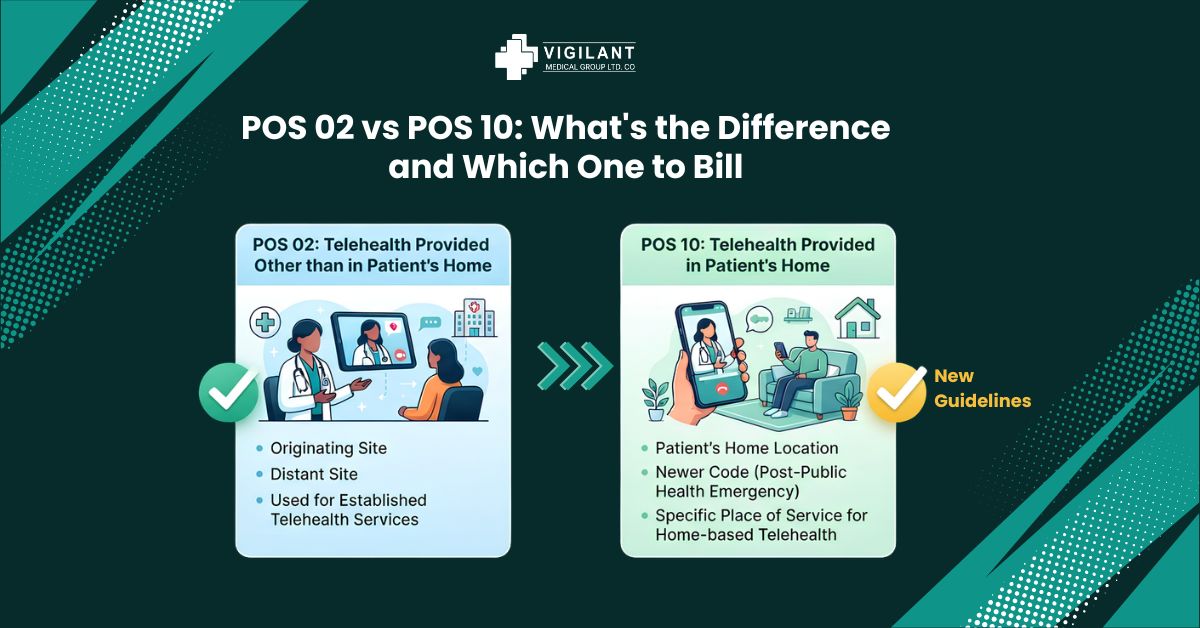
For telehealth specifically, two codes are relied on: POS 02 and POS 10. Both signal that care was delivered virtually, but they are separated by one detail that matters enormously.
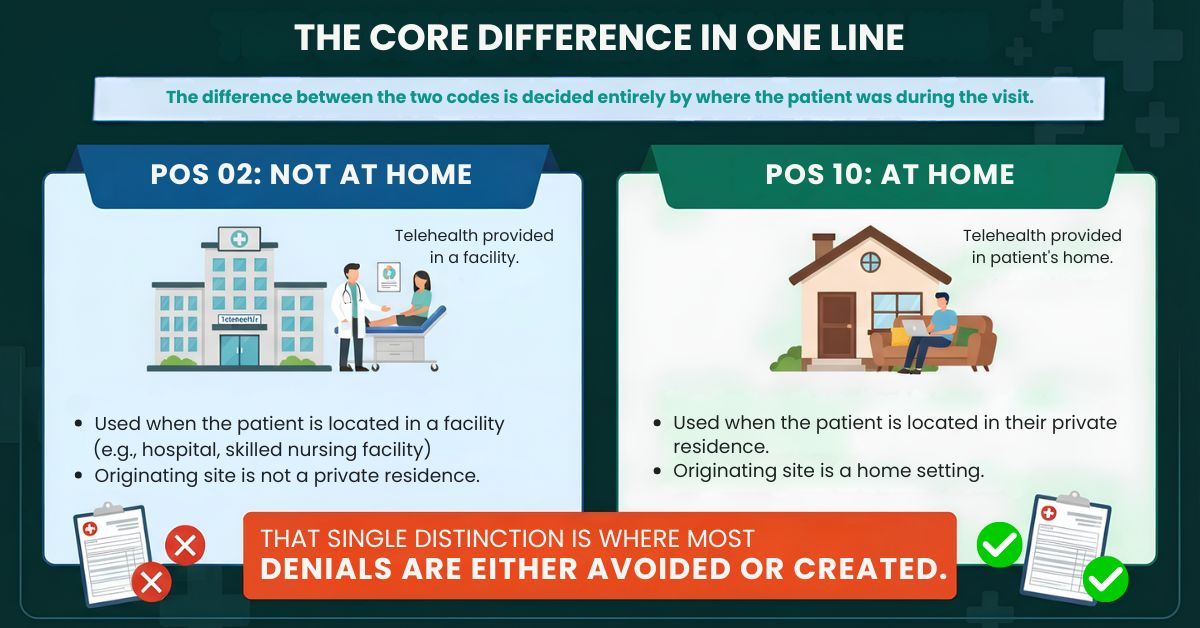
POS 02 = Telehealth When the Patient Is Not at Home
POS 02 is the code that should be selected when a telehealth service is furnished and the patient is located somewhere other than their home.
Typical POS 02 settings include:
- A hospital or hospital outpatient department
- A clinic, school, or community center
- A skilled nursing facility
- An employer’s office where a secured video visit is accessed
The deciding factor is patient location, not provider location. Where the healthcare provider happens to be sitting is not what controls this code; the patient’s setting is what gets reported.
POS 10 = Telehealth When the Patient Is at Home
POS 10 is the code that should be applied when a telehealth service is delivered and the patient is located in their home during the encounter.
“Home” can include a private residence, temporary lodging, or another non-facility living arrangement.
POS 10 was added to the national code set effective January 1, 2022, and was made available for Medicare billing on April 1, 2022.
This code was created so that home-based virtual care could be separated from facility-based virtual care.
Why the Choice Affects Your Payment
Reimbursement is not treated the same across these two codes, which is why accuracy is rewarded financially.
- Claims billed with POS 02 are typically reimbursed at the facility rate, which is generally lower.
- Claims billed with POS 10 are usually reimbursed at the non-facility rate, which is generally higher.
Starting January 1, 2024, the non-facility (higher) rate was applied to POS 10 telehealth services under the Physician Fee Schedule, which marked a shift from earlier policy.
In short, when POS 10 services are mistakenly billed as POS 02, reimbursement is frequently shortchanged. When POS 02 services are billed as POS 10, audit and recoupment risk is increased.
If the patient was at home → POS 10 should be billed. If the patient was in a facility, school, workplace, or any non-home setting → POS 02 should be billed. If the location cannot be confirmed from the documentation → the claim should be held until verification is completed.
The Role of Modifiers:
POS codes are not the whole story, because telehealth modifiers are also expected by most payers.
Modifier 95 is appended when the service is delivered through real-time, synchronous audio-video technology.
Modifier 93 is appended when the service is delivered audio-only.
Modifier GT is still requested by some payers, particularly within certain Medicaid plans.
The mode of delivery is described by the modifier, while the patient’s location is described by the POS code. Both are needed for a clean claim.
Common Mistakes That Trigger Denials
Most telehealth rejections that are reviewed by our team trace back to a handful of repeat errors.
- The patient’s location is not documented, so the chosen POS code cannot be supported during an audit.
- A default POS 02 setting is left unchanged in the EHR from pandemic-era workflows, even when POS 10 should now be used.
- Payer-specific rules are ignored, since not every commercial plan or Medicaid program follows CMS guidance exactly.
- Provider eligibility is overlooked, because not all provider types are reimbursed for telehealth under every plan.
- The POS code and modifier are mismatched, which causes the claim to be flagged.
Documentation That Protects the Claim
Strong documentation is what allows a POS code to be defended if a claim is ever reviewed.
- The patient’s location should be recorded at the start of the visit (for example, “patient located at home” or “patient located at workplace”).
- The telehealth platform and the modality (audio-video or audio-only) should be noted.
- Patient consent and visit details should be captured in the note.
A pre-charting prompt or an EHR checkbox is often recommended so that location is captured every single time without being left to memory.
Payer Rules Are Not Always Identical
CMS guidance provides the foundation, but it should never be assumed that every payer follows it.
- A POS value that is accepted by one plan may be rejected by another, even for the same service.
- Some commercial payers and Medicaid managed care organizations require their own POS values or modifier combinations.
- Payer-specific telehealth rules should be verified before claims are submitted, ideally through a quick-reference grid built for your top payers.
Frequently Asked Questions
What is the difference between POS 02 and POS 10?
The difference is determined by the patient’s location during the telehealth visit. POS 02 is used when the patient is not at home, while POS 10 is used when the patient is at home.
When should POS 10 be used instead of POS 02?
POS 10 should be used whenever a telehealth service is delivered and the patient is located in their home at the time of the encounter. If the patient is in a facility, clinic, school, or workplace, POS 02 should be used instead.
Does POS 02 reimburse less than POS 10?
In most cases, yes. POS 02 is typically paid at the facility rate, which is lower, while POS 10 is generally paid at the higher non-facility rate under current Physician Fee Schedule policy.
What modifiers are used with POS 02 and POS 10?
Modifier 95 is used for real-time audio-video telehealth, and Modifier 93 is used for audio-only telehealth. Modifier GT is still required by some payers, especially within certain Medicaid plans.
Do all insurance payers accept POS 10?
Not always. While Medicare and most major payers accept POS 10, some commercial insurers and Medicaid managed care plans apply their own POS and modifier rules, so payer policies should always be verified.
Is POS 10 only used for Medicare?
No. POS 10 can be used across many payers, but the exact reimbursement and acceptance rules vary, so each payer’s telehealth policy should be checked before billing.
Final Thoughts
The choice between POS 02 and POS 10 comes down to one honest question, where was the patient sitting during the visit, yet that one question quietly decides whether a telehealth claim is paid correctly, underpaid, or sent back for rework. When the logic is understood and the documentation is consistent, these codes stop being a source of denials and start protecting revenue the way they were designed to.
- Telehealth claims are reviewed against current CMS rules and payer-specific requirements, location and modifier mismatches are flagged before submission, and clean claims are pushed out so reimbursements keep moving. If POS 02 and POS 10 errors have been slowing your payments, a review by our certified billing and coding team can help your practice stay compliant, reduce denials, and recover the revenue that should have been collected all along.