

Charge capture in the field of medical billing is how a medical practice records every billable service it provides. A doctor sees a patient, runs a test, or performs a procedure, and that work has to be written down, coded, and sent to the payer. If it never gets recorded, it never gets paid. That is the whole idea in one line.
Vigilant Medical Billing Group was built around this exact problem. Practices lose real money at this step, often without knowing it, and our job is to catch what would otherwise disappear. You can read more about what we do at www.vigilantbillingms.us.
Why Charge Capture Matters
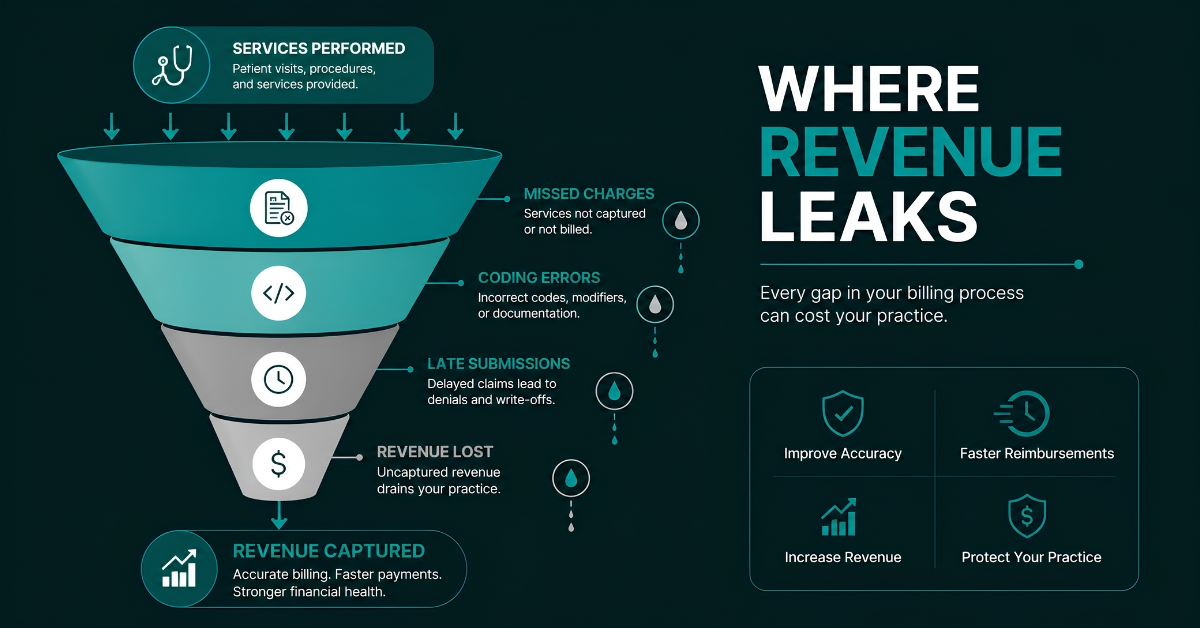
Think of charge capture as the front door of your revenue cycle. Everything that happens later, the claims, the payments, the reports, depends on what walks through that door.
Here is a small example. A cardiologist sees 24 patients on a busy Tuesday. Two EKGs never make it from the exam room to the charge slip. Nobody notices, because a missed charge does not trigger a denial or an alert. It just vanishes. Let that happen a few times a week and the losses pile up fast.
This is not a rare problem. Research cited by the Healthcare Financial Management Association (HFMA) puts the typical yearly loss from weak charge capture at over 100,000 dollars per practice. The Medical Group Management Association (MGMA) has flagged the same pattern in its practice data for years.
When charge capture works well, a few things change:
- You get paid for the work you actually did.
- Fewer denials, so your staff spends less time on rework.
- Payments arrive faster.
- Your records hold up better in payer and CMS audits.
- Your reports finally reflect what really happened in the clinic.
How the Charge Capture Process Works
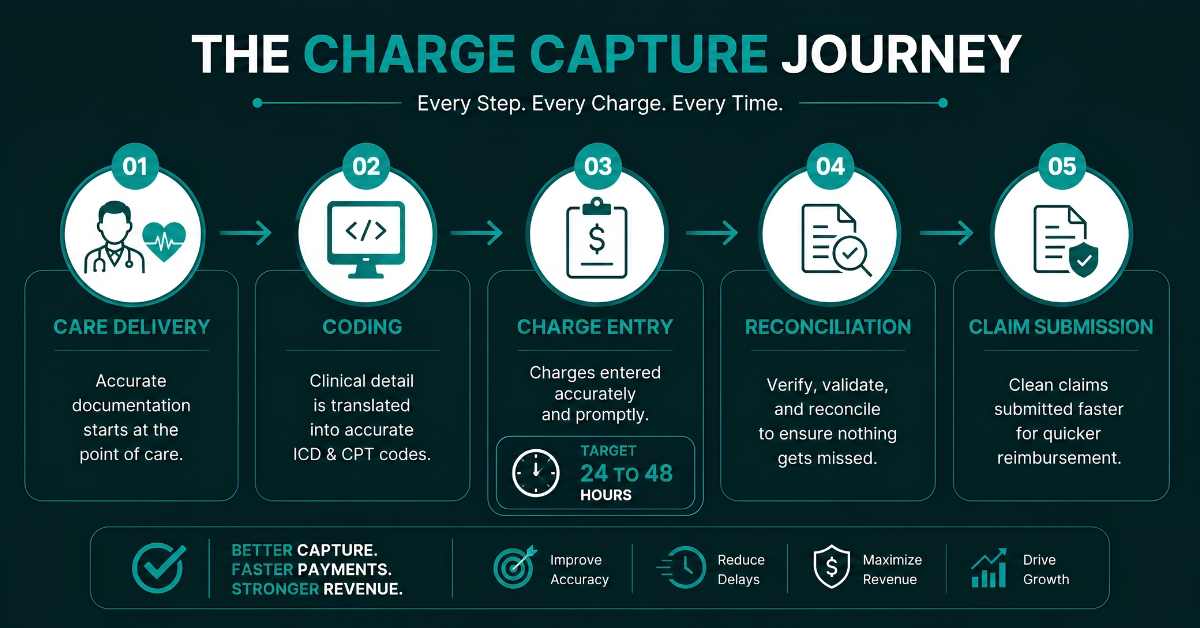
The flow itself is not complicated. The hard part is doing it accurately, every day, for every patient.
- The provider treats the patient and documents the visit.
- A coder assigns CPT, HCPCS, and ICD-10 codes to each service.
- The charges go into the billing system with the right fees and modifiers.
- Someone checks the charges against the schedule and the clinical notes. This step catches most missed charges.
- The claim goes out to the payer.
The coding rules change every year. Official guidance comes from the Centers for Medicare and Medicaid Services (CMS), and organizations like the AAPC train and certify the coders who apply those rules.
Common Charge Capture Errors
Missed charges. The service happened, but nobody recorded it.
- Wrong codes. A bad CPT or ICD-10 code gets the claim denied.
- Undercoding. The visit was a level 4, but it went out as a level 3. Providers often do this out of caution, and it quietly costs them.
- Modifier mistakes. Payers reject these fast, and each rejection means rework.
- Charge lag. Charges sit for a week before anyone enters them. Some miss the filing deadline entirely.
- Reconciliation gaps. The schedule says 22 patients. The billing system shows 20. Where did the other two go?
A missed charge never triggers a denial. Denials show up in reports because the payer rejected something. A missed charge just never enters the system, so no report ever flags it. That is why revenue leakage from charge capture is so hard to spot without a proper audit.
Manual vs Automated Charge Capture
Plenty of practices still run on paper charge slips. It can work, but the comparison below shows what it tends to cost.
| Factor | Manual Charge Capture | Automated Charge Capture |
|---|---|---|
| Method | Paper charge slips, manual typing | Digital capture tied to the EHR |
| Error Risk | High. Charges get missed or mistyped | Low. The system flags gaps as they happen |
| Speed | Charges can sit for days | Charges post the same day |
| Charge Lag | Often 3 to 7 days, sometimes longer | Usually under 24 to 48 hours |
| Revenue Impact | Regular leakage and denials | Cleaner claims, faster payment |
Best Practices for Better Charge Capture
- Get charges entered within a day or two of the visit.
- Match charges against the appointment schedule daily, not monthly.
- Pull a random sample of charts each month and audit them for missed charges.
- When codes change in January, make sure your team knows before the first claim goes out.
- Watch three numbers: charge lag, denial rate, and missed charges found in audits.
- Put a second set of eyes on every encounter before the claim leaves.
How Vigilant Medical Billing Group Handles Charge Capture
- Every encounter gets reviewed. Not sampled, reviewed.
- Certified coders handle the CPT, HCPCS, and ICD-10 coding.
- We reconcile charges against your schedule every day.
- Claims go out fast, which keeps charge lag short and denials low.
- You get plain reports showing what was captured, billed, and paid.
One of the first things we do with a new practice is look back at recent encounters. It is common to find services that were performed, documented, and never billed. That is money the practice earned and simply never asked for.
Frequently Asked Questions:
1. What is the difference between charge capture and charge entry?
Charge capture is the whole process, from documenting the service to getting it ready for billing. Charge entry is one step inside it, the moment charges are typed into the billing system. Capture is the process, entry is a task.
2. Who is responsible for charge capture in a medical practice?
Everyone touches it. The provider documents, the coder codes, the billing team enters and reconciles. When one link is weak, the whole chain leaks. Many practices hand the process to a billing partner like Vigilant Medical Billing Group so one team owns it end to end.
3. What is charge lag in medical billing?
Charge lag is the gap between the date of service and the date the charge is entered for billing. A day or two is fine. A week is a problem. Wait long enough and the claim can miss the payer filing deadline, which makes it unpayable.
4. How does charge capture affect the revenue cycle?
It is the first financial step, so every later step inherits its mistakes. A missed charge never produces a denial or a warning. It just quietly lowers revenue, which is why leakage here is so hard to spot in normal reports.
5. What is a charge capture audit?
An audit compares what was documented and scheduled against what was actually billed. It surfaces missed charges, coding errors, and lag. Practices that audit regularly usually recover money in the very first review.
Conclusion:
Charge capture is the part that decides whether you actually get paid for the work you did. Services must be documented, coded correctly, and sent out fast, or the revenue quietly disappears. Missed charges do not announce themselves. They just chip away at your bottom line week after week.