- A patient statement is the final bill sent to a patient after insurance has been processed.
- It is different from an Explanation of Benefits (EOB), which is issued by the insurer.
- Statements that are unclear, delayed, or inaccurate are among the top reasons for non-payment.
- Electronic patient statements are proven to reduce collection time significantly.
- Vigilant Billing’s statement workflow is designed to maximize collections while preserving patient trust.
35%
of patient balances go uncollected by most practices
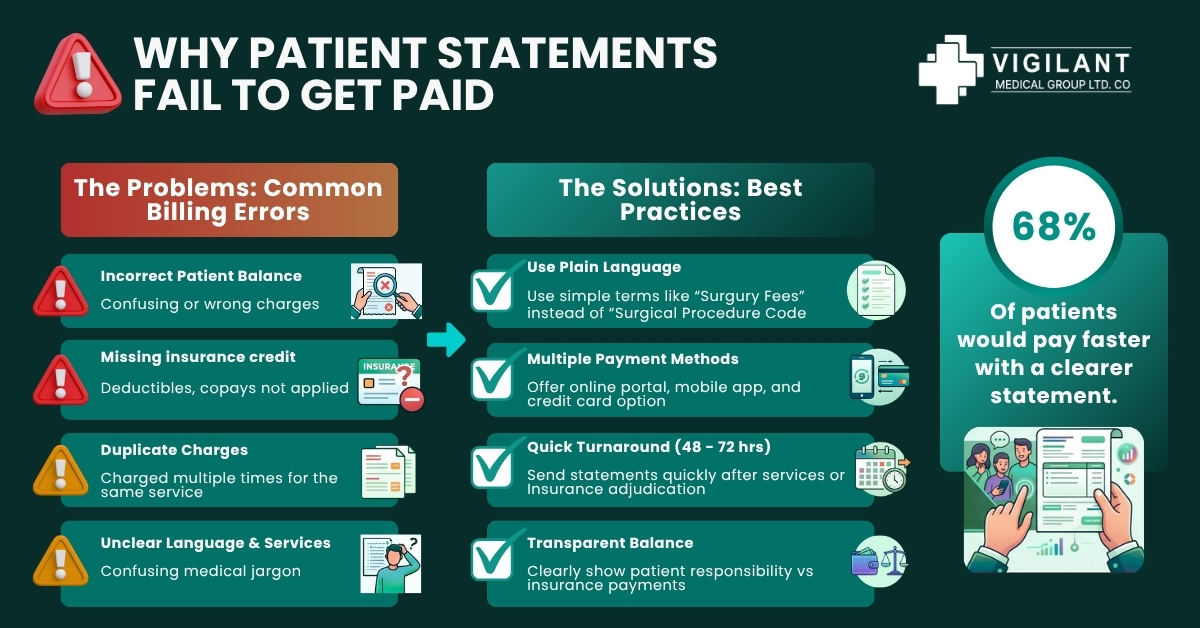
68%
of patients would pay faster with a clearer statement
2.4×
faster payment when electronic statements are used
What Is a Patient Statement in Medical Billing?
EOB vs. Patient Statement: Side-by-Side Comparison
| Feature | Explanation of Benefits (EOB) | Patient Statement |
|---|---|---|
| Issued By | Insurance Company | Healthcare Provider / Billing Office |
| Purpose | To explain what insurance covered | To request payment from the patient |
| Contains Payment Request? | No | Yes |
| Legally Binding? | Informational only | Yes |
| Delivery Method | Mail or patient portal (insurer) | Mail, email, text, or portal |
| When Is It Received? | After insurance processes the claim | After insurance payment is applied |
| Actionable for Provider? | No | Yes |
What a Patient Statement Should Contain
A patient statement that is difficult to understand is a statement that is unlikely to be paid. Clarity, completeness, and professional formatting are not optional, they are revenue-critical. The following elements are expected to be found on every properly prepared patient statement.
| # | Element | Why It Matters | Status if Missing |
|---|---|---|---|
| 1 | Patient Name & Account Number | Identifies the correct patient and links to their account | Non-Compliant |
| 2 | Provider Name, NPI & Address | Lets patient know who is billing them | Non-Compliant |
| 3 | Date of Service | Helps patient recall the visit being billed | Confusion Risk |
| 4 | Description of Services | Plain-language explanation of what was done | Dispute Risk |
| 5 | Total Charges | Original billed amount before insurance | Confusion Risk |
| 6 | Insurance Payment Applied | Shows what was paid by the insurer | Dispute Risk |
| 7 | Adjustments | Contractual write-offs or discounts applied | Confusion Risk |
| 8 | Amount Due from Patient | The actual amount owed must be clear and prominent | Non-Collectible |
| 9 | Payment Due Date | Establishes urgency and reduces delays | Delay Risk |
| 10 | Payment Options | Online, phone, mail more options = faster payment | Revenue Risk |
| 11 | Billing Contact Information | Allows patients to ask questions or dispute errors | Compliance Risk |
| 12 | Financial Assistance Notice | Required for non-profit hospitals under IRS 501(r) | Legal Risk |
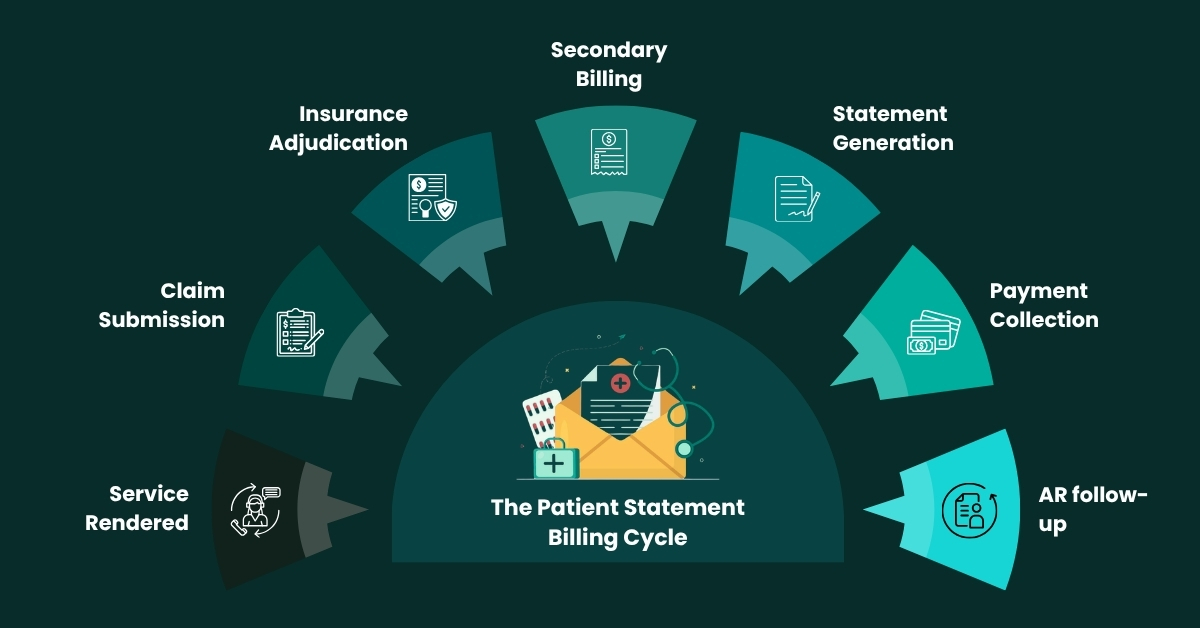
The Patient Statement Billing Cycle Explained
Understanding how a patient statement fits into the broader revenue cycle is important for any practice that wants to optimize collections. The cycle is sequential and any break in the chain is felt in the collections numbers.
Service Is Rendered
The patient is seen, a procedure is performed, or a test is conducted. Demographic and insurance information is captured at the point of care.
Claim Is Coded and Submitted
A coded claim is prepared using ICD-10 diagnosis codes and CPT procedure codes, then submitted to the primary insurance carrier typically within 24–48 hours.
Insurance Adjudicates the Claim
The insurer reviews the claim, applies the patient's benefits, and issues a payment (or denial). An EOB is generated by the insurer.
Secondary Insurance Is Billed
If the patient carries secondary coverage, the remaining balance is submitted to the secondary insurer before any patient billing occurs.
Patient Statement Is Generated
Once all insurance payments have been posted, the patient's remaining responsibility is calculated and a statement is prepared for delivery.
Statement Is Sent & Payment Is Collected
The statement is delivered via mail, email, or patient portal. Follow-up reminders are sent at 30, 60, and 90-day intervals if no payment is received.
Accounts Receivable Follow-Up
Unpaid balances are escalated through the AR follow-up process. At a defined threshold, accounts may be referred to collections based on the practice's policy.
Common Errors Found on Patient Statements
Statement errors are far more prevalent than most practices realize. When a patient receives an incorrect bill, the response is almost always the same they call the billing office, dispute the charge, delay payment, or simply ignore the statement altogether.
The following are the most commonly identified errors in patient statements across the industry, as tracked by organizations like the Centers for Medicare & Medicaid Services (CMS) and the American Hospital Association (AHA).
| Error Type | Frequency | Impact on Collection | Root Cause |
|---|---|---|---|
| Incorrect patient balance | Very High | Immediate dispute / non-payment | Insurance payment posted incorrectly |
| Missing insurance payment credit | High | Overbilling, compliance violation | ERA/EOB not matched to account |
| Duplicate charges | Moderate | Patient complaints, refund requests | System or data entry error |
| Services not rendered | Moderate | Fraud risk, legal exposure | Coding from wrong encounter |
| Wrong patient / wrong account | Moderate | HIPAA violation risk | Demographic errors at registration |
| Incorrect adjustment written off | Moderate | Revenue leakage | Incorrect contractual adjustment posted |
| Missing itemized charges | Lower | Patient confusion, delayed payment | System formatting default |
Billing errors don’t begin at the statement but they begin at registration.
Contact us today and learn more about how to avoid future errors in billing.
Paper Statements vs. Electronic Statements
One of the most impactful decisions a practice can make for its collections rate is the choice between paper and electronic patient statements. Evidence consistently shows that electronic delivery leads to faster payment, lower operational cost, and higher patient satisfaction.
| Metric | Paper | Electronic | Advantage |
|---|---|---|---|
| Average days to payment | 28–45 days | 10–18 days | Electronic |
| Cost per statement | $2.50–$5.00 | $0.10–$0.50 | Electronic |
| Patient open rate | ~55% | ~78% | Electronic |
| Dispute rate | ~14% | ~8% | Electronic |
| Same-day payment option | No | Yes (via payment link) | Electronic |
| Environmental impact | High (paper waste) | Minimal | Electronic |
| Preferred by patients 65+ | Often Yes | Variable | Hybrid recommended |
Legal and Regulatory Considerations
Patient statements are not just billing tools, they are legal documents subject to federal and state regulations. The following regulatory frameworks govern how patient statements are prepared, sent, and managed.
- No Surprises Act (2022): Patients must be provided with good-faith cost estimates prior to scheduled services. Statements that significantly exceed these estimates are subject to a patient dispute resolution process.
- Fair Debt Collection Practices Act (FDCPA): Patient balances that are turned over to collections must follow FDCPA guidelines. Statements must not contain threatening or misleading language.
- HIPAA Privacy Rule: Patient statements contain PHI (Protected Health Information) and must be transmitted and stored in compliance with HIPAA standards.
- IRS 501(r) for Non-Profits: Tax-exempt hospitals are required to include written notice of financial assistance availability on all patient statements.
- CMS Billing Standards: Medicare and Medicaid billing rules mandate specific content requirements and prohibit certain billing practices on patient-facing statements.
Best Practices for Patient Statement Management
A well-managed patient statement workflow is one of the simplest ways to improve a practice’s financial performance. The following practices are followed by high-performing billing teams and are embedded in the Vigilant Billing process.
Timing of Statement Delivery
Statements should be sent within 5-7 business days of insurance payment being posted. Every day of delay is a day of lost revenue. Industry benchmarks from MGMA (Medical Group Management Association) suggest that top-performing practices send statements within 48-72 hours of final payment posting. Visit: www.mgma.com
Plain-Language Formatting
Medical billing is already confusing for patients. Statements written in billing jargon or cluttered with unexplained codes create friction that directly reduces payment rates. Every statement should be formatted so that a patient without any healthcare knowledge can understand exactly what they owe and why.
Multiple Payment Methods
The easier it is to pay, the more likely it is that payment will be received. Statements should include at least three payment methods: online portal, phone, and mail. Text-to-pay features have been shown to increase collection rates among patients under 55, according to InstaMed’s Annual Patient Payments Report (instamed.com).
Systematic Follow-Up Schedule
A single statement is rarely enough. A structured follow-up sequence typically at 30, 60, and 90 days, should be built into the workflow for all unpaid balances. Escalation procedures should be clearly defined for accounts reaching the 90-day threshold.
How Patient Statements Impact Revenue Cycle Performance
| Year | Patient Responsibility as % of Total Revenue |
|---|---|
| 2015 | 19% |
| 2016 | 21% |
| 2017 | 24% |
| 2018 | 26% |
| 2019 | 28% |
| 2020 | 27% |
| 2021 | 30% |
| 2022 | 32% |
| 2023 | 34% |
| 2024 | 37% (projected) |
Source: Kaiser Family Foundation, Employer Health Benefits Annual Survey; TransUnion Healthcare 2024 Report
How Vigilant Billing Manages Patient Statements
| Process Area | Vigilant Billing Approach | Industry Average |
|---|---|---|
| Statement turnaround time | Within 48–72 hours of final payment posting | 7–14 days |
| Statement format | Plain-language, itemized, mobile-optimized | Standard billing template |
| Delivery options | Email, text, portal, and paper (patient preference) | Mail only or email only |
| Follow-up sequence | 30 / 60 / 90-day structured reminders | Single statement, ad hoc follow-up |
| Error audit | Pre-send review on every statement | No standard review process |
| Payment options included | Online, phone, mail, text-to-pay | Phone and mail |
| Financial assistance notice | Included on all qualifying accounts | Inconsistent |