
Key Highlights at a Glance
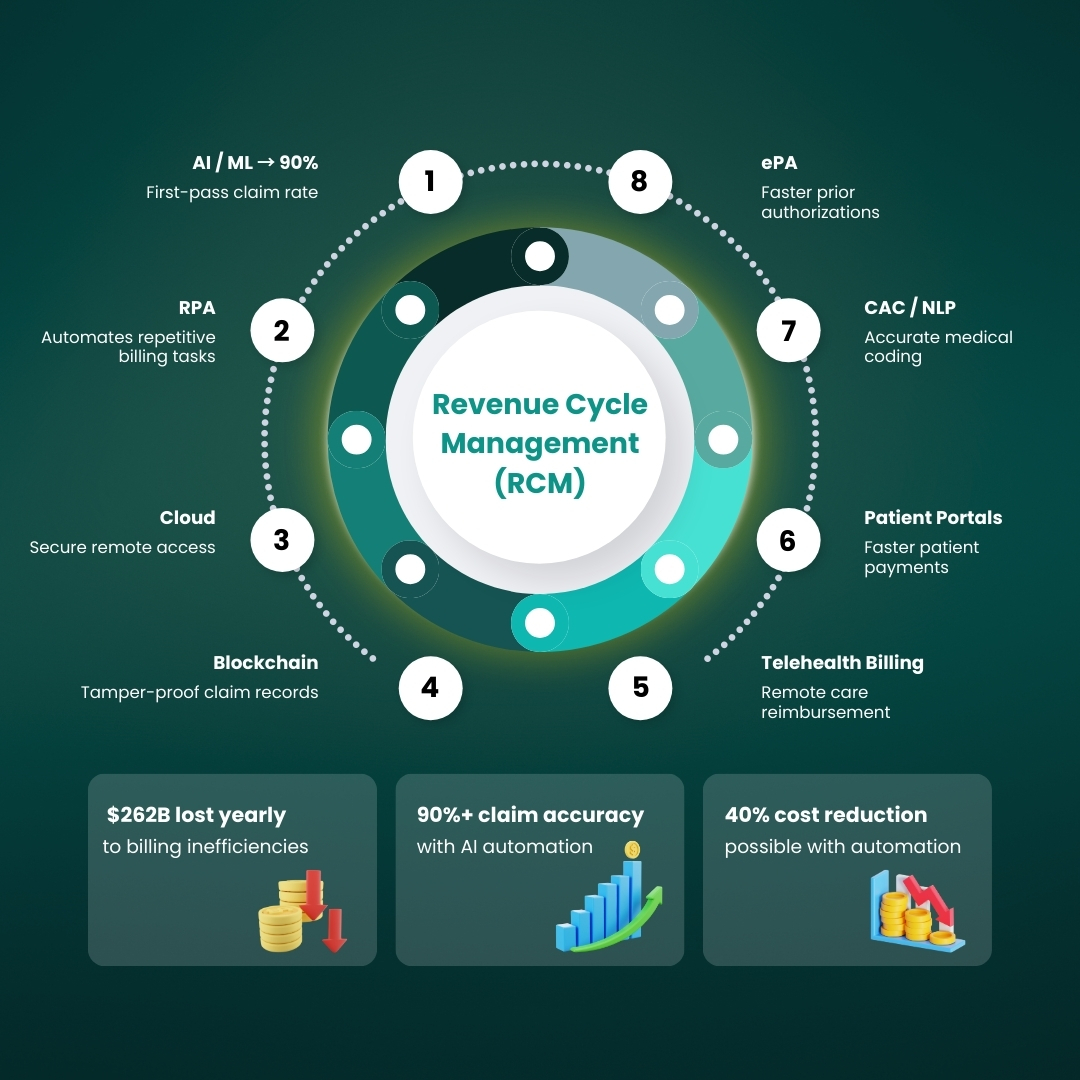
- 90%+ first-pass claim rates achievable with AI-powered claim scrubbing
- $50.47B projected global medical billing outsourcing market by 2034 (CAGR 12.05%)
- 16 hrs/week lost to prior authorization tasks ePA cuts this significantly
- 300+ billing codes now cover digital health technologies, including 117 for software solutions
- 40% reduction in admin billing costs possible with automation
U.S. providers lose an estimated $262 billion in revenue annually mostly from billing inefficiency, not fraud. AI-powered automation alone can cut admin billing costs by up to 40%.
Introduction
1. AI & Machine Learning in Billing
AI is no longer experimental, it’s standard equipment in high-performing billing departments. The American Medical Association has been tracking AI integration in coding workflows, and the results are consistently strong when implementations are done thoughtfully.
The most impactful application is predictive denial management: ML models trained on millions of historical claims flag errors before submission, helping leading platforms achieve 90%+ first-pass resolution rates. Pair that with automated claim scrubbing, NLP-powered ICD-10/CPT code suggestions, and intelligent payment posting and you’re looking at a billing engine that runs faster and more accurately than any manual team can.
One honest caveat: AI billing tools are only as good as the workflows they’re embedded in. Practices getting the best ROI treat it as human-AI collaboration, not a replacement for experienced billers.
2. RPA & Cloud Platforms
Robotic Process Automation puts software bots to work to manage the repetitive and rule-based work that is quietly eating up your team’s days: eligibility verification, claim status check, prior authorization follow-ups, denial re-submissions. According to HFMA benchmarks, organizations operating on RPA standards report a reduction of 30-50% in standard processing time. Bots don’t call in sick, and they don’t make typos at 4pm.
Cloud-based billing platforms are the infrastructure that makes all of this scale. Modern platforms like AdvancedMD and NextGen Healthcare offer HIPAA-compliant, auto-updating environments your team can access from anywhere. If your billing software lives on a local server and requires IT maintenance, you’re carrying unnecessary overhead both in cost and in coding compliance lag.
3. Electronic Prior Authorization (ePA)
4. Patient Portals & Price Transparency
5. Value-Based Care & What It Means for Billing
Now under the CMS’s Quality Payment Program, a significant and rising part of Medicare payment is required to depend on quality indicators, cost efficiency and enhancements actions not simply procedure volume. This is the transition between fee-for-service to value-based care and is gaining momentum.
The billing implication: claims must now capture clinical outcome data alongside procedure codes. Bundled payments require revenue tracking across multiple providers. Denial management now involves clinical documentation disputes, not just coding fixes. Billing teams need to work with clinical teams more closely than ever it’s as much a culture shift as a technology one. Practices not yet in a value-based contract should begin preparing their infrastructure now; the HHS value-based care roadmap makes clear this direction is irreversible.
6. Technology Adoption & Comparison
Here’s where the industry stands right now, and a quick-reference breakdown of each technology’s practical value:
Source: Healthcare IT industry surveys & RCM analytics reports 2025–2026
| Technology | Primary Function | Maturity | ROI Impact | Complexity |
|---|---|---|---|---|
| AI & Machine Learning | Claim coding & denial prediction | High | High | Medium |
| Robotic Process Automation | Workflow bots & automation | High | High | Low |
| Cloud-Based Platforms | Remote access & infrastructure | Mature | Medium | Low |
| Electronic Prior Auth (ePA) | Authorization streamlining | Growing | High | Low |
| Computer-Assisted Coding | Auto ICD-10/CPT assignment | High | High | Medium |
| Patient Billing Portals | Transparency & self-pay | Mature | Medium | Low |
| Blockchain | Fraud prevention & security | Emerging | Long-term | High |
Start with AI claim scrubbing + automated eligibility verification these two deliver measurable ROI within 60–90 days and build the internal confidence to fund the next phase. Layer in patient portals and analytics from there. Need help building your roadmap? Talk to our team.
Vigilant Billing helps practices reduce denials, accelerate reimbursements, and build billing systems that actually work backed by expert human oversight and the latest technology.
- Reduce claim denials
- Faster reimbursements with AI-powered workflows
- Patient billing portals that improve collections
- Full compliance with 2026 coding & regulatory requirements