Your Complete Guide to Dual Coverage
Medical bills are confusing enough on their own but when two insurance plans are involved, the process can feel even more overwhelming. A clear understanding of primary vs secondary insurance is considered essential for anyone by whom dual coverage is carried, whether through an employer, a spouse’s plan, Medicare, or Medicaid.
When multiple health plans are held by a single individual, a coordination process is triggered. This process formally referred to as Coordination of Benefits (COB) is used to determine which plan is paid first, which is paid second, and how much of a medical bill is ultimately covered by each. Without a proper understanding of how COB is applied, unnecessary out-of-pocket expenses may be incurred, claims may be denied, and billing delays may be experienced.
According to a 2025 projection by the Congressional Budget Office, roughly 20 million Americans out of approximately 319 million insured individuals are estimated to be covered under dual health insurance. That is a significant population for whom this topic is directly relevant.
This guide has been prepared to help you understand exactly what primary and secondary insurance are, how the order of payment is determined, and how maximum benefit can be extracted from dual coverage.
According to the U.S. Department of Health and Human Services (ASPE Coverage Report 2024), over 300 million Americans were reported to have some form of health coverage by mid-2024, with a notable share being covered under dual arrangements through employers, Medicaid, or private plans combined.
What Is Primary Insurance?
Primary insurance is defined as the health plan by which a medical claim is processed first. When a healthcare service is received, the claim is submitted directly to the primary insurer by the provider. The primary plan then evaluates the claim according to its own schedule of benefits, its coverage limits are applied, and an Explanation of Benefits (EOB) statement is issued.
For most insured individuals, the plan obtained through their own employer is treated as primary. If two employer-sponsored plans are held simultaneously by a person, the plan that has been held for the longer period of time is generally designated as primary.
The primary insurer is not made aware of nor influenced by any secondary coverage that may be held. Claims are assessed and paid exactly as though no secondary coverage existed.
What Is Secondary Insurance?
Secondary insurance is the backup plan by which the remaining balance is addressed after the primary insurance has paid its portion. The remaining amount which may include deductibles, copayments, coinsurance, or services that were only partially covered is submitted to the secondary insurer together with the EOB that was issued by the primary payer.
It is important to note that double payment is not permitted under secondary insurance. The combined benefits of both plans are never allowed to exceed 100% of the actual cost of the medical service that was received. What the primary plan failed to pay is paid by the secondary plan instead, however, subject to the coverage rules and limits of the secondary plan.
Ordinary sources of secondary coverage include employment based coverage by the employer of a spouse, Medicaid, Medicare Supplement (Medigap) plans or even a parental plan where the dependent below the age of 26 is covered by the Affordable Care Act.
Primary vs Secondary Insurance Comparison
| Feature | Primary Insurance | Secondary Insurance |
|---|---|---|
| Claims | Paid first | Paid second (after primary) |
| Coverage Role | Main/primary coverage | Supplemental/gap coverage |
| Claim Submission | Submitted directly | Submitted after primary EOB is received |
| Deductibles | Own deductible is applied | A separate deductible may be applied |
| Typical Source | Employer or individual plan | Spouse, parent, or Medicaid |
| Out-of-Pocket Help | Covered up to its limits | Remaining eligible costs are covered |
| Can Pay 100% Alone? | Yes, if within limits | No payment is only made after primary |
| Payment Limit | Plan coverage limit | Actual cost cannot be exceeded |
| Required for COB? | Yes always processed first | Yes needed to trigger COB |
How Coordination of Benefits (COB) Works
The system through which the claims are made by the health insurance plans in case a policy holder owns more than one plan is known as Coordination of Benefits. There are COB rules that have been developed by the National Association of Insurance Commissioners (NAIC) and the majority of states in the United States have adopted the model regulations or have developed their own uniform guidelines.
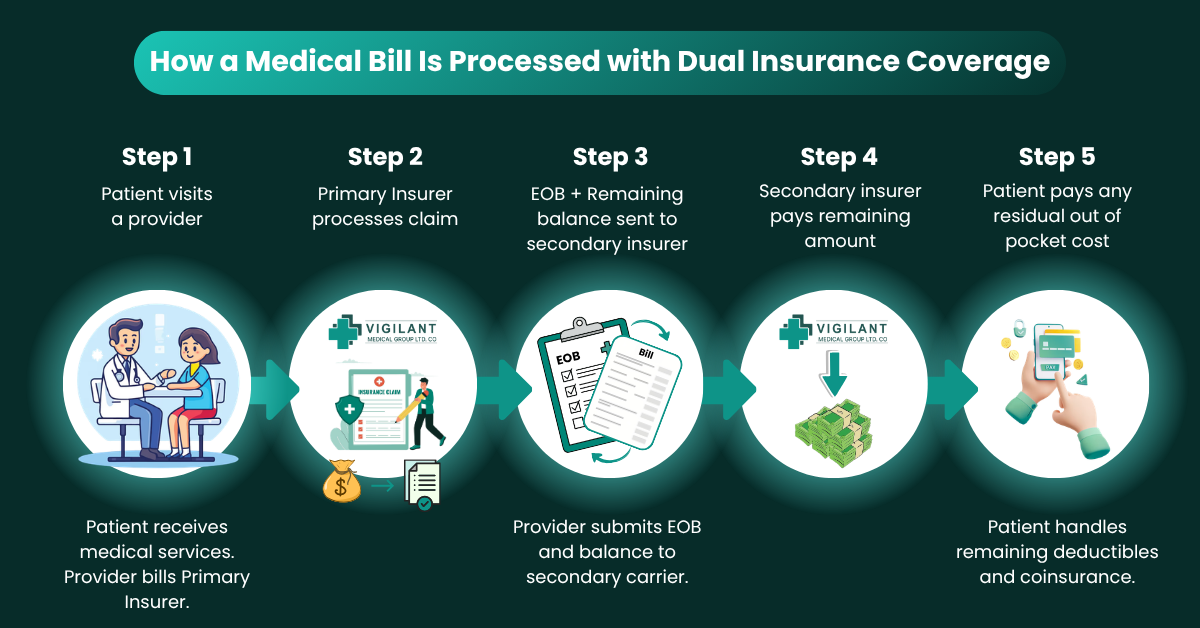
The process unfolds in a straightforward sequence:
- A claim is submitted by the healthcare provider to the primary insurer.
- The claim is processed by the primary insurer and its eligible share is paid.
- An Explanation of Benefits (EOB) is generated and sent to both the patient and the provider.
- The remaining balance, along with the primary EOB, is submitted to the secondary insurer.
- The claim is processed by the secondary insurer, what was already paid by the primary is deducted, and any remaining eligible amount is paid.
- Any costs not covered by either plan are left to be paid by the patient.
COB rules are designed to ensure that no overpayment occurs. If the full allowable amount has already been covered by the primary insurer, no additional payment is required to be made by the secondary insurer.
Both insurance providers should be notified immediately when dual coverage is held. If secondary coverage is not disclosed, claims may be delayed, partial payments may be issued, or outright denial may result. A COB form is typically requested by insurers when the existence of another active policy is detected.
How Is the Order of Payment Determined?
The determination of which plan serves as primary and which serves as secondary is governed by specific rules. These rules are applied in a defined sequence:
1. Subscriber vs. Dependent Rule
When an individual has been enrolled as the employee/subscriber in one plan and as a dependent under the other, the plan in which a person is enlisted as the subscriber will always be considered to be the primary one. This is to say, that on the incidence of ones having their own plan that is sponsored by the employer together with being included as a dependent in a spouse plan, the personal plan is paid out first.
2. Active Employee vs. COBRA/Retiree Rule
The plan under which a person is covered as an active employee is always treated as primary over a plan under which they are covered as a retired, laid-off, or COBRA-continuation participant.
3. The Birthday Rule (for Dependent Children)
In cases where the child is registered on the insurance programs of the two parents as a dependent, the Birthday Rule comes into use. This rule was formulated by NAIC and the plan of the parent whose birthday (month and day, but not year) is earlier in the calendar year is considered to be primary. To illustrate, when the birthday of one parent is on the 10th of February and the other parent is on the 5th of September, the plan of the former is considered primary.
When both the parents share the same birthday, the one that was active the longest can be considered the primary one. It is noted that a court order prevails always when it comes to divorce or legal separation and this supersedes the birthday rule.
4. Medicare-Specific Rules
When Medicare is involved, the order is governed by federal law specifically the Medicare Secondary Payer (MSP) Act. In most cases, an active employer’s group health plan is treated as primary for an active employee, while Medicare is treated as secondary. However, for retirees, Medicare is typically paid first.
Types of Health Insurance Coverage in the U.S.
Approximate distribution of health insurance coverage sources among insured Americans (Source: ASPE HHS Coverage Report, 2024) HHS ASPE Health Coverage Report 2024 — ASPE.hhs.gov
As illustrated above, employer-sponsored coverage remains the most dominant source of primary insurance across the United States. A large portion of individuals by whom dual coverage is carried hold Medicare or Medicaid as secondary, particularly among those aged 65 and above.
Common Real-World Scenarios
Dual Employer Coverage (Married Couple)
When both spouses are employed and each is enrolled in their employer’s plan, each person’s own employer plan is treated as primary for themselves. A spouse may be added as a dependent under the other’s plan, in which case the spouse’s own plan remains primary and the second plan is treated as secondary.
Child Covered by Both Parents
A child who is covered under both parents’ employer plans triggers the Birthday Rule. The parent whose birthday falls earlier in the calendar year is considered to hold the primary plan for the child. The other parent’s plan is treated as secondary, and copays or deductibles left unpaid by the primary may potentially be covered by it.
Medicare + Employer Coverage
An employer plan is considered primary and Medicare secondary with an active employee above 65 years old as long as the employer employs 20 or more workers. In the case of retirees, this order is reached in reverse with Medicare being paid first and any retiree group coverage following.
Medicaid as Secondary Insurance
Medicaid, as a government program, is always treated as the payer of last resort. Any other insurance whether employer-based, ACA Marketplace, or Medicare — is paid before any contribution is made by Medicaid. Remaining eligible costs may then be covered by Medicaid, depending on the state program by which the individual is covered.
Benefits and Drawbacks of Dual Coverage
Benefits
- Deductibles and copays are potential out of pocket costs that can be cut down.
- The more comprehensive coverage is available when a given service is not covered by a given plan.
- The risk of financial exposure when spending the long time in hospitals or under the care of specialists can be minimized.
- Dual coverage may be applied in cases where change of jobs or insurance plan is being done.
Drawbacks
- The benefit of secondary coverage may be outweighed by higher combined premium costs.
- Claims processing is made more complex and time-consuming.
- Network confusion may arise when different in-network requirements are set by two plans.
- Nothing may be paid by the secondary plan if the full allowable amount has already been covered by the primary.
Several practical steps can be taken to ensure that dual coverage is used as efficiently as possible:
- Both insurance companies should be notified immediately upon a second plan being obtained. COB forms should be completed accurately.
- All healthcare providers should be informed of dual coverage before any services are rendered.
- The primary EOB should be retained after every claim, as it will be required when a submission is made to the secondary insurer.
- Deadlines for secondary claim submissions should be carefully tracked, as strict filing windows are imposed by most insurers.
- Both plans should be reviewed annually to evaluate whether the cost of dual premiums is justified by the savings that have been achieved.
- In-network providers who are accepted by both plans should be sought where possible, to avoid unexpected out-of-network charges being incurred.
Frequently Asked Questions (FAQs)
1. Can two health insurance plans be held at the same time?
Yes. Dual coverage is legal and commonly held. COB rules are applied to ensure no overpayment occurs.
2. Who decides which plan is primary?
The order is determined by COB rules, it is not left to personal choice. Subscriber status, employer coverage, and the birthday rule are all applied.
3. What is the birthday rule?
A standard industry practice by which the plan of the parent born earlier in the calendar year is designated as primary for a dependent child.
4. Is Medicaid ever treated as primary insurance?
Medicaid is always designated as the payer of last resort. All other coverage is paid before Medicaid is considered.
5. Can something that is denied by primary be covered by secondary?
Not automatically. If a service is excluded from the primary plan, it may be covered by the secondary if listed under that plan’s own benefits.
6. How is a claim submitted to secondary insurance?
The claim is submitted along with the EOB issued by the primary insurer, within the required filing deadline.
Conclusion
The difference between primary and secondary insurance are the real financial implications that are felt by patients, families, and healthcare providers alike. A thorough understanding of the Coordination of Benefits process, the factors by which payment order is determined, and the most common real-world scenarios will help ensure that medical bills are handled correctly and out-of-pocket costs are kept as low as possible.
Whether dual coverage is held through a spouse’s plan, Medicare, Medicaid, or a parent’s policy, the same principles are applied: primary is paid first, secondary is paid what is left, and the total payments are never allowed to exceed the actual cost of care. Annual plan reviews, timely COB updates, and accurate claim filings are the most reliable strategies by which the benefits of dual coverage can be maximized.
The team at Vigilant Medical Group is available to help you evaluate your primary and secondary coverage, identify coverage gaps, and reduce your out-of-pocket costs.
Get a Free Consultation Today → Call +1-469-799-5556
www.vigilantms.us