Why Smart Psychiatric Practices Are Choosing to Outsource Psychiatric Billing Services in 2026
What are Outsourced Psychiatric Billing Services?
Outsourced psychiatric billing services refer to the engagement of a specialized third-party company to manage the complete revenue cycle of a psychiatric or behavioral health practice. Instead of having a single or two in-house personnel to do all the tasks including claims filing to handling the claim denial, a specialized external team with extensive knowledge in mental health billing is contracted.
Services are usually covered by:
- Checking of insurance and eligibility before appointments.
- CPT and ICD-10 coding that differentiates psychiatric assessment, psychotherapy, and administration of medications.
- Online filing of claims and tracking.
- Denial management and processing of appeals.
- Posting and reconciliation of payment.
- Billing of patients, collections and coordination of payment plans.
- Monitoring compliance (HIPAA, Mental Health Parity Act, CMS guidelines)
- Revenue cycle transparency, reporting and analytics.
The outsourced medical billing market reached $6.28 billion in 2024 and continues to grow at approximately 12% annually. By 2025, outsourced billing services already accounted for 51.3% of the entire mental health billing service market making it the dominant service model in the field.
(Source: Toward Healthcare, 2026)
In contrast with the general medical billing companies, dedicated psychiatric billing partners are aware of the nuances that can make a difference between a paid and an unpaid claim in the mental health environment. These are session-limit tracking, pre-authorization on longer courses of therapy, telehealth coverage policies, and the documentation requirements of behavioral health payers.
When evaluating a billing partner, always ask specifically about their experience with behavioral health payers and CPT codes such as 90791 (psychiatric evaluation), 90837 (60-min psychotherapy), and 99213–99215 (medication management). A generalist billing team may miss nuances that cost your practice thousands in underpayments.
Key Statistics (2024–2025)
These figures are based on the latest reports on the industry and financial organizations operating in the healthcare sector and explain the reason why this model has become so widespread:
- The mental health billing service market is expected to hit the 14.08 billion mark in the year 2035 as compared to its present base of healthy compound annual growth rate.
- In 2025, the largest market share by service model was the outsourced billing services with a 51.3% revenue share of the mental health billing market.
- According to the Healthcare Financial Management Association (HFMA) practices that outsource RCM services have experienced a 10-25 percent growth in collections as a whole.
- Companies that outsource their billing services normally have a 15-25 percent increase in total revenue collection.
- Claim processing time can be reduced by up to 50% through outsourced billing platforms with integrated technology.
- Billing costs can be reduced by up to 30% compared to maintaining an equivalent in-house operation.
- Solo practitioners in the United States spend an average of 10.9% of collections on in-house billing, according to AMA data — whereas outsourcing at 5–7% represents meaningful savings.
- A Texas-based psychiatry group reduced claim denials by 42% within 60 days of transitioning to an outsourced billing service.
Performance Gains:
The following chart illustrates the average performance gains associated with outsourcing psychiatric billing, based on published industry data and reported practice outcomes. These figures represent documented improvements in key revenue cycle metrics:
| Metric | Performance Gain (Best Representation) | Value |
|---|---|---|
| Revenue Improvement |
|
10–25% |
| Billing Staff Reduction |
|
Up to 30% |
| Claim Processing Speed |
|
Up to 50% |
| Denial Rate Reduction |
|
42% (case study) |
| Clean Claim Rate |
|
98%+ |
Sources: HFMA, ZipDo, MediBill RCM LLC, CPa Medical Billing, Toward Healthcare (2024–2026)
In-House vs. Outsourced Psychiatric Billing: Side-by-Side Comparison
One of the most effective ways to evaluate the outsourcing decision is through a direct comparison of measurable factors. The table below draws on current industry benchmarks and reported practice data:
| Factor | In-House Billing | Outsourced Psychiatric Billing |
|---|---|---|
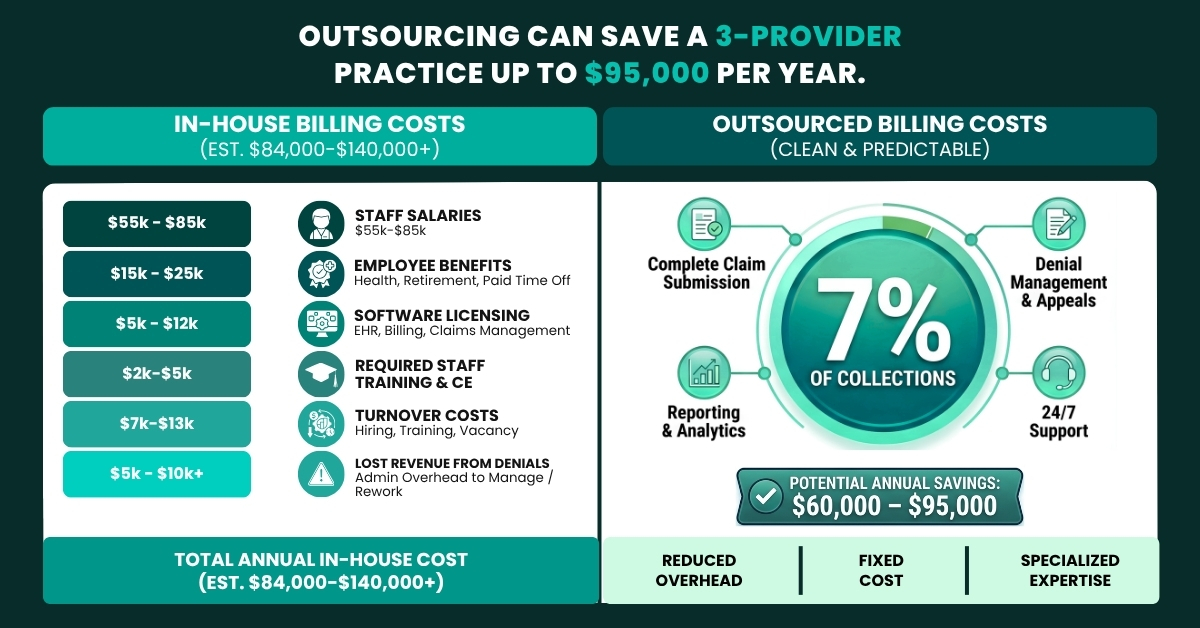
| Annual Cost (3-provider group) | $84,000–$140,000 | $42,000–$70,000 (at 7%) |
| Denial Rate (average) | 12–18% | 2–5% (clean claim rate 98%+) |
| Claim Processing Time | Standard (delays common) | Up to 50% faster |
| Regulatory Compliance | Risk of gaps | Continuously updated |
| Scalability | Requires new hires | Instant, no extra cost |
| Technology Access | Limited / costly | Advanced RCM software included |
| Staff Turnover Risk | High | None (provider's concern) |
| HIPAA Audit Readiness | Variable | Built-in compliance reviews |
| Revenue Improvement | Baseline | 10–25% uplift (HFMA data) |
Sources: MGMA 2024–2025, HFMA, AMA, MediBill RCM LLC, Toward Healthcare
The Best Advantages of Psychiatric Billing Outsourcing
The positive impacts of the change in psychiatric practices, when switching to an outsourced billing model, are experienced at various levels of the organization, including financial, operational, and clinical. This is a breakdown of what that transition entails:
Significant Cost Reduction
The actual expense of having an in-house billing operation is regularly under quoted. A three-provider group, including salaries, benefits, payroll taxes, software licenses, training costs, and turnover costs, generally incurs between $84,000 and 140,000 a year on billing alone. In the case of the same group outsourcing 7-percent of collections, the cost is reduced to around $42,000 – a variance of up to $95,000 every year.
Increased Clean Claim Audits and Reimbursements.
Psychiatric billing outsourced teams will always record a clean claim rate of 98% and above. It implies that virtually all claims are made properly the first time, avoiding the denial-resubmission-sluggish cash flow that bedevils many in-house processes. This, with a 50% decrease in the time to process claims, directly translates into better financial predictability of the practice.
Special Compliance Under the Overhead.
The regulations that pertain to mental health billing, such as the Mental Health Parity and Addiction Equity Act (MHPAEA), CMS regulations, and Medicaid-specific rules, are continually evolving. The 2025 Physician Fee Schedule saw a slight yet significant decrease in the conversion factor of Medicare, reducing to 32.35, which has a direct impact on psychiatric visits. Outsourced billing staff follow up on these changes real-time to ensure that the practice never has to.
Reduced Provider Burnout
Administrative overload is cited as one of the main factors that lead to burnout in mental health providers. By taking billing off of the internal workload, clinicians and support staff are liberated to devote their efforts to patient care, documentation, and practice development. It is not a monetary gain, but a wellbeing gain that has long-term retention consequences.
Data-Driven Financial Visibility
Professional billing partners furnish practices with frequent, comprehensive reports on the collections performance, pending claims, denial patterns, payer pattern, and health of revenue cycle. Such transparency enables practice owners to make strategic decisions as opposed to reactivity.
Scalability No Growing Pains.
An outsourced billing partner can expand immediately to accommodate demand whether a practice is adding a new provider, opening a second location or needs seasonal volume changes. No delays in hiring, no training, no coverage gaps – one of the most important features in an expanding behavioral health organization.
Common Challenges and How Outsourcing Resolves Them
Psychiatric billing is uniquely complex within the broader healthcare billing landscape. The following are the most frequently encountered challenges and the mechanisms by which an outsourced billing partner addresses each one:
| Challenge | How Outsourcing Resolves It |
|---|---|
| Complex CPT & ICD-10 Coding | Special billing departments are regularly trained on psychiatric codes, with the most recent updates of 2024-2025 ICD-10-CM codes used to diagnose mental health and substance use. |
| High Pre-Authorization Requirements | The management of prior authorization is done proactively, with the automated reminder and payer-specific workflow integrated into the billing process. |
| Frequent Regulatory Changes | Outsourced partners are continually updated on CMS changes, MHPAEA enforcement change, and fee schedule revision to immediately apply them. |
| Backlog of Claim Denials and Appeals. | The service is designed to support the workflows of managing denials quickly, including tracking of the root causes to avoid future occurrences of denials. |
| Staff Turnover and Gaps in Knowledge. | Billing continuity is maintained regardless of internal staff changes, as the external team holds all process knowledge. |
| Telehealth Billing Complexity | Providers are guided through payer-specific telehealth rules, including 2025 Medicare requirements and coverage nuances for remote psychiatric services. |
How to Choose the Right Psychiatric Billing Partner
Not all billing companies are created equal, and the wrong partnership can create new problems rather than solving existing ones. Several criteria deserve careful evaluation when a billing partner is being selected:
- Look for a company whose primary focus is mental health and psychiatric billing
- A good partner must be capable of supplying clean claim rates which are documented preferably at 95-98 and above.
- Handling of patient data is done with a high degree of confidentiality. Check HIPAA compliance position of the company, data encryption policy and breach response protocols.
- The billing partner must be capable of smoothly integrating with the already established electronic health record systems to reduce the need of manual data entry and risk of errors.
- Reports on collections, denials, A/R aging and payer performance should be standard and not optional and should be done monthly (or more often).
- Request references of practices of an equal size and specialty prior to commitment.
- Know the fee structure (percentage-based, flat-rate, or hybrid)? and make sure that there are no onboarding or setup fees which were not revealed initially.
Frequently Asked Questions (FAQs)
How much does it cost to outsource psychiatric billing?
The majority of psychiatric billing outsourced services are based on a percentage of 5 to 8 percent of collections with behavioral health billing being on the higher side owing to the complexity of coding.
Would outsourcing reduce control over billing of my practice?
No. Billing partners offer complete transparency in the form of periodic reports, real-time dashboard, and account managers. All billing decisions are maintained by practices, and the billing team is not a black box but more of an extension of the organization.
Is outsourced psychiatric billing HIPAA compliant?
It must be. Any billing partner handling protected health information (PHI) is required to operate as a HIPAA Business Associate, with a signed Business Associate Agreement (BAA) in place. Always verify this before signing any service contract.
How long does the transition to outsourced billing take?
Onboarding timelines vary by provider and complexity, but most practices can expect a transition period of two to six weeks. During this period, the billing partner learns the practice’s workflows, configures system integrations, and begins taking over claim processing in a structured handoff.
What types of psychiatric practices benefit most from outsourcing?
Solo practitioners with no dedicated billing staff, group practices experiencing denial rates above 10%, telehealth-heavy practices navigating complex payer rules, and rapidly scaling organizations all represent strong candidates for outsourcing. The model is effective across practice sizes.
- Vigilant Billing specializes in outsourced psychiatric billing services built for mental health and psychiatry practices of every size. From claim submission to denial management, every step of your revenue cycle is handled by certified billing experts who understand behavioral health inside and out.
- Let Vigilant Billing turn your billing challenges into consistent, reliable revenue.