
RPA in Healthcare Claims Processing: What It Is, How It Works, and Why It Matters
RPA is software that mimics what a human does at a computer; logging into systems, copying and pasting data, filling out forms, clicking through portals but does it automatically, without anyone sitting at the keyboard. It does not think or make decisions the way AI does. It simply follows a defined set of instructions, precisely and consistently, every single time.
At Vigilant Medical Billing Group, a significant portion of the work done on behalf of client practices involves tasks that are repetitive, rule-based, and time-sensitive, exactly the kind of work that Robotic Process Automation, or RPA, was built for.
This blog covers what RPA is in healthcare claims, where it is being applied across the revenue cycle, what measurable results have been observed, and what every practice should understand before considering adoption.
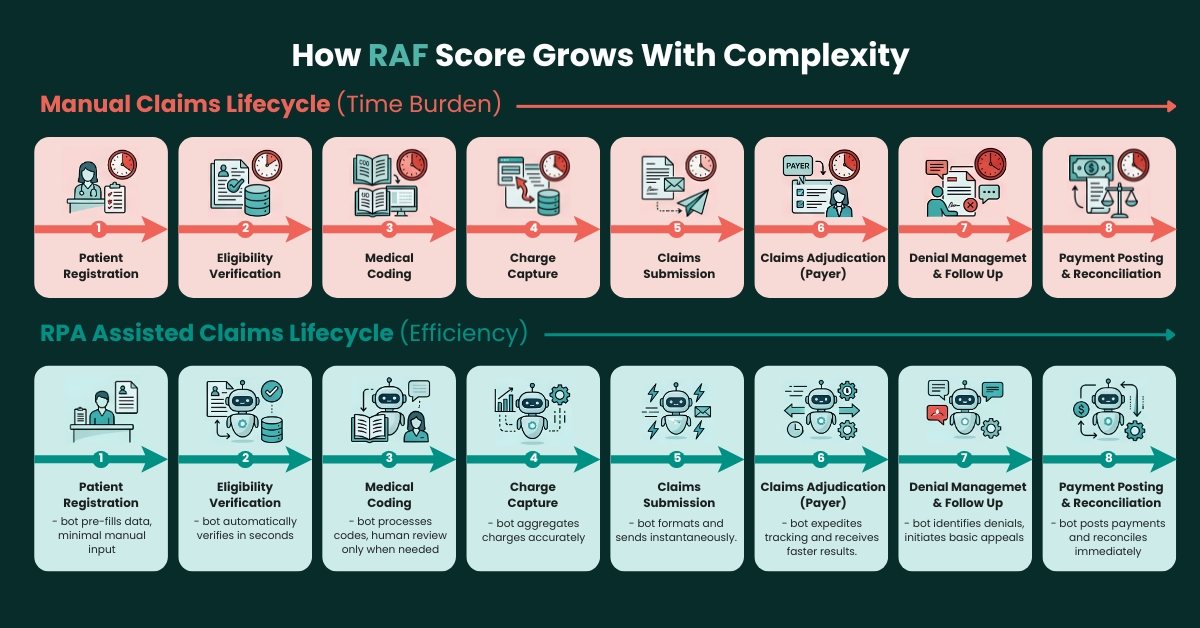
1. What Is RPA in Healthcare?
RPA is short for Robotic Process Automation. In healthcare, it means software robots, that are set up to carry out structured, repetitive digital chores that a person would otherwise have to do like log in, click through screens , type in details, or move information between different platforms.
Now, these bots dont replace clinical decision-making. They mostly support the administrative side, like workflows that follow the same logic over and over, with no need for human judgment. In claims processing specifically, so many steps across the revenue cycle contain at least some part of this kind of work, even if its not obvious at first.
The Healthcare Information and Management Systems Society (HIMSS) has published resources describing how RPA fits into the broader digital transformation of healthcare administration.
According to CAQH, the U.S. healthcare system spends an estimated $40 billion annually on administrative transactions that could be automated. Eligibility verification, prior authorization, and claims submission are among the costliest when performed manually
2. Why Claims Processing Is a Strong Candidate for RPA
Not every area of a healthcare organization can be automated in a clean way. RPA tends to shine when the process is high volume, driven by explicit rules, uses organized data, and needs to interact with digital systems. Claims processing pretty much checks all those boxes.
A normal medical practice might manage dozens to hundreds of claims per day. Each claim usually walks through a similar path, using payer specific requirements that you can map in advance. The inputs involved—like CPT codes, ICD-10 codes, NPI identifiers, member IDs are structured and fairly consistent. And almost every step requires some portal access, system browsing, or document handoff, in other words the usual digital motions.
So overall, claims and the surrounding revenue cycle are among the most automation-ready parts of healthcare operations.
- High transaction volume means efficiency gains can build up over time
- Workflows that rely on rules can be modeled with accuracy, and then executed consistently
Not every business function is well suited for automation. RPA works best in processes that are high-volume, rule-based, involve structured data, and require interaction with digital systems. Healthcare claims processing meets every one of these criteria.
A typical medical practice handles dozens to hundreds of claims daily. Each claim moves through the same sequence of steps, governed by payer-specific rules that are known in advance. The data involved like CPT codes, ICD-10 codes, NPI numbers, member IDs are structured and consistent. And virtually every step involves some form of portal login, system navigation, or file transfer.
This combination makes the revenue cycle one of the most automation-ready functions in healthcare administration.
- High transaction volume means automation delivers compounding time savings
- Rule-based workflows can be programmed with precision and consistency
- Structured data makes extraction, validation, and transfer reliable
- Multi-system environments e.g. EHR, clearinghouse, payer portals are where RPA operates most effectively
Before implementing RPA, map out the current-state workflow in detail. Automating a broken process does not fix the process but it just breaks it faster. Practices that take time to clean up their workflows before automation consistently report better outcomes than those who deploy bots into existing, unreviewed processes.
3. Where RPA Is Being Applied in Claims Processing
Eligibility and Benefits Verification
Before a single claim is submitted, the patient’s insurance eligibility must be confirmed. This typically requires a staff member to log into one or more payer portals, enter patient information, and retrieve the result, a task that can take several minutes per patient and must be repeated at every visit.
RPA bots can be scheduled to run eligibility checks automatically the night before appointments, across all patients on the schedule, across all payers simultaneously. Results are written back into the practice management system without staff involvement.
Claims Data Entry and Pre-Submission Editing
One of the most error-prone steps in the claims process is the transfer of encounter data from the EHR into the billing system. When this is done manually, even experienced billers introduce transcription errors that lead to denials.
RPA eliminates this risk by automating the data extraction and mapping process. The bot reads structured data from the EHR and populates the corresponding fields in the billing or practice management system, following predefined logic for code assignments and required fields.
Claim Scrubbing and Validation
Each payer has its own set of rules around what constitutes a clean claim. Certain combinations of diagnosis and procedure codes are not accepted by specific plans. Required fields vary by payer. Date format requirements differ.
RPA bots can apply a rule set at the point of submission that checks each claim against payer-specific requirements, flags potential issues, and either auto-corrects or holds the claim for human review. This reduces denials on first submission.
Claims Submission and Status Tracking
Once a claim is scrubbed and ready, it must be submitted to the appropriate payer i.e often through a clearinghouse or directly via a payer portal. RPA can handle this submission automatically, on a continuous basis, without requiring batching by time of day.
After submission, bots can periodically query claim status from payer systems and update the billing platform accordingly, alerting staff only when a claim has been denied or requires action.
Denial Management and Appeals
Denial management is one of the most labor-intensive functions in any billing department. Each denial must be reviewed, categorized by reason, researched, corrected, and resubmitted often under tight timelines.
RPA can accelerate this by automatically pulling denial remittance data, categorizing denials by reason code, populating appeal templates with the appropriate documentation, and initiating the resubmission workflow, leaving only the judgment-dependent exceptions for staff.
Payment Posting
Electronic remittance advice (ERA) files must be reconciled with patient accounts in the billing system. This can be done manually, but it is time-consuming and introduces the risk of misapplied payments.
RPA bots can be programmed to read incoming ERA files, match payments to the correct claims and patient accounts, post the payments automatically, and flag any discrepancies for human review.
4. Manual Claims Processing vs. RPA-Assisted Claims Processing
The table below maps the key steps in the claims workflow to what each looks like in a manual environment versus an RPA-assisted one, along with the operational impact of the change.
| Claims Process Step | Manual Processing | With RPA Automation | Impact of RPA |
|---|---|---|---|
| Patient Eligibility Verification | Staff manually checks each payer portal | Bots query payer portals automatically before each visit | Faster verification, fewer eligibility-related denials |
| Claims Data Entry | Coders and billers key in data from EHR to billing system | RPA extracts and maps data automatically between systems | Near-zero data entry errors; significant time savings |
| Claim Scrubbing | Manual review against payer rules before submission | Bots apply payer-specific edits automatically at submission | Higher first-pass acceptance rates |
| Claims Submission | Batch submission managed by staff at set intervals | Bots submit claims continuously as they are ready | Faster submission cycles; earlier payment timelines |
| Denial Management | Staff manually identifies denial reasons and resubmits | RPA flags denials, categorizes them, and initiates workflows | Faster appeal turnaround; reduced write-offs |
| Payment Posting | ERA files manually matched to patient accounts | Bots auto-post ERAs and flag unmatched payments for review | Faster reconciliation; reduced posting errors |
| Payer Follow-Up | Staff calls or logs into payer portals to check claim status | Bots query claim status on a schedule and escalate delays | Proactive follow-up without additional staff hours |
| Reporting & Analytics | Reports built manually from billing software exports | RPA aggregates data from multiple systems into dashboards | Real-time visibility into KPIs without manual effort |
Note: Outcomes vary based on payer mix, EHR platform, RPA vendor, and implementation quality.
5. Reported Outcomes: What the Data Shows
Healthcare organizations that have implemented RPA in revenue cycle operations have reported measurable gains across multiple areas. The table below summarizes reported efficiency and accuracy improvements by application area.
| RPA Application Area | Reported Efficiency Gain | Error Reduction | Source / Context |
|---|---|---|---|
| Eligibility Verification | Up to 70% faster | Significant reduction in eligibility denials | CAQH Index, administrative cost research |
| Claims Data Entry | Up to 80% time savings | Near-elimination of keying errors | Industry RPA implementation case studies |
| Payment Posting | 60–75% reduction in posting time | Reduced misapplied payment rates | Healthcare RCM vendor benchmarks |
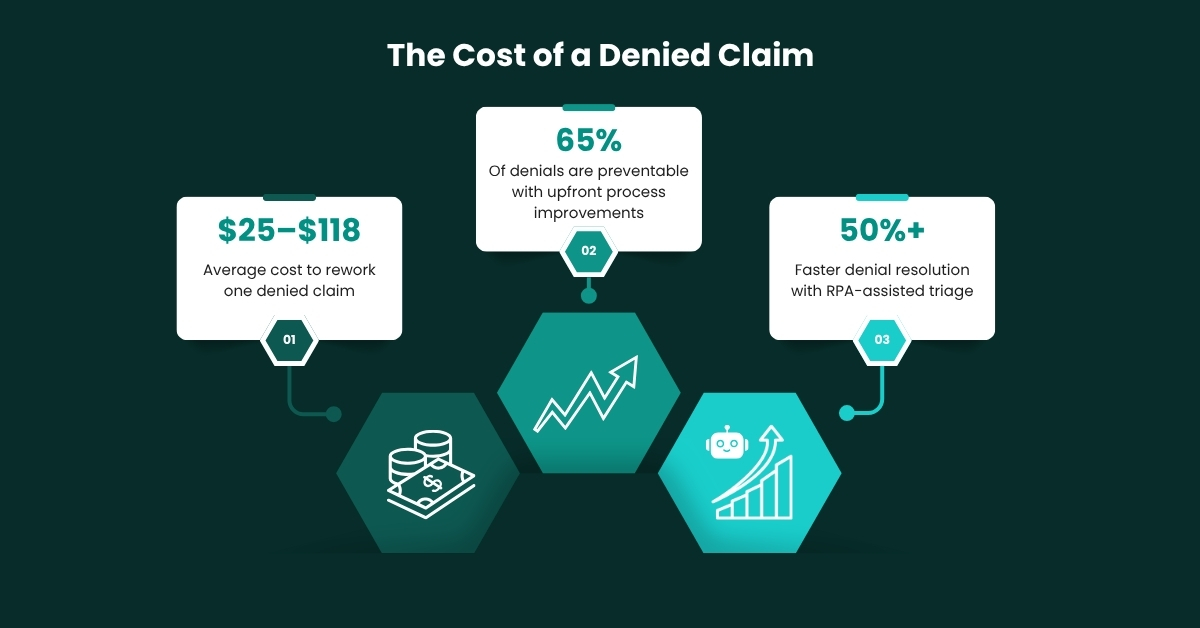
| Denial Management | Up to 50% faster resolution | Fewer repeat denials on same accounts | HFMA revenue cycle benchmarks |
| Prior Authorization | 30–60% reduction in processing time | Fewer missing information rejections | AMA prior auth reform impact data |
Sources: CAQH Index, HFMA benchmarking studies, AMA administrative burden research, healthcare RCM vendor implementation data. Specific results vary by organization size and implementation scope.
The CAQH Index tracks the adoption of electronic administrative transactions across the healthcare industry and is a key resource for understanding where automation is creating the most impact.
6. RPA vs. AI in Healthcare Claims: Understanding the Difference
RPA and artificial intelligence are often mentioned in the same breath, but they are not the same thing. Understanding the distinction helps practices set realistic expectations.
RPA operates by following rules. It does exactly what it is programmed to do, in the exact sequence it is programmed to do it. It does not learn. It does not adapt. If a payer changes its portal layout or a field is renamed, the bot will fail until it is updated.
AI, including machine learning and natural language processing, adds a layer of pattern recognition and decision-making. AI-enhanced tools can read unstructured documents, interpret denial reason codes in free text, predict which claims are likely to be denied, and suggest corrective actions.
Many modern revenue cycle platforms are combining both: RPA for execution and AI for decision support. For practices evaluating vendors, it is worth asking which category each feature falls under, since they carry different cost and maintenance profiles.
When evaluating RPA vendors for claims automation, ask specifically about how the system handles payer portal changes and system updates. Maintenance of bots after go-live is a real cost that is often underestimated. Vendors who offer managed bot maintenance as part of their service model reduce this burden significantly.
7. What to Consider Before Implementing RPA in Your Practice
Process Readiness
RPA works best when the underlying process is already clean. If the claims workflow contains workarounds, inconsistencies, or undocumented steps, the bot will inherit those problems. A process review before implementation is not optional, it is foundational.
EHR and Billing System Compatibility
RPA bots interact with software at the user interface level, which means they can technically work with any system a human can operate. However, compatibility with the EHR and practice management platform affects how efficiently the bot can be built and how stable it will be over time. Practices should confirm with their vendor that their specific systems are supported.
Payer Portal Variability
Payer portals vary significantly in layout, data structure, and update frequency. A bot built for one payer’s portal may require reconfiguration when that payer redesigns its interface. Practices with large and diverse payer mixes should understand the maintenance implications before committing to portal-based RPA.
Staff Impact and Change Management
The introduction of automation creates natural concerns among billing staff about job security. These concerns are worth addressing directly and early. In most practices, RPA does not reduce headcount, it redirects staff from repetitive data tasks toward higher-value work: working denials, managing complex accounts, and engaging with patients on billing questions. Clear communication about this transition supports adoption.
Compliance and Audit Trails
Any automated process that touches patient data must be designed with HIPAA compliance in mind. Bots must access only the data they are authorized to use, and every action taken should be logged for audit purposes. Practices should confirm that their RPA vendor maintains appropriate business associate agreements and data access controls.
The Office for Civil Rights (OCR) at HHS oversees HIPAA enforcement, and guidance on technology vendor relationships can be found at hhs.gov/hipaa.
RPA bots generate audit logs of every action they take, every login, every data entry, every submission. This actually gives practices better documentation of their claims process than most manual workflows, where individual steps may go unrecorded.
8. The Relationship Between RPA and Denial Prevention
One of the most significant financial benefits of RPA in claims processing is its impact on denial rates. Denials are costly not just because of the lost reimbursement, but because of the staff time required to work each one. Industry estimates consistently place the cost of reworking a denied claim between $25 and $118 per claim, depending on complexity.
RPA reduces denials at the front end by eliminating data entry errors, applying payer-specific edits at submission, and ensuring that eligibility is verified before the claim is even generated. At the back end, it accelerates the denial management process by automating triage and routing.
For practices where denial rates are above the industry benchmark generally, considered to be around 5 to 10 percent of submitted claims, automation-assisted clean claim improvements can represent a meaningful recovery in net revenue.
The Healthcare Financial Management Association (HFMA) publishes annual benchmarking data on denial rates, revenue cycle performance, and best practices for denial prevention that serve as useful benchmarks for practice administrators.
Track first-pass resolution rate (FPRR) before and after RPA implementation. FPRR measures the percentage of claims paid on first submission without requiring rework. It is the single clearest indicator of whether automation is improving claims quality at the source, and most billing platforms can generate this metric with standard reporting.
9. Choosing the Right RPA Approach for Your Practice
RPA for healthcare claims can be approached in two primary ways: building custom bots in-house using a general-purpose RPA platform, or purchasing an integrated revenue cycle solution that includes pre-built automation features.
General-Purpose RPA Platforms
Platforms such as UiPath, Automation Anywhere, and Microsoft Power Automate allow organizations to build custom bots for virtually any workflow. These platforms offer flexibility but require technical expertise to build, test, and maintain bots. They are best suited to larger health systems with dedicated IT or RCM technology teams.
RCM-Integrated Automation Solutions
Many revenue cycle management vendors now embed automation directly into their platforms handling eligibility, claim scrubbing, submission, and denial triage without requiring separate RPA software. For smaller and mid-sized practices, this is often the more practical path, as the automation is purpose-built for healthcare claims workflows and maintained by the vendor.
Billing Partner Support
For practices that outsource billing, the choice of billing partner matters. Partners who have invested in automation technology pass the efficiency benefits to their clients through faster submissions, higher clean claim rates, and more proactive denial management, without requiring the practice to manage the technology directly.
Final Thoughts
RPA is not a future concept in healthcare claims processing but in fact it is being deployed today, across practices of all sizes, and the results are measurable. Reduced denial rates, faster payment cycles, fewer data entry errors, and lower administrative cost per claim are being reported consistently by organizations that have implemented it thoughtfully.
RPA delivers its value when it is applied to well-defined processes, supported by the right systems, and accompanied by clear communication to the teams it affects. For practices still relying entirely on manual claims workflows, the gap between what is possible and what is currently being achieved is widening, and the cost of that gap compounds every billing cycle.
- Partner with Vigilant Medical Billing Group and let automation work for your practicet. Contact us today to see how RPA-powered claims management can speed up approvals, reduce denials, and free up your team for what matters most: patient care.