There is a quiet financial crisis running through the structure of American healthcare, and it has nothing to do with treatment costs or physician fees. It lives in spreadsheets, denial queues, and overworked billing departments. The healthcare system loses billions of dollars each year because of coding errors, eligibility mismatches, missing documentation, and billing staff who cannot handle the increasing requirements from different payers.
Into this landscape, artificial intelligence in medical billing has arrived, not as a distant future concept, but as a present-day operational reality changing how healthcare providers get paid.
Hospital and clinic and independent practice facilities now implement AI for medical billing because it solves the revenue cycle management challenges which have existed for many years.
This blog presents an overview of medical billing artificial intelligence, which includes its functions and operational mechanisms, numeric data, and essential knowledge for healthcare organizations that need to evaluate their options.
What Is AI Medical Billing?
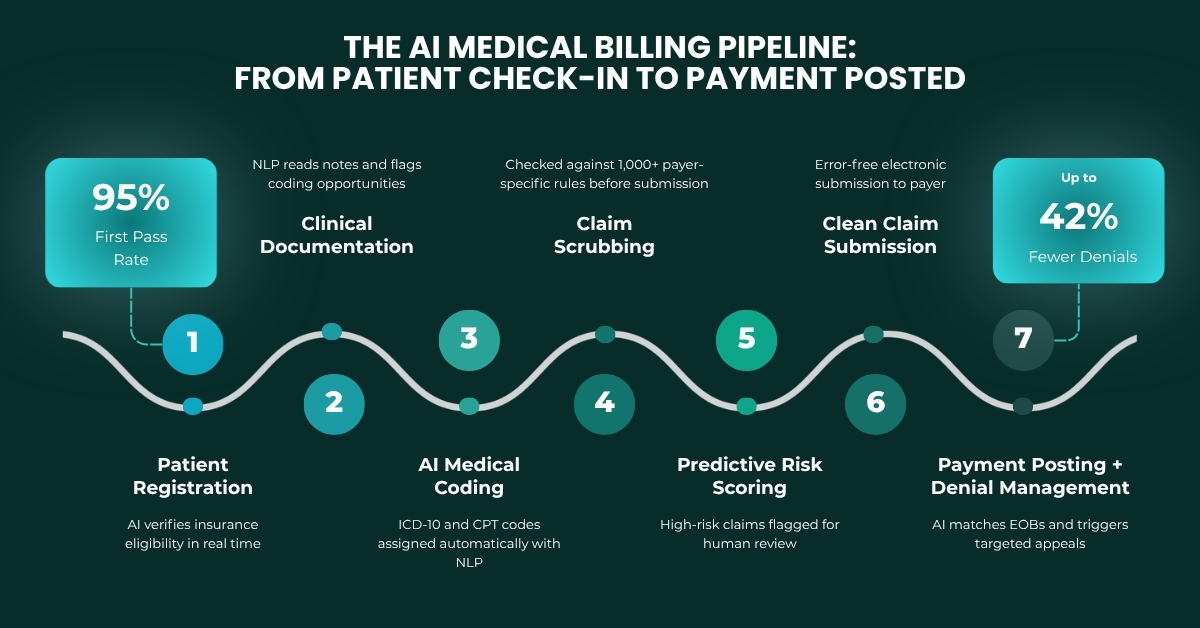
The term AI medical billing describes the use of artificial intelligence technologies which include machine learning and natural language processing and predictive analytics throughout all revenue cycle operations in healthcare institutions. Intelligent software systems take on the full range of provider payment tasks which include complex data-heavy and repetitive work processes needed to process medical claims. The traditional medical billing process required human coders and billing specialists to handle all aspects of clinical documentation review which included assigning ICD-10 and CPT codes and verifying patient insurance coverage and submitting claims to payers and handling denial management.
AI in healthcare claims processing fundamentally changes this dynamic. Rather than waiting for a claim to be denied and then reacting, AI-powered systems prevent errors before claims are submitted, flag high-risk claims for human review in real time, and continuously learn from every outcome. A machine learning model in medical billing AI tends to adapt when payer rules shift, when coding guidelines get updated, and when brand-new denial patterns start showing up.
84% of large U.S. health insurers were already using AI for operational purposes in 2024, with 44% using it for claims adjudication alone (National Association of Insurance Commissioners, 2024 Survey).
How AI in Healthcare Claims Processing Actually Works
The intelligence in AI in healthcare claims processing is not confined to a single task. It operates across multiple interconnected stages of the revenue cycle, with each capability reducing friction at a different point in the claims journey.
Real-Time Insurance Eligibility Verification
Before a claim is ever submitted, AI tools verify a patient’s insurance coverage instantly. Rather than manually calling a payer or logging into a portal, AI cross-checks coverage, coordination of benefits, and patient demographics in a single automated workflow. Experian Health’s 2025 data shows that 26% of all denials trace back to intake errors, wrong policy numbers, outdated insurance cards, missed eligibility rechecks. Real-time AI verification addresses these problems at the source before they become costly denials.
AI-Assisted Medical Coding
Natural language processing helps these systems read clinical notes, operative reports, and physician documentation, then suggest ICD-10 and CPT codes based on what was really documented. It kind of reduces how much you have to lean on one individual coder’s know-how, while also boosting uniformity across large volumes. As a real-world benchmark: Geisinger Health, using an autonomous coding engine, reduced its coding-related denial rate to under 0.1%. Johns Hopkins Medicine reduced eligibility-related denials by 35% after implementing AI verification tools.
Predictive Claim Denial Prevention
Maybe one of the most transformative sides of AI in medical billing is that it can sort of predict which claims are probably going to be denied before they ever leave the door. You train machine learning models on millions of past claims, and then they can assign a denial risk score to each new one, route the higher risk ones to a more focused human check, and then recommend adjustments in near real time
Automated Claim Scrubbing
AI-powered scrubbing reviews every claim against thousands of payer-specific rules before submission. Things like missing modifiers, wrong place-of-service codes, invalid code pairings, and documentation gaps are detected on their own. And what used to take hours of careful manual review, now tends to happen in seconds, with a lot more steady results, across the board.
Intelligent Denial Management
When a claim is denied, AI does not just flag it but It classifies the denial reason, drafts appeal letters with payer-specific language, estimates the probability of overturning the decision and then basically ranks which denials are worth reworking first. So denial management turns from a reactive scramble into some sort of strategic revenue recovery operation, not really optional.
Fraud Detection and Compliance Monitoring
In AI billing systems, pattern-recognition algorithms spot billing anomalies like duplicate claims, upcoding, unbundling, and statistically unusual billing patterns that human reviewers are more likely to miss. And yes, the CMS itself leans on more sophisticated AI algorithms for its own claims audits, so provider-side AI becomes a critical compliance safeguard, even when everyone is busy.
Key Benefits of AI in Medical Billing
The advantages of using artificial intelligence for medical billing solutions go way beyond “just” cutting denials. These are the tangible outcomes healthcare organizations are reporting in 2026:
- Up to 42% reduction in claim denial rates, described by practices using AI-powered real-time eligibility verification (Experian Health 2025).
- First-pass acceptance rates of up to 95%+, compared to the 78–85% industry average with traditional billing.
- A/R days cut from 45–60 down to 30–40 on average, which makes cash flow noticeably steadier.
- Collections increased by 10–15% with AI-driven revenue cycle automation (HFMA benchmark data)
- Cost per claim reduced from $25–$118 (traditional rework) to under $4 with AI agent deployment.
- ROI of $3.20 for every $1 spent on AI healthcare tools, typically realized within 14 months of implementation.
- 68% reduction in workflow costs at facilities that implemented robotic process automation (RPA) alongside AI.
- Staff follow-up time on claims reduced by 66%, freeing billing teams for higher-value exception management.
- Automated compliance rule updates, AI platforms update payer rule engines without requiring staff retraining.
The most ROI-positive starting point for most independent practices is AI-powered eligibility verification. It addresses the highest-volume error source at the lowest implementation complexity. Starting there, measuring results, and expanding from that foundation is the recommended approach.
AI vs. Traditional Medical Billing
The table below provides a side-by-side comparison of AI-powered billing against traditional manual billing across the key dimensions that affect revenue cycle performance. All figures are derived from 2024–2025 industry data.
| Feature | Traditional Billing | AI-Powered Billing |
|---|---|---|
| Claim Processing Speed | Days to weeks | Minutes to hours |
| First-Pass Acceptance Rate | 78–85% | Up to 95%+ |
| Denial Rate | 10–15% average | Reduced by 30–42% |
| Coding Accuracy | Coder-dependent | AI-assisted near-zero errors |
| Eligibility Verification | Manual portal/call | Real-time automated |
| Rework Cost Per Claim | $25–$118 | Under $4 with AI agents |
| A/R Days | 45–60 days | 30–40 days |
| Scalability | Limited by headcount | Scales with volume |
| Fraud Detection | Reactive manual audits | Proactive pattern-based AI |
| Compliance Updates | Manual training needed | Automated rule-engine updates |
Sources: HFMA 2025, Experian Health State of Claims 2025, MGMA Cost & Revenue Survey 2025, Azalea Health case data, Ventus AI deployment benchmarks, OmniMD ROI analysis 2026.
AI Medical Billing Market Growth Chart
The market for AI in medical billing has gone from niche to pretty much required in under a decade. The data visualization below shows projected market value growth through 2034, pushed along by rising denial rates, labor shortages inside billing departments, and more and more payer complexity across all specialties.
AI in Medical Billing — Market Growth Projection (USD Billion)
CAGR: 25.4% (2025–2034) | Source: Industry research compiled from P3Care, HFMA, market reports
Challenges and Honest Limitations
AI medical billing is not really a plug-and-play thing, and healthcare providers deserve a clear eyed view of the problems that can show up during adoption. The technology is powerful, but it is only as effective as the plan behind how it’s rolled out.
Implementation Cost and Integration Complexity
Most AI billing platforms were originally built for large health systems with dedicated IT infrastructure. For smaller independent practices, cost and integration complexity remain the two biggest barriers to adoption. Experian Health’s 2025 survey found that while 67% of healthcare organizations believe AI can improve the claims process, only 14% have actually implemented AI billing tools. The good news is that cloud-hosted, per-claim billing models are rapidly making AI accessible to practices of all sizes.
Human Oversight Remains Non-Negotiable
AI is a strong tool, but it is not a total replacement for seasoned billing professionals. There’s regulatory interpretation, complicated case reviews, payer negotiation, and those situations where clinical judgment still matters, so you still need people with experience. AAPC 2025 data shows that practices combining staff expertise with AI oversight achieved a further 18% improvement in denial rates over practices that used automation without monitoring. In most cases, the cost effective approach is a deliberate hybrid which means machine precision at scale, plus human judgment where things get ambiguous.
Data Privacy and HIPAA Compliance
Any AI platform that touches patient billing data has to be evaluated very carefully for HIPAA compliance, including data encryption, access controls, audit logging, and breach notification protocols. Healthcare organizations should request detailed security documentation from any AI billing vendor before deployment.
Risk of AI-Assisted Upcoding
A 2026 Blue Health Intelligence analysis found that some facilities adopting AI documentation tools experienced unusual increases in billing complexity ratings that were not matched by corresponding treatment evidence. This underscores the importance of maintaining internal compliance oversight and audit programs even when AI systems are in use.
The Future of AI in Medical Billing
The trajectory of artificial intelligence medical billing points clearly toward deeper automation, smarter revenue intelligence, and more proactive financial management across the entire healthcare revenue cycle. Several emerging capabilities are already in development or early adoption:
- Generative AI for Prior Authorization: Automatically drafting prior authorization requests using clinical record summaries, addressing the 70% of prior auth processes that still rely on manual labor.
- Agentic AI Systems: AI agents that interact with payer portals, clearinghouses, and EHRs through browser-native automation, no API integration required, cutting cost-per-claim to under $4 for enterprise medical groups.
- Value-Based Care Billing Intelligence: As payers shift toward value-based contracts, AI tracks quality metrics, links clinical outcomes to financial performance, and ensures accurate incentive-based reimbursement reporting.
- Real-Time Compliance Monitoring: AI systems that update billing rules automatically whenever CMS guidelines change, eliminating the lag between regulatory updates and practice-level compliance.
- Predictive Financial Scenario Modeling: Revenue leaders gain the ability to model future financial outcomes, simulating the impact of payer mix changes, coding pattern shifts, or new service lines on revenue cycle performance.
Frequently Asked Questions
Q: What is AI medical billing?
A: AI medical billing is the use of machine learning, natural language processing, and predictive analytics to automate and optimize the healthcare revenue cycle, including coding, eligibility verification, claim scrubbing, denial prevention, and payment posting.
Q: Can AI replace medical billers and coders?
A: Not entirely. AI handles repetitive, rules-based tasks at scale and with far greater consistency. However, regulatory interpretation, complex case review, and payer negotiation still require human expertise. The most effective and cost-efficient model is a hybrid of AI automation with human oversight.
Q: How much does AI medical billing software cost?
A: Costs vary widely. Enterprise platforms can require significant upfront investment. However, cloud-hosted, per-claim or per-provider pricing models are now widely available, making AI billing accessible to independent practices. ROI is typically realized within 14 months through reduced denials and faster reimbursements.
Q: Is AI medical billing HIPAA compliant?
A: Reputable AI billing platforms are built with HIPAA compliance as a foundation, incorporating data encryption, access controls, and audit logging. Practices should always request full security and compliance documentation from vendors before deployment.
Q: What is the biggest benefit of AI in healthcare claims processing?
A: The ability to flag and correct high-risk claims before submission delivers the most immediate financial impact. Practices using AI eligibility verification and predictive analytics have reported denial rate reductions of 30–42%.
Conclusion:
The evidence is there and it’s clear enough. Not acting timely is costly. And the technology is not just for big hospital systems anymore, it is out there, doable, and backed up for medical practices of all kinds and sizes, even the small teams. This move toward AI in medical billing is already in motion across American healthcare, and the providers who make the jump first will be the ones who gather more, spend less, and keep one step ahead of whatever comes next in payer complexity.
At Vigilant Billing, the future of AI in medical billing is not just understood, it is put to work for healthcare providers every single day. AI-assisted coding, real-time eligibility verification, predictive denial prevention, and transparent revenue cycle reporting are delivered as one seamless solution. Whether the practice is a solo clinic or a large multi-specialty group, enterprise-grade AI medical billing is made available at every scale.
✅ Fewer Denials ✅ Faster Reimbursements ✅ Full Compliance
✅ Dedicated Support